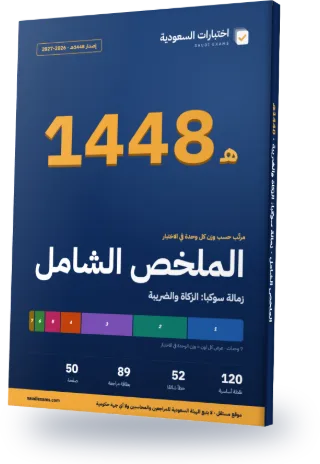
SOCPA Fellowship Zakat & Tax Complete Review Guide 2026–2027
Every exam topic in a 50-page Arabic PDF, ordered from the heaviest unit to the lightest. The first three chapters alone cover about 75% of the exam questions.
- 50Pages
- 120Key points
- 52Common mistakes
- 89Flashcards
Guide map
Each chapter is one exam unit, ordered by its weight in the real exam.
| Chapter | Unit | Weight | Exam questions | Key points |
|---|---|---|---|---|
| 1 | Zakat | 25% | 18 | 18 |
| 2 | Income tax | 25% | 17 | 18 |
| 3 | Value added tax | 25% | 17 | 18 |
| 4 | Excise tax | 10% | 7 | 18 |
| 5 | Real estate transaction tax | 8% | 5 | 17 |
| 6 | Conceptual framework of zakat and tax | 5% | 4 | 15 |
| 7 | ZATCA's statute and the dispute committees | 3% | 2 | 16 |
Chapter 1 in full: Zakat
25% of the exam, about 18 questions. These are its key points, as in the guide.
- A «Saudi» under the Regulation is a Saudi national plus GCC nationals treated as Saudis. Subject to it are: a resident Saudi person carrying on a licensed activity, a sole proprietorship or company owned by a Saudi, the Saudi partner's or shareholder's share in resident companies, licensed financing funds, and the non-Saudi shareholder's share in a resident company listed on the Saudi market, except non-Saudi founders' shares (Art. 3). Income tax payers and shares subject to income tax are outside the Regulation (Art. 6).
- A natural person is resident with a permanent home and at least 30 days in the zakat year, or at least 183 days without one. A legal person is resident if incorporated under Saudi law or if its principal place of management is in the Kingdom, which requires at least two of three conditions: board meetings and key decisions in the Kingdom, senior executive decisions there, and most revenue earned there (Arts. 4 and 5).
- Public-benefit payers are exempted from zakat collection by an annual request filed within 120 days of the zakat year end: charities, civil foundations, training units, waqfs and non-profit companies, plus anyone ZATCA decides is not subject. Spending on a named person may not exceed 10% (of the foundation's net profit, the waqf's yield, or the non-profit company's revenue) (Art. 7). ZATCA may cancel the decision if the payer gave false information (Art. 8).
The rest of chapter 1, on this page
- The first zakat year starts on the earliest of: commercial registration issue, the first license needed for the activity, or the capital deposit (Art. 10). Registration with ZATCA is due before the end of the first financial year (Art. 98). A payer is treated as stopped for liquidation purposes as soon as liquidation proceedings open (Art. 12).
- The rate is 2.5% of the base for the Hijri year. If the zakat year differs from the Hijri year, use actual days: (2.5% ÷ days of the Hijri year) × days of the financial year. A financial period under 354 days is subject at the start of activity and not at the end (Art. 15).
- A books payer must file the return and pay within 120 days of the zakat year end (extended to the next working day if the last day is an official holiday), paying by bank transfer through SADAD or another accepted method (Art. 102). Supporting documents are in Arabic, and ZATCA must give at least 10 working days to supply a requested document (Art. 99). Documents are kept for 10 years (Art. 110), and requested information is due within 20 working days during an examination (Art. 105).
- Base for a books payer = additions − deductions (Art. 21). Additions: equity and equivalents, the liabilities listed in Art. 29 up to the deducted assets, and the difference between adjusted and book net profit after zakat and tax (Art. 23). Values are taken from the balance sheet at the zakat year end (Art. 17).
- If the base falls below adjusted net profit, the base becomes the lower of adjusted net profit and (undeducted assets + the gap between adjusted and book profit). A negative base with no adjusted profit means no base. The maximum base is equity and equivalents at balance-sheet value plus the same gap (Arts. 27 and 28).
- Non-current liabilities are added (non-current debts, end-of-service and leave provisions, deferred tax liability, lease liabilities and negative derivatives). Partners' loans count as liabilities only if conditions are met (approved statements, fixed repayment term, market-rate return, and no single-controller entity); otherwise they are equity. Carried-forward losses and treasury shares reduce equity. Liabilities are apportioned by the share of the deducted asset (Arts. 20, 25, 29, 30, 39 and 40).
- A books payer deducts: investments (domestic, foreign and in funds) subject to conditions, net fixed assets, intangibles not held for trading, non-sale items such as spare parts and raw materials that are not part of the final product, statutory deposits earning no return, and deferred tax assets. Inventory held for sale and loans receivable are not deducted, except partners' loans under conditions (Arts. 26, 31, 33 and 48-56).
- An expense is accepted if it is actual (ordinary or necessary, even for earlier years), related to the activity, and supported by documents ZATCA accepts (Art. 62). Accepted items include annual depreciation, owners' wages registered with social insurance, board remuneration, donations to licensed bodies in the Kingdom, employees' children's school fees under conditions, provisions formed, and zakat or income tax paid (Art. 63). A bad debt is accepted with a licensed auditor's certificate, revenue previously recognised, and a debtor that is not a related party; the certificate is waived if the debt is 1% of revenue or less, or on a final bankruptcy judgment (Art. 65).
- A consolidated return is allowed for a holding company and its wholly owned subsidiaries, inside or outside the Kingdom, whether owned directly or indirectly. A subsidiary included in the consolidated return files a separate information return, and the payer may not revert without ZATCA approval. A subsidiary not wholly owned is assessed separately from the holding company (Art. 16).
- Financing activities (banks and finance companies licensed by the central bank, and licensed financing funds): base = sources of funds × (zakat assets ÷ total assets). With a net profit, the minimum is 4 times it and the maximum 8 times, after removing the zakat provision effect; with no net profit, they are 40% and 80% of gross profit; with no profit at all, there are no limits (Arts. 67-72). For insurance: the statutory deposit with the Insurance Authority is deducted unless the payer may invest it, and policyholders' share of the surplus and the non-current unearned premium reserve are added (Art. 81).
- An estimated payer has no financial statements reflecting its activity: base = (sales ÷ 8) + (sales × 15%), sales may not be below those declared in VAT returns, the rate is 2.5%, and the minimum zakat is 500 riyals. With no VAT-registered sales, ZATCA estimates sales at the highest of several criteria (including average employees × 6,000 riyals and imports or purchases × 115%). If the result is below the capital in the commercial register, that capital is the base (Arts. 84-89).
- Installments: the payer files a reasoned request, ZATCA replies within 30 days of completion, the period may not exceed the period the liability relates to (though it may exceed twice its number of years), and it is cancelled after two consecutive or three non-consecutive missed installments (Arts. 118 and 119). An overpayment is carried forward unless the payer asks for a refund within 5 years of the statutory payment date; ZATCA finishes within 30 days of the right being established, and no refund is considered while returns are unfiled or an objection is pending, until a final judgment (Art. 107).
- On late payment, ZATCA sends three demands of 30 days each, then takes statutory enforcement steps (Art. 120). Seizure may reach movable and immovable assets by writing to the central bank, the Capital Market Authority, the Ministry of Finance and the Ministry of Justice, and by attaching income and sums held by third parties; employees' dues and living expenses may not be seized, and business tools and personal necessities up to 300,000 riyals are excluded. From sale proceeds, seizure and sale costs are paid first, then zakat, and any remainder is returned to the payer (Arts. 122-125).
- ZATCA issues the assessment from the return and available information, and the notice states the basis, the amount, the payment date and the right to object (Arts. 112 and 113). The books payer bears the burden of proving the return, and ZATCA may reject an unproven item (Art. 111). A zakat assumption requires a warning and 60 days (Arts. 114 and 115). The reassessment period is 5 years from the filing deadline, rising to 10 years for late filing, an incomplete return, non-payment or an assumption, and with no limit for evasion, consent to reassessment, or non-registration (Art. 106).
- A payer may object to ZATCA's decision before ZATCA within 60 days of the day after notification, ZATCA decides within 90 days, and within 30 days of a rejection (or of the 90 days passing) the payer may ask for referral to the Internal Committee for settlement or sue before the adjudication circuits, or the decision becomes immune (Committee Rules, Arts. 5 and 6). For an objection to be formally admitted, the payer pays the undisputed items and 10% to 25% of the disputed amounts, or provides a guarantee (Art. 116). Circuit decisions are final where the amounts due do not exceed 50,000 riyals; others can be appealed within 30 days of the day after receipt (Committee Rules, Arts. 33 and 34).
Common mistakes in this chapter
- The minimum base is not always adjusted net profit. It applies only when the computed base falls below it, and then the lower of adjusted net profit and undeducted assets plus the gap is used (Art. 27).
- Provisions are generally treated as equity and added at the closing balance, except end-of-service and statutory leave provisions, which are treated as non-current liabilities (Art. 24).
- Current liabilities are added only in three cases: a current asset is deducted, they exceed current assets, or they are in effect non-current (for example a debt renewed with the same creditor for the same purpose) (Art. 29).
- No netting of credit and debit balances, even with an owner; the payer is treated as separate from its creditors and debtors (Art. 34).
- Dividends declared and paid into shareholders' accounts are not added, but dividends declared and not deposited during the year are added (Arts. 36 and 37).
- Deducting an investment in a domestic entity needs a non-current asset, held for non-trading purposes, in an entity registered with ZATCA and subject to zakat. A foreign investment also requires its zakat to be paid in the return (Arts. 43 and 44).
- An actual expense is accepted even if it relates to earlier years. Provisions formed during the year are accepted expenses, but they are added back to the base at their balance as equity, and zakat or income tax paid is also an accepted expense (Arts. 62 and 63).
- A short period at the start of activity (under 354 days) is subject to zakat, while one at the end is not. A temporary stop does not stop collection, and a permanent stop needs a written request within 60 days (Arts. 15 and 11).
The other chapters are in the full guide
One purchase · lifetime access · review guide included
7-day review plan
The chapters are spread over 6 days by weight so each day carries a similar load. Day 7 is a full exam.
Day 1 · 25% of the exam
Chapter 1: Zakat
Day 2 · 25% of the exam
Chapter 2: Income tax
Day 3 · 25% of the exam
Chapter 3: Value added tax
Day 4 · 10% of the exam
Chapter 4: Excise tax
Day 5 · 8% of the exam
Chapter 5: Real estate transaction tax
Day 6 · 8% of the exam
Chapter 6: Conceptual framework of zakat and tax
Chapter 7: ZATCA's statute and the dispute committeesDay 7
Full mock exam: 70 questions in 160 minutes, then review the common mistakes in the units where you lost marks.
How many correct answers do you need?
- Pass mark 60%42 correct out of 70
Before you read: see your score today
10 free questions from the main units, no sign-up. Then you know which chapter to start with.
Try 10 free questions and see your levelA look at each chapter
The first three key points of each chapter, as they appear in the guide (in Arabic in the PDF).
Chapter 1: Zakat
- A «Saudi» under the Regulation is a Saudi national plus GCC nationals treated as…
- A natural person is resident with a permanent home and at least 30 days…
- Public-benefit payers are exempted from zakat collection by an annual request filed within 120…
Chapter 2: Income tax
- Persons subject to tax
- An individual is resident with a permanent home and at least 30 days in…
- A company is resident if formed under the Companies Law or if its head…
Chapter 3: Value added tax
- VAT is a general indirect consumption tax charged at every stage, built on input…
- The tax point is the earliest of the date of supply, the tax invoice…
- If an invoice was issued or payment made before the Law took effect or…
Chapter 4: Excise tax
- Excise goods
- A 100% rate applies to tobacco, energy drinks, and electronic smoking devices and liquids…
- Sweetened-drink tiers
Chapter 5: Real estate transaction tax
- The law imposes 5% on a real estate disposal, whether it covers the whole…
- A real estate disposal is a transfer of ownership of the property, a permanent…
- The tax is calculated on the total agreed value, provided it is within fair…
Chapter 6: Conceptual framework of zakat and tax
- Zakat is one of the pillars of Islam
- Four conditions make zakat due on wealth
- The hawl is one lunar (Hijri) year, except for crops and fruits, whose zakat…
Chapter 7: ZATCA's statute and the dispute committees
- The Authority's Statute was issued by Council of Ministers Decision No. 570 dated 22/9/1442…
- The Authority has public legal personality and financial and administrative independence, is organisationally linked…
- Besides the chair (the Minister) and the Governor, the board includes representatives of Interior…
The full guide comes with lifetime access
The full guide (50 pages) is included with lifetime access to this exam, together with every question and full mock exam. Chapter 1 is free for everyone.
Questions about the guide
Is the guide free?
Chapter 1 is free to read on the guide page. The full guide comes with lifetime access to this exam; 7-day access does not include it.
Is it up to date for 2026–2027?
Yes. Unit weights and exam facts follow what the exam body last published, and the last check date is printed in the guide. If the standards change we update the file and buyers download the new version.
Does the guide have questions?
No. The guide covers key points and common mistakes; scoring, weak-area practice and full mock exams are on the site.
Can I read it on my phone?
Yes. A5 pages in a single column, with chapters linked from the contents.
- Pages
- 50
- Edition
- 1448 AH · 2026–2027
- Language
- Arabic
- Last updated
Buy this exam
Pick the access that lasts until your test date.
Included
- Full mock exams: 70 questions in 160 minutes, with a score for every unit
- 381 questions, every option explained with its source
- Practice that starts with your weakest units, plus a review of your mistakes
- Complete Review Guide 2026–2027 (PDF), with lifetime access only
Continue with your Google account and you go straight to the payment page.
You pay on the Waffo Pancake checkout page (in English). The amount is in US dollars and your bank converts it to riyals. One payment with no automatic renewal, by Visa, Mastercard (a mada card with either logo works too), Apple Pay or Google Pay. Your statement shows "WAFFO". Purchases are not refundable.