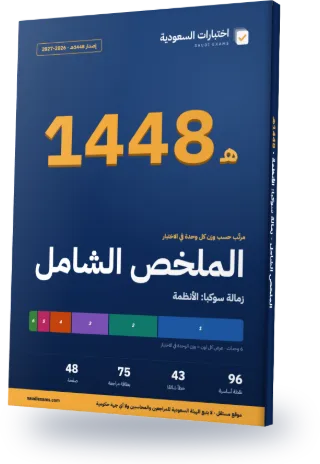
SOCPA Fellowship Regulations Complete Review Guide 2026–2027
Every exam topic in a 48-page Arabic PDF, ordered from the heaviest unit to the lightest. The first three chapters alone cover about 80% of the exam questions.
- 48Pages
- 96Key points
- 43Common mistakes
- 75Flashcards
Guide map
Each chapter is one exam unit, ordered by its weight in the real exam.
| Chapter | Unit | Weight | Exam questions | Key points |
|---|---|---|---|---|
| 1 | Commercial laws | 39% | 19 | 18 |
| 2 | Laws related to the profession | 23% | 12 | 18 |
| 3 | Accounting and Auditing Profession Law | 18% | 9 | 18 |
| 4 | Financial transactions (Civil Transactions Law) | 11% | 5 | 18 |
| 5 | Principles of commercial law | 6% | 3 | 12 |
| 6 | Introduction to the study of law | 4% | 2 | 12 |
Chapter 1 in full: Commercial laws
39% of the exam, about 19 questions. These are its key points, as in the guide.
- There are four bankruptcy procedures: preventive settlement, financial reorganisation, liquidation and administrative liquidation, with matching special procedures for small debtors. Settlement and reorganisation help the debtor reach agreement with creditors; liquidation collects claims, sells the bankruptcy assets and distributes the proceeds under a trustee; administrative liquidation is for assets whose sale is not expected to cover the costs of the procedure (Art. 1).
- A debtor may apply for preventive settlement if financial difficulty is likely, or if he is distressed or insolvent, but not if he went through it in the previous twelve months (Art. 13). Financial reorganisation may be requested by the debtor, a creditor or the competent authority on the same grounds (Art. 42). The claims stay in a settlement lasts up to 90 days from opening, extendable by 30 days once or more, and never beyond 180 days (Art. 18).
- Voting on the proposal: owners vote before creditors if the proposal affects their rights (Art. 28), and creditors are grouped into classes by the nature of their debts (Art. 29). The proposal passes if every class approves; a class approves when creditors holding two-thirds of the value of the debts voted in that class vote yes, including creditors holding more than half of the debts of non-related parties (Art. 31).
The rest of chapter 1, on this page
- In liquidation, filing the request or the judgment opening it stays claims until the request is rejected or the procedure ends, and the court lets a secured creditor enforce against the asset securing his debt (Art. 97). The trustee's fees and the costs of sale are paid first (Art. 195), then in order: debts secured by a real security, secured financing, an amount for the debtor's employees equal to 30 days' wages, family maintenance, costs of continuing the business, earlier wages, unsecured debts, and last the unsecured government dues (Art. 196).
- There are five company forms (Art. 4): general partnership, limited partnership, joint stock, simplified joint stock and LLC. A company formed under the law has Saudi nationality and its head office must be in the Kingdom (Art. 3). A general partnership is formed by two or more persons personally and jointly liable with all their assets, who acquire merchant status (Art. 35); a limited partnership has a general-partner group and a limited-partner group, whose members are liable only up to their share and do not acquire merchant status (Art. 51).
- A joint stock company has capital divided into tradable shares; the company alone is liable for its debts and the shareholder only for the value of the shares he subscribed (Art. 58). Its issued capital may not be less than SAR 500,000 and at least a quarter must be paid at formation (Art. 59). It is run by a board of at least three members (Art. 67), which meets at least four times a year, needs half the members present for a valid meeting, decides by a majority of those present, and the chair's side prevails on a tie (Art. 80).
- Simplified joint stock company: the minimum capital of a joint stock company does not apply (Art. 139); it may be formed by one person whose liability is limited to what he allocated as capital (Art. 150); and the shareholders set its structure in its articles (Art. 138). LLC: its financial liability is separate and a partner is liable only up to his share (Art. 156); its shares are of equal value and indivisible and non-tradable (Art. 174); and it is not dissolved by a partner's death, interdiction, insolvency or withdrawal unless the contract says so (Art. 184).
- Ordinary general assembly of a joint stock company: quorum is a quarter of the voting shares (the articles may raise it, up to half); if it is not met, a second meeting is valid with any number; decisions need a majority of the votes represented (Art. 92). Extraordinary: quorum is half (up to two-thirds), the second meeting a quarter, the third any number; decisions need two-thirds of the votes represented, and three-quarters for capital increase or reduction, extending the company's term, dissolving it early, merger or split (Art. 93).
- Every company has one or more auditors licensed in the Kingdom, appointed, with his fees, term and scope fixed, by the partners, the general assembly or the shareholders as the case may be; he may be removed without prejudice to his right to compensation, and the manager or chair must notify the competent authority of the removal and its reasons within 5 days (Art. 18). The appointment requirement does not apply to micro and small companies, except those listed on the capital market, those whose contract or articles require one and the other cases in Art. 19; holders of 10% of the voting shares or interests may ask for an auditor.
- Bill of exchange (Art. 1): the word «bill of exchange» in the body of the instrument, an unconditional order to pay a fixed sum, the drawee's name, the due date, the place of payment, the payee's name or order, the date and place of issue, and the drawer's signature. Promissory note (Art. 87): the order clause or the words «promissory note», an unconditional undertaking to pay a fixed sum, the due date, the place of payment, the payee's name, the date and place of issue, and the maker's signature. A bill payable at a fixed period after sight must be presented for acceptance within one year of its date (Art. 22).
- Cheque (Art. 91): the word «cheque» in the body of the instrument, an unconditional order to pay a fixed sum, the drawee's name, the place of payment, the date and place of issue, and the drawer's signature. A cheque issued in the Kingdom and payable there may be drawn only on a bank (Art. 93); it is payable on sight (Art. 102) and must be presented within one month if drawn in the Kingdom, or within 3 months if drawn abroad and payable in the Kingdom (Art. 103). Actions against the acceptor of a bill are time-barred 3 years after the due date, against the drawer and endorsers 1 year after the protest, and between endorsers 6 months after payment or suit (Art. 84).
- Commercial contracts: a commission agent contracts in his own name for the principal's account, and a broker brings the two parties together without being a party to the contract (two theory definitions). Commercial Agencies Law: only a Saudi may be a commercial agent in the Kingdom, and a company must have Saudi capital, board members and signatories (Art. 1); no one may act unless entered in the agents' register at the Ministry of Commerce (Art. 3). Commercial Pledge Law: it applies to a written pledge of movable property securing an economic debt (Art. 2), and a pledge may secure a debt not yet established, such as a contingent one (Art. 3).
- Finance companies: financing may be practised only under a licence (Art. 4); the supervisor issues its approval or reasoned refusal within 60 days of a complete application, and the licence lasts 5 years (Art. 5); activity must start within a year of the licence and may not stop for more than 3 consecutive months without approval (Art. 6). Finance lease: the lessor is a licensed joint stock company, the contract is written or electronic and registered in the contracts register (Art. 3), the lessor's ownership holds against third parties by registration (Art. 19), if the lessor sells the asset it passes subject to the contract (Art. 15), and the lessee may pledge it only with the lessor's written consent (Art. 16).
- Security rights in movable assets: a security right is valid between the parties if it is in writing, the grantor is entitled to create it, the secured obligation and the collateral are described, and the secured party gave or undertook to give value (Art. 6). The law does not apply to ships, aircraft, listed securities, trademarks, investment accounts and assets with an ownership register (Art. 5). It takes effect against third parties by registration or possession (Art. 8). Priority: a perfected right before an unperfected one, then the earlier registration, and among unperfected rights the earlier creation (Art. 19); perfected rights rank ahead of other debts, including workers' rights and government dues (Art. 20).
- Insurance and banks. Insurers: no one may do insurance business without a licence from the insurance regulator; an insurer must be a joint stock company whose main purpose is insurance, its capital may be changed only with the Central Bank's approval, and it may not directly own insurance brokerage firms (Art. 3 as amended in 1443); practising without a licence carries a fine of up to SAR 2 million and imprisonment of up to 4 years, or either (Art. 21). Banks: deposit liabilities may not exceed 15 times reserves plus paid-up capital (Art. 6); the statutory deposit is at least 15% of deposits (adjustable between 10% and 17.5%) and the liquidity reserve at least 15% (Art. 7); credit to one person may not exceed 25% of reserves and capital (Art. 8); and at least 25% of annual net profit goes to the statutory reserve until it equals paid-up capital (Art. 13).
- The Investment Law (Royal Decree M/19, 16/1/1446H) replaced the old Foreign Investment Law. Investors get equal treatment between local and foreign investors in similar circumstances, and an investment may be confiscated only by a final court judgment and expropriated only for the public interest against fair compensation (Art. 4). A foreign investor must register with the Ministry of Investment before any investment, except in securities governed by the Capital Market Law (Art. 7), and must apply for the Ministry's approval before investing in an activity on the excluded-activities list (Art. 8). The fine is up to SAR 300,000, doubled for a repeat, and an appeal lies to the competent court within 30 days (Arts. 11, 12).
- The Capital Market Law: the Authority is responsible for issuing regulations and applying the law (Art. 5); its Board has five full-time members serving 5 years, renewable once (Art. 7). Insider trading is prohibited for a person who obtains inside information through a family, work or contractual relationship, and covers both trading and disclosing to someone expected to trade (Art. 50); deliberately creating a misleading impression is prohibited as manipulation (Art. 49). The Committee for the Resolution of Securities Disputes must begin hearing a case within 14 days of filing, a case is not accepted before a complaint to the Authority and 90 days unless excepted, and its decisions may be appealed within 30 days (Art. 30). Art. 59 penalties include a warning, bans, payment of up to three times the gain, and a fine of up to SAR 25 million for an intentional violation.
- Competition: agreements that restrict competition are prohibited, such as price fixing, market sharing and bid rigging (Art. 5), as is abuse of a dominant position, such as selling below total cost (Art. 6); economic concentration must be notified to the Authority at least 90 days before completion if sales exceed the threshold set by the regulations (Art. 7); the fine is up to 10% of the annual sales concerned (Art. 19). E-commerce: a consumer may cancel within 7 days of receiving the product unless he has used it, and may also cancel if delivery is delayed more than 15 days (Arts. 13, 14); the fine is up to SAR 1 million (Art. 18). Franchise: an opportunity may be offered only after the business has operated for at least one year through two persons or sales outlets (Art. 5), and the franchisor must give the franchisee the disclosure document at least 14 days before signing or before any payment (Art. 7).
Common mistakes in this chapter
- A distressed debtor has stopped paying a debt when due; an insolvent debtor has debts that exhaust all his assets. A debtor may apply for preventive settlement in all three cases, including when financial difficulty is likely and default is feared, so actual default is not required (Arts. 1, 13).
- Quorum is a different test from majority. An ordinary assembly of a joint stock company needs a quarter of the shares as quorum and decides by a majority of the votes represented; an extraordinary one needs half and decides by two-thirds, rising to three-quarters for capital increase or reduction, extension, early dissolution, merger and split (Arts. 92, 93).
- The periods for losses of half the capital depend on the form. In a joint stock company the board discloses within 60 days and calls the extraordinary assembly within 180 days; in an LLC the manager calls the partners within 60 days only (Arts. 132, 182).
- A general partner acquires merchant status and is liable with all his assets; a limited partner does not acquire it and is liable only up to his share. A partner's death or interdiction does not dissolve a general partnership or an LLC unless the contract says so (Arts. 35, 50, 51, 184).
- A cheque is payable on sight and may be drawn only on a bank, while a bill of exchange has a due date. The limitation periods differ: 3 years against the acceptor, 1 year against the drawer and endorsers from the protest, and 6 months between endorsers (Arts. 84, 102, 103).
- An unregistered commercial pledge or security right stays valid between the parties and takes effect against third parties only by registration or possession. A pledge of trade stock takes effect against third parties only by possession, and a floating pledge by registration or possession (Commercial Pledge Law Arts. 4, 6).
- In a finance lease the lessor bears the cooperative insurance on the asset and it cannot be imposed on the lessee; basic maintenance is on the lessor unless agreed otherwise, operational maintenance on the lessee. Rent is due even if the lessee does not use the asset, unless the cause is the lessor (Arts. 6, 7, 9).
- Market manipulation (Art. 49) is deliberately creating a false or misleading impression about the market or prices; insider trading (Art. 50) is an insider trading on, or disclosing, unannounced information that would materially affect the price. The committee's fine for an intentional violation is up to SAR 25 million, while the fine the CMA Board imposes instead of a case is up to SAR 5 million (Art. 59).
The other chapters are in the full guide
One purchase · lifetime access · review guide included
7-day review plan
The chapters are spread over 6 days by weight so each day carries a similar load. Day 7 is a full exam.
Day 1 · 39% of the exam
Chapter 1: Commercial laws
Day 2 · 23% of the exam
Chapter 2: Laws related to the profession
Day 3 · 18% of the exam
Chapter 3: Accounting and Auditing Profession Law
Day 4 · 11% of the exam
Chapter 4: Financial transactions (Civil Transactions Law)
Day 5 · 6% of the exam
Chapter 5: Principles of commercial law
Day 6 · 4% of the exam
Chapter 6: Introduction to the study of law
Day 7
Full mock exam: 50 questions in 120 minutes, then review the common mistakes in the units where you lost marks.
How many correct answers do you need?
- Pass mark 60%30 correct out of 50
Before you read: see your score today
10 free questions from the main units, no sign-up. Then you know which chapter to start with.
Try 10 free questions and see your levelA look at each chapter
The first three key points of each chapter, as they appear in the guide (in Arabic in the PDF).
Chapter 1: Commercial laws
- There are four bankruptcy procedures
- A debtor may apply for preventive settlement if financial difficulty is likely, or if…
- Voting on the proposal
Chapter 2: Laws related to the profession
- The acts of money laundering in Article 2
- Reporting and records
- Money laundering penalties
Chapter 3: Accounting and Auditing Profession Law
- The Saudi Organization for Chartered and Professional Accountants has legal personality and financial and…
- Conditions for a full-time licence
- A person dismissed by a disciplinary decision from government service qualifies only after 3…
Chapter 4: Financial transactions (Civil Transactions Law)
- The owner owns the thing's fruits, products and accessories unless a provision or an…
- A neighbour cannot claim against his neighbour for ordinary, unavoidable inconveniences of neighbourhood, but…
- Any co-owner may take measures to preserve the common property even without the others'…
Chapter 5: Principles of commercial law
- In the Commercial Register Law, a merchant is a natural or legal person who…
- Article 16 of the Commercial Courts Law refers to two kinds of commercial acts…
- All the merchant's financial transactions and personal withdrawals are entered in the original journal…
Chapter 6: Introduction to the study of law
- A legal rule is a general, abstract directive setting conduct that people in society…
- Generality means the rule addresses people by description, not by name; abstraction means it…
- The sanction of a legal rule is tangible and imposed by the state, which…
The full guide comes with lifetime access
The full guide (48 pages) is included with lifetime access to this exam, together with every question and full mock exam. Chapter 1 is free for everyone.
Questions about the guide
Is the guide free?
Chapter 1 is free to read on the guide page. The full guide comes with lifetime access to this exam; 7-day access does not include it.
Is it up to date for 2026–2027?
Yes. Unit weights and exam facts follow what the exam body last published, and the last check date is printed in the guide. If the standards change we update the file and buyers download the new version.
Does the guide have questions?
No. The guide covers key points and common mistakes; scoring, weak-area practice and full mock exams are on the site.
Can I read it on my phone?
Yes. A5 pages in a single column, with chapters linked from the contents.
- Pages
- 48
- Edition
- 1448 AH · 2026–2027
- Language
- Arabic
- Last updated
Buy this exam
Pick the access that lasts until your test date.
Included
- Full mock exams: 50 questions in 120 minutes, with a score for every unit
- 291 questions, every option explained with its source
- Practice that starts with your weakest units, plus a review of your mistakes
- Complete Review Guide 2026–2027 (PDF), with lifetime access only
Continue with your Google account and you go straight to the payment page.
You pay on the Waffo Pancake checkout page (in English). The amount is in US dollars and your bank converts it to riyals. One payment with no automatic renewal, by Visa, Mastercard (a mada card with either logo works too), Apple Pay or Google Pay. Your statement shows "WAFFO". Purchases are not refundable.