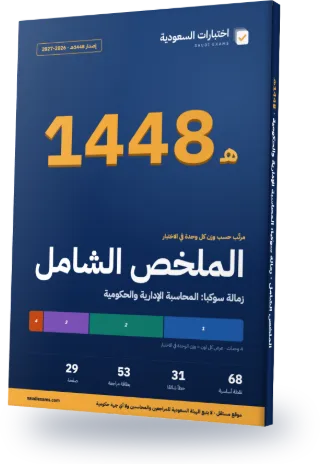
SOCPA Fellowship Managerial & Gov Complete Review Guide 2026–2027
Every exam topic in a 29-page Arabic PDF, ordered from the heaviest unit to the lightest. The first three chapters alone cover about 93% of the exam questions.
- 29Pages
- 68Key points
- 31Common mistakes
- 53Flashcards
Guide map
Each chapter is one exam unit, ordered by its weight in the real exam.
| Chapter | Unit | Weight | Exam questions | Key points |
|---|---|---|---|---|
| 1 | Management accounting | 36% | 13 | 18 |
| 2 | Cost accounting | 35% | 13 | 16 |
| 3 | Accounting in government entities | 23% | 8 | 16 |
| 4 | Non-profit organisations | 7% | 2 | 18 |
Chapter 1 in full: Management accounting
36% of the exam, about 13 questions. These are its key points, as in the guide.
- A standard is a predetermined unit cost; variance = actual − standard, unfavorable (U) when actual cost is higher and favorable (F) when lower.
- A material price variance usually belongs to purchasing, usage to production, wage rate to personnel and efficiency to the supervisor.
- Mix variance = (actual quantity at actual mix − actual quantity at standard mix) × standard price; yield variance measures actual output against the output allowed from actual input.
The rest of chapter 1, on this page
- Idle time variance = idle hours × standard rate, always unfavorable.
- Overhead two-way analysis: budget (controllable) and volume variances; three-way: spending, efficiency, volume; four-way: variable spending, efficiency, fixed spending, volume.
- Safety stock guards against stock-outs from higher usage or late delivery; maximum stock = EOQ + safety stock when an order arrives.
- ABC inventory classification: class A items are few but high in value and need the tightest control; class C items are many and low in value and need only simple control.
- Value engineering redesigns the product and processes to cut cost without sacrificing functions the customer values; kaizen reduces cost gradually after production starts.
- Activity-based costing pools costs by activity and charges them with cost drivers; it gives more accurate costs for low-volume complex products than a direct-labour-hour rate.
- Activity levels: unit, batch, product and facility; facility-level costs have no causal driver.
- Contribution margin = selling price − variable cost; contribution margin ratio = margin ÷ selling price.
- Operating income = total contribution margin − fixed costs; high operating leverage means profit is more sensitive to a change in sales.
- A special order is accepted if its price exceeds the differential cost, spare capacity exists and regular sales are unaffected.
- Decisions: make or buy (compare avoidable costs), shutdown (compare contribution with avoidable fixed costs), further processing (extra revenue vs extra cost, ignoring costs before the split-off point).
- Cost-plus pricing: price = cost × (1 + markup percentage); target pricing starts from the price the market accepts.
- Transfer prices may be based on market price, cost or negotiation; when the seller has spare capacity, the minimum is variable cost.
- A flexible budget recomputes variable costs at the actual activity level, so it suits control better than a static budget.
- The cash budget excludes non-cash expenses such as depreciation; it shows surplus or deficit and the need to borrow.
Common mistakes in this chapter
- Price variance uses quantity purchased if measured at purchase and quantity used if measured at usage; usage variance always uses quantity used. Students often use the purchased quantity for the second variance.
- Standard quantity allowed is based on actual output, not budgeted output. If 2,500 units were made against a budget of 3,000, compute the standard on 2,500.
- The fixed overhead production volume variance measures capacity use, not spending; it is unfavorable when standard hours allowed fall below normal capacity. Fixed spending variance = actual − budgeted fixed overhead.
- In EOQ, demand and cost units must be consistent (annual). EOQ does not depend on lead time, and it does not rise in proportion to demand: quadrupling demand only doubles EOQ because of the square root.
- Do not confuse target costing (start from market price and work down to cost) with kaizen costing (continuous small reductions on existing products during manufacturing). Check whether profit is a percentage of price or of cost.
- In special-order and shutdown decisions, sunk and unavoidable fixed costs are dropped, and the contribution lost from the alternative use of capacity (opportunity cost) is added. Full unit cost is not always the relevant cost.
- With a scarce resource, do not rank products by contribution per unit but by contribution per hour (or unit) of the scarce resource; the product with the highest unit margin may earn least per hour.
- ROI may lead managers to reject projects earning less than the current average even when above the required rate; RI accepts them. Payback ignores discounting, so it alone cannot judge profitability. In costs of quality, inspection (appraisal) is not prevention.
The other chapters are in the full guide
One purchase · lifetime access · review guide included
7-day review plan
The chapters are spread over 6 days by weight so each day carries a similar load. Day 7 is a full exam.
Day 1 · 36% of the exam
Chapter 1: Management accounting
Day 2 · 35% of the exam
Chapter 2: Cost accounting
Day 3 · 23% of the exam
Chapter 3: Accounting in government entities
Day 4 · 7% of the exam
Chapter 4: Non-profit organisations
Day 5
Full mock exam: 36 questions in 108 minutes, then review the common mistakes in the units where you lost marks.
How many correct answers do you need?
- Pass mark 60%22 correct out of 36
Before you read: see your score today
10 free questions from the main units, no sign-up. Then you know which chapter to start with.
Try 10 free questions and see your levelA look at each chapter
The first three key points of each chapter, as they appear in the guide (in Arabic in the PDF).
Chapter 1: Management accounting
- A standard is a predetermined unit cost; variance = actual − standard, unfavorable (U)…
- A material price variance usually belongs to purchasing, usage to production, wage rate to…
- Mix variance = (actual quantity at actual mix − actual quantity at standard mix)…
Chapter 2: Cost accounting
- Cost accounting measures the cost of products and services to value inventory and determine…
- A direct cost is traced to the product economically (table wood, carpenter's wage), while…
- Product costs (materials, labour, manufacturing overhead) are carried in inventory until sale, while period…
Chapter 3: Accounting in government entities
- Accrual basis recognises a transaction when the event occurs, not when cash moves; cash…
- Royal Order 51574 (13/9/1440 AH) authorised the Ministry of Finance to adopt and update…
- The 4th edition (2025) of the Manual was approved by Ministerial Decision 50 (7/1/1447…
Chapter 4: Non-profit organisations
- Net assets
- Unrestricted
- Restricted
The full guide comes with lifetime access
The full guide (29 pages) is included with lifetime access to this exam, together with every question and full mock exam. Chapter 1 is free for everyone.
Questions about the guide
Is the guide free?
Chapter 1 is free to read on the guide page. The full guide comes with lifetime access to this exam; 7-day access does not include it.
Is it up to date for 2026–2027?
Yes. Unit weights and exam facts follow what the exam body last published, and the last check date is printed in the guide. If the standards change we update the file and buyers download the new version.
Does the guide have questions?
No. The guide covers key points and common mistakes; scoring, weak-area practice and full mock exams are on the site.
Can I read it on my phone?
Yes. A5 pages in a single column, with chapters linked from the contents.
- Pages
- 29
- Edition
- 1448 AH · 2026–2027
- Language
- Arabic
- Last updated
All Accounting & Tax Exams review guides
Back to SOCPA Fellowship Exam: Managerial and Governmental Accounting
Buy this exam
Pick the access that lasts until your test date.
Included
- Full mock exams: 36 questions in 108 minutes, with a score for every unit
- 315 questions, every option explained with its source
- Practice that starts with your weakest units, plus a review of your mistakes
- Complete Review Guide 2026–2027 (PDF), with lifetime access only
Continue with your Google account and you go straight to the payment page.
You pay on the Waffo Pancake checkout page (in English). The amount is in US dollars and your bank converts it to riyals. One payment with no automatic renewal, by Visa, Mastercard (a mada card with either logo works too), Apple Pay or Google Pay. Your statement shows "WAFFO". Purchases are not refundable.