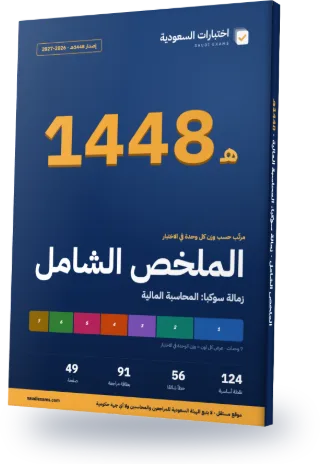
SOCPA Fellowship Financial Accounting Complete Review Guide 2026–2027
Every exam topic in a 49-page Arabic PDF, ordered from the heaviest unit to the lightest. The first three chapters alone cover about 52% of the exam questions.
- 49Pages
- 124Key points
- 56Common mistakes
- 91Flashcards
Guide map
Each chapter is one exam unit, ordered by its weight in the real exam.
| Chapter | Unit | Weight | Exam questions | Key points |
|---|---|---|---|---|
| 1 | Policies, events and special measurement topics | 22% | 13 | 18 |
| 2 | Inventories and non-current assets | 17% | 10 | 18 |
| 3 | Cash, financial instruments and receivables | 13% | 8 | 16 |
| 4 | Leases, liabilities and equity | 13% | 8 | 18 |
| 5 | Consolidation, business combinations and investments | 13% | 8 | 18 |
| 6 | Revenue, zakat and income taxes | 12% | 7 | 18 |
| 7 | Conceptual Framework and the accounting cycle | 10% | 6 | 18 |
Chapter 1 in full: Policies, events and special measurement topics
22% of the exam, about 13 questions. These are its key points, as in the guide.
- IAS 8: a change in accounting policy is applied retrospectively unless impracticable; a change in estimate is applied prospectively in the period of change and later periods; a material prior period error is corrected by restating comparatives or the opening balances of the earliest period presented. (u6.1)
- IAS 10: an adjusting event provides evidence of a condition that existed at the reporting date, such as settlement of a court case after year-end, bankruptcy of a customer already in difficulty or discovery of fraud. A non-adjusting event arises after the reporting date, such as a fire or a fall in market prices of investments, and is disclosed if material. (u6.1)
- IAS 10: if management decides after the reporting date to liquidate the entity, or has no realistic alternative, the statements are not prepared on a going concern basis. In the Kingdom they are then prepared under the liquidation basis financial reporting standard endorsed by SOCPA. (u6.1)
The rest of chapter 1, on this page
- IAS 24: related parties include the parent, subsidiaries, associates, joint ventures, key management personnel and their close family members, and post-employment benefit plans. A provider of finance, a trade union, a government agency, or a major customer or supplier is not a related party merely because of normal dealings. Key management personnel compensation is disclosed. (u6.2)
- IAS 33 paragraph 10: basic EPS = profit attributable to ordinary equity holders of the parent ÷ weighted average number of ordinary shares outstanding. Profit is reduced by cumulative preference dividends for the period whether or not declared, and by non-cumulative preference dividends if declared. (u6.2)
- IAS 33: for diluted EPS, after-tax interest on convertible bonds is added to the numerator and conversion shares to the denominator; options use the treasury share method (only the shares deemed issued for no consideration); anti-dilutive instruments are excluded. (u6.2)
- IFRS 2: equity-settled share-based payment is measured at grant-date fair value and spread over the vesting period with a credit to equity; market conditions are built into grant-date fair value, while non-market vesting conditions adjust the number of instruments expected to vest. Cash-settled awards create a liability remeasured at fair value until settlement. (u6.2)
- IAS 19: short-term benefits are recognised undiscounted, and under a defined contribution plan the expense is the contribution payable. Under a defined benefit plan, service cost and net interest go to profit or loss, while remeasurements (actuarial gains and losses and the return on plan assets excluding interest) go to other comprehensive income and are never reclassified. (u6.3)
- IAS 19: the defined benefit obligation is discounted using market yields on high-quality corporate bonds, or on government bonds where there is no deep market in such bonds. The end-of-service benefit in the Kingdom is a defined benefit plan, usually unfunded. (u6.3)
- IAS 26: the retirement benefit plan reports on its own; a defined contribution plan presents net assets available for benefits, and a defined benefit plan also presents the actuarial present value of promised retirement benefits. (u6.3)
- IAS 21: functional currency is the currency of the primary economic environment in which the entity operates. When translating a foreign operation into the presentation currency, assets and liabilities use the closing rate, income and expenses use transaction-date rates (or an average as an approximation), and differences go to other comprehensive income and are reclassified to profit or loss on disposal. (u6.4)
- IAS 29: in a hyperinflationary economy the statements are restated using a general price index into the measuring unit current at the reporting date; monetary items are not restated, and the gain or loss on the net monetary position goes to profit or loss. One indicator is cumulative inflation over three years approaching or exceeding 100%. (u6.4)
- Branch accounting: the branch current account in the head office books mirrors the head office account in the branch books; both are eliminated in the combined statements, together with unrealised profit on goods transferred to the branch above cost and still unsold. (u6.4)
- IAS 34 and IFRS 8: interim reports use the same accounting policies as the annual statements, and interim tax expense uses the estimated annual effective rate. Under IFRS 8 a segment is reportable if its revenue, profit or loss, or assets are 10% or more of the total (paragraph 13), and the external revenue of reportable segments must cover at least 75% of entity revenue. (u6.4)
- IAS 36: goodwill, indefinite-life intangibles and intangibles not yet available for use are tested annually; other assets when there is an indication of impairment. A cash-generating unit's loss goes first to goodwill, then to other assets pro rata to carrying amount, without reducing any asset below the highest of its fair value less costs of disposal, its value in use and zero. (u6.5)
- IAS 23: a qualifying asset takes a substantial period to get ready for use or sale. For specific borrowings, actual costs less investment income on temporary investment of the funds are capitalised; for general borrowings, a capitalisation rate is applied to expenditure. Capitalisation starts when expenditure, borrowing costs and activities are all under way, is suspended during extended periods without active development, and ceases when substantially all activities are complete. (u6.5)
- IFRS 13: Level 1 is quoted prices in active markets for identical assets, Level 2 is observable inputs other than Level 1 prices, and Level 3 is unobservable inputs. A non-financial asset is measured on its highest and best use from market participants' view, in the principal market or, if none, the most advantageous market. (u6.5)
- IAS 20, IAS 41, IFRS 17, IFRS 6 and IFRS for SMEs: a government grant is recognised under the income approach once there is reasonable assurance the conditions will be met and the grant received; an asset grant is shown as deferred income or deducted from the asset. A biological asset is measured at fair value less costs to sell, with changes in profit or loss. IFRS 17 measures contracts as fulfilment cash flows plus the contractual service margin. Exploration and evaluation spending under IFRS 6 is measured at cost and tested for impairment when indicators exist. In the Kingdom, SMEs apply the endorsed IFRS for SMEs and may elect full IFRS only if they apply all of it and keep applying it. (u6.6)
Common mistakes in this chapter
- Switching from one depreciation method to another is a change in accounting estimate applied prospectively, while moving investment property from the cost model to the fair value model is a change in accounting policy.
- Dividends declared after the reporting date are not recognised as a liability in the statement of financial position; they are disclosed in the notes as a non-adjusting event.
- Bonus issues and share splits are not time-weighted: they are treated as if they had occurred at the start of the earliest period presented, and comparative EPS is restated too.
- Equity-settled share-based payment is not remeasured after grant date, whereas the liability for cash-settled share-based payment is remeasured at each reporting date until settlement.
- An impairment loss on goodwill is never reversed in a later period (IAS 36 paragraph 124); impairment of other assets may be reversed, up to the carrying amount that would have existed without the impairment.
- Transaction costs are not deducted from fair value under IFRS 13 because they are specific to the transaction, but costs of transport to the principal market are deducted when location is a characteristic of the asset.
- The end-of-service benefit is not a defined contribution plan: the obligation is measured actuarially and discounted, and recording the amount payable as if service ended at the reporting date is not enough.
- Bearer plants such as date palms are accounted for under IAS 16 as property, plant and equipment, while the produce growing on them is a biological asset under IAS 41.
The other chapters are in the full guide
One purchase · lifetime access · review guide included
7-day review plan
The chapters are spread over 6 days by weight so each day carries a similar load. Day 7 is a full exam.
Day 1 · 22% of the exam
Chapter 1: Policies, events and special measurement topics
Day 2 · 17% of the exam
Chapter 2: Inventories and non-current assets
Day 3 · 13% of the exam
Chapter 3: Cash, financial instruments and receivables
Day 4 · 13% of the exam
Chapter 4: Leases, liabilities and equity
Day 5 · 13% of the exam
Chapter 5: Consolidation, business combinations and investments
Day 6 · 22% of the exam
Chapter 6: Revenue, zakat and income taxes
Chapter 7: Conceptual Framework and the accounting cycleDay 7
Full mock exam: 60 questions in 180 minutes, then review the common mistakes in the units where you lost marks.
How many correct answers do you need?
- Pass mark 60%36 correct out of 60
Before you read: see your score today
10 free questions from the main units, no sign-up. Then you know which chapter to start with.
Try 10 free questions and see your levelA look at each chapter
The first three key points of each chapter, as they appear in the guide (in Arabic in the PDF).
Chapter 1: Policies, events and special measurement topics
- IAS 8
- IAS 10
- IAS 10
Chapter 2: Inventories and non-current assets
- Inventory cost = costs of purchase + costs of conversion + other costs incurred…
- Fixed production overheads are allocated on the basis of normal capacity; any amount left…
- Cost formulas
Chapter 3: Cash, financial instruments and receivables
- Cash flows fall into three activities
- A bank overdraft repayable on demand that forms part of cash management is included…
- Income taxes paid are classified as operating unless they can be specifically identified with…
Chapter 4: Leases, liabilities and equity
- A contract is, or contains, a lease if it conveys the right to control…
- A lessee may elect not to recognise a right-of-use asset and liability for short-term…
- Lease payments in the liability
Chapter 5: Consolidation, business combinations and investments
- The acquisition method has four steps
- Identifiable assets acquired and liabilities assumed are measured at their acquisition-date fair values, with…
- Goodwill = consideration transferred + non-controlling interests + fair value of previously held interest…
Chapter 6: Revenue, zakat and income taxes
- A contract exists for IFRS 15 purposes when the parties have approved it, each…
- A performance obligation is a promise in a contract to transfer a distinct good…
- The transaction price is the consideration the entity expects to be entitled to for…
Chapter 7: Conceptual Framework and the accounting cycle
- General purpose financial reporting serves existing and potential investors, lenders and other creditors in…
- Relevance
- Faithful representation
The full guide comes with lifetime access
The full guide (49 pages) is included with lifetime access to this exam, together with every question and full mock exam. Chapter 1 is free for everyone.
Questions about the guide
Is the guide free?
Chapter 1 is free to read on the guide page. The full guide comes with lifetime access to this exam; 7-day access does not include it.
Is it up to date for 2026–2027?
Yes. Unit weights and exam facts follow what the exam body last published, and the last check date is printed in the guide. If the standards change we update the file and buyers download the new version.
Does the guide have questions?
No. The guide covers key points and common mistakes; scoring, weak-area practice and full mock exams are on the site.
Can I read it on my phone?
Yes. A5 pages in a single column, with chapters linked from the contents.
- Pages
- 49
- Edition
- 1448 AH · 2026–2027
- Language
- Arabic
- Last updated
Buy this exam
Pick the access that lasts until your test date.
Included
- Full mock exams: 60 questions in 180 minutes, with a score for every unit
- 341 questions, every option explained with its source
- Practice that starts with your weakest units, plus a review of your mistakes
- Complete Review Guide 2026–2027 (PDF), with lifetime access only
Continue with your Google account and you go straight to the payment page.
You pay on the Waffo Pancake checkout page (in English). The amount is in US dollars and your bank converts it to riyals. One payment with no automatic renewal, by Visa, Mastercard (a mada card with either logo works too), Apple Pay or Google Pay. Your statement shows "WAFFO". Purchases are not refundable.