CMA Part 1
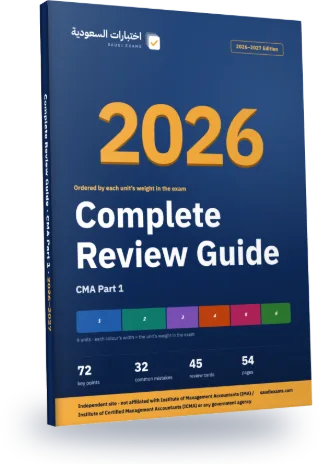
CMA Part 1 Complete Review Guide 2026–2027
Every exam topic in a 54-page Arabic PDF, ordered from the heaviest unit to the lightest. The first three chapters alone cover about 55% of the exam questions.
- 54Pages
- 72Key points
- 32Common mistakes
- 45Flashcards
Guide map
Each chapter is one exam unit, ordered by its weight in the real exam.
| Chapter | Unit | Weight | Exam questions | Key points |
|---|---|---|---|---|
| 1 | Planning, Budgeting, and Forecasting | 20% | 20 | 14 |
| 2 | Performance Management | 20% | 20 | 14 |
| 3 | External Financial Reporting Decisions | 15% | 15 | 14 |
| 4 | Cost Management | 15% | 15 | 14 |
| 5 | Internal Controls | 15% | 15 | 8 |
| 6 | Technology and Analytics | 15% | 15 | 8 |
Chapter 1 in full: Planning, Budgeting, and Forecasting
20% of the exam, about 20 questions. These are its key points, as in the guide.
- Strategy connects purpose to action. Vision describes the desired future; mission clarifies the business and customers served. Choose a multiyear horizon suited to the industry, rather than assuming a universal number of years. Translate mission into measurable strategic objectives, then consistent annual tactics and resource commitments. Assign responsibility and review progress. [S1 §9.2; S2 §9.4; S7 §7.1]
- Situational analysis examines the starting position. SWOT separates internal strengths/weaknesses from external opportunities/threats. PEST examines political, economic, social and technological conditions; PESTEL adds environmental and legal factors. Competitive analysis compares rivals. Five Forces examines rivalry, entry, substitutes, supplier power and buyer power: it analyzes industry profit pressure, not just named competitors. [S3 §9.3; S4 §8.3; S5 The Five Forces]
- Cost leadership seeks a cost advantage; differentiation offers valued distinctions; focus applies either approach to a narrower segment. BCG classifies high/low growth and relative share: stars high/high, cash cows low/high, question marks high/low, dogs low/low. Scenario planning tests plausible futures; contingency plans specify responses to disruptions. These tools inform investment decisions, rather than guarantee outcomes. [S6 §8.6; S8 How Does the Growth Share Matrix Work?; S9 Governance/Scenario modelling]
The rest of chapter 1, on this page
- A useful budgeting process coordinates sales, operations and finance around explicit assumptions. Senior management sets direction and resolves resource conflicts; participation adds operating knowledge and commitment. Slack means deliberately easy targets, such as overstated resource needs. Evaluate managers with regard to costs they can influence over the relevant period. Document major assumption changes and authorize revisions without hiding the original target. [S7 §7.1 Top-Down versus Bottom-Up; S14 Incremental budgeting; S21 §9.3]
- Build standards from product/activity analysis, engineering requirements, current prices and relevant history. Material standard cost = standard quantity × standard price; labor = standard hours × standard rate. Ideal standards assume perfect conditions; practical standards allow normal unavoidable losses and interruptions while requiring efficient work. Authoritative standards are imposed; participative standards involve those responsible for execution. [S10 §8.1 Fundamentals; S7 §7.1 Top-Down versus Bottom-Up]
- Simple regression predicts ŷ = a + bx; multiple regression uses ŷ = a + b1x1 + b2x2 + … . A coefficient measures the fitted change associated with its predictor, holding the other included predictors fixed. Original example: ŷ = 7,500 + 4.2x predicts 20,100 at x = 3,000. Inspect model fit and unusual observations; extrapolation beyond observed conditions is risky. Association alone does not establish causation. [S11 §4.1.4.1 Definition/Disadvantages; S22 §3.1.3.6]
- Under the cumulative average-time model, Y = aX^b, b = log(r)/log(2), where r is the learning rate and Y is average time for all X units. Total time T(X) = XY; a later batch takes T(end) − T(start). Original example: first unit 125 hours, 80% learning. At 4 units average = 80, total = 320; at 8 average = 64, total = 512. Units 5–8 require 192 hours. Use only while the assumed learning pattern remains reasonable. [S12 p13 Learning curve; S23 Cumulative Average Learning Curves]
- Expected cash flow is Σ(probability × cash flow), using mutually exclusive outcomes whose probabilities total 1. Original example: collection is 50,000 with probability 0.3 or 80,000 with probability 0.7; expected collection = 71,000. It supports comparisons but may be no possible single outcome and conceals dispersion. A liquidity plan should also test adverse outcomes, rather than treating the mean as guaranteed cash. [S13 §4.2 Mean/NOTE; S20 §18.5 Scenarios]
- The annual master budget integrates operating and financial schedules, commonly split into months or quarters. A project budget follows a defined project and its milestones, potentially spanning fiscal years. A rolling budget replaces an elapsed period with a new one to maintain its forward horizon; it suits changing conditions but requires continuing work and clear performance targets. Incremental budgeting is simpler, but may preserve obsolete costs. [S7 §7.1 Budget development; S15 Rolling budget; S14 Incremental budgeting; S27 Project Time/Cost Management]
- Choose the method for the problem. Zero-based budgeting justifies and ranks decision packages from scratch; it challenges inherited spending but takes time. Activity-based budgeting translates required output into activities and resource needs, useful for complex overhead but data-intensive. Flexible cost = fixed cost + variable rate × activity within the relevant range; reset stepped costs when thresholds change. At 1,600 units, 9,000 + 6(1,600) = 18,600. [S14 Zero-based budgeting; S16 Activity-based budgeting; S17 Flexible budgeting]
- Sales revenue = units × price; forecast demand using market, customer and economic assumptions. Operating schedules link sales to production, materials, labor and overhead. Production = sales + ending finished goods − beginning finished goods. Original example: 2,400 + 500 − 350 = 2,550 units. With 3 kg/unit, ending raw materials 900 kg and beginning 750 kg, purchases = 7,800 kg. Labor at 0.4 hour/unit and 25/hour costs 25,500. Check capacity and inventory policy; budget overhead by its fixed/variable behavior. [S18 §7.2 Production/Direct Materials/Direct Labor/Manufacturing Overhead]
- Bridge manufacturing to profit: cost of goods manufactured = beginning WIP + manufacturing costs − ending WIP; COGS = beginning finished goods + cost of goods manufactured − ending finished goods. Selling/administrative costs are separate from manufacturing inventory. Contribution margin = sales − all variable costs, including variable selling costs; it covers fixed costs then profit. Original example: price 70, variable manufacturing 32, commission 3: unit contribution = 35; 2,400 sales units give 84,000. [S19 §2.1 Figs 2.8–2.9; S24 §3.1 Unit/Total Contribution Margin]
- Cash budgeting follows payment timing, including credit collections, payables, capital purchases and financing; exclude depreciation. Original example: opening cash 12,000; current/prior sales 90,000/60,000, collected 40% now and 60% next month. Receipts = 72,000. Cash operating payments 68,000 plus equipment 15,000 leave 1,000 before financing. To retain 8,000, borrow 7,000, assuming no borrowing interest/fees in this period. [S25 §7.3 Cash Budget]
- Pro forma income statements forecast profit, balance sheets forecast balances, and cash flow statements reconcile operating, investing and financing cash movements. They must reconcile: projected profit updates retained earnings after dividends; collection/inventory/payment policies determine working capital; capital spending and depreciation update assets; financing changes debt/equity and future interest. Long-range cash forecasts should reflect growth, inflation, investment, taxes, debt service and dividend assumptions. Compare strategic targets across profit and liquidity scenarios, then identify external financing needs. A profitable growth plan can still require cash before customers pay. [S26 §18.4 Balance sheet/Linkages; S20 §18.5 Funding needs/Value of Growth]
Common mistakes in this chapter
- An external recession is a threat, not an internal weakness; a scarce internal skill is a weakness. Classify the factor before choosing an action. [S3 §9.3; S4 §8.3]
- Do not apply an 80% learning rate to each successive unit. In this model it applies to cumulative average time when cumulative output doubles. [S12 p13 Learning curve]
- A flexed budget retains budgeted rates and uses actual activity. Substituting actual prices would hide price or spending differences. [S17 Flexible vs flexed budget]
- Materials purchased, materials used, units produced and units sold are different quantities when inventories change. [S18 §7.2 Direct Materials; S19 §2.1 Manufacturing Organizations]
- Profit is not cash: credit sales can precede collection, while equipment purchases consume cash without becoming an immediate operating expense. [S25 §7.3 Capital Asset/Cash Budget]
- A probability-weighted average is not a promise or a complete risk measure. Check the shortfall in adverse outcomes. [S13 §4.2 Mean; S20 §18.5 Scenarios]
The other chapters are in the full guide
One purchase · lifetime access · review guide included
7-day review plan
The chapters are spread over 6 days by weight so each day carries a similar load. Day 7 is a full exam.
Day 1 · 20% of the exam
Chapter 1: Planning, Budgeting, and Forecasting
Day 2 · 20% of the exam
Chapter 2: Performance Management
Day 3 · 15% of the exam
Chapter 3: External Financial Reporting Decisions
Day 4 · 15% of the exam
Chapter 4: Cost Management
Day 5 · 15% of the exam
Chapter 5: Internal Controls
Day 6 · 15% of the exam
Chapter 6: Technology and Analytics
Day 7
Full mock exam: 100 questions in 180 minutes, then review the common mistakes in the units where you lost marks.
Before you read: see your score today
10 free questions from the main units, no sign-up. Then you know which chapter to start with.
Try 10 free questions and see your levelA look at each chapter
The first three key points of each chapter, as they appear in the guide (in Arabic in the PDF).
Chapter 1: Planning, Budgeting, and Forecasting
- Strategy connects purpose to action. Vision describes the desired future; mission clarifies the business…
- Situational analysis examines the starting position. SWOT separates internal strengths/weaknesses from external opportunities/threats. PEST…
- Cost leadership seeks a cost advantage; differentiation offers valued distinctions; focus applies either approach…
Chapter 2: Performance Management
- Build standards before judging results. A standard costing system sets expected input prices and…
- State the sign convention
- Materials
Chapter 3: External Financial Reporting Decisions
- Read the four statements together
- Indirect operating cash flow starts with net income, adds noncash expenses, removes investing gains…
- Consolidation reports a controlled group as one entity. Assess the VIE model where applicable…
Chapter 4: Cost Management
- Cost behavior depends on the time horizon and relevant range. Within a stated range…
- Actual costing uses actual direct costs and an actual overhead rate; normal costing uses…
- Absorption costing inventories variable and allocated fixed manufacturing costs; variable costing inventories variable manufacturing…
Chapter 5: Internal Controls
- Controls give reasonable, not absolute, assurance.
- Design deficiency means the control cannot meet its objective as configured.
- Reperformance is stronger evidence of operating effectiveness than inquiry alone.
Chapter 6: Technology and Analytics
- Master data are stable reference attributes; transactions are events.
- SaaS
- Completeness, accuracy and timeliness are core data-quality dimensions.
The full guide comes with lifetime access
The full guide (54 pages) is included with lifetime access to this exam, together with every question and full mock exam. Chapter 1 is free for everyone.
Questions about the guide
Is the guide free?
Chapter 1 is free to read on the guide page. The full guide comes with lifetime access to this exam; 7-day access does not include it.
Is it up to date for 2026–2027?
Yes. Unit weights and exam facts follow what the exam body last published, and the last check date is printed in the guide. If the standards change we update the file and buyers download the new version.
Does the guide have questions?
No. The guide covers key points and common mistakes; scoring, weak-area practice and full mock exams are on the site.
Can I read it on my phone?
Yes. A5 pages in a single column, with chapters linked from the contents.
- Pages
- 54
- Edition
- 1448 AH · 2026–2027
- Language
- Arabic
- Last updated
All Accounting & Tax Exams review guides
Back to CMA Part 1: Financial Planning, Performance, and Analytics
Buy this exam
Pick the access that lasts until your test date.
Included
- Timed supplementary practice sessions: 100 questions in 180 minutes
- 500 questions, every option explained with its source
- Practice that starts with your weakest units, plus a review of your mistakes
- Complete Review Guide 2026–2027 (PDF), with lifetime access only
Continue with your Google account and you go straight to the payment page.
You pay on the Waffo Pancake checkout page (in English). The amount is in US dollars and your bank converts it to riyals. One payment with no automatic renewal, by Visa, Mastercard (a mada card with either logo works too), Apple Pay or Google Pay. Your statement shows "WAFFO". Purchases are not refundable.