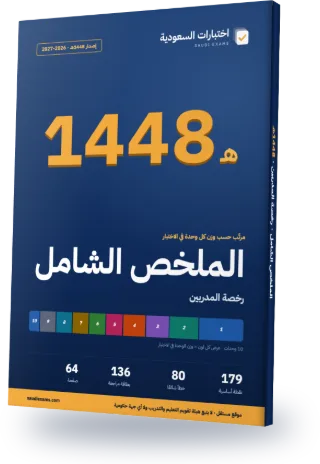
Trainer License Complete Review Guide 2026–2027
Every exam topic in a 64-page Arabic PDF, ordered from the heaviest unit to the lightest. The first three chapters alone cover about 44% of the exam questions.
- 64Pages
- 179Key points
- 80Common mistakes
- 136Flashcards
Guide map
Each chapter is one exam unit, ordered by its weight in the real exam.
| Chapter | Unit | Weight | Exam questions | Key points |
|---|---|---|---|---|
| 1 | Training Modes, Strategies and Assessment Types | 20% | 15 | 18 |
| 2 | Thinking and Digital Skills | 13% | 10 | 18 |
| 3 | Knowing the Trainee and Training Principles | 11% | 8 | 18 |
| 4 | Planning Training and Designing Learning Experiences | 11% | 8 | 18 |
| 5 | Delivering Training in a Flexible, Motivating and Safe Environment | 8% | 6 | 18 |
| 6 | Evaluating Training and Reporting | 8% | 6 | 18 |
| 7 | Professional Ethics and National Training Regulations | 8% | 6 | 18 |
| 8 | Continuous Professional Development and Learning Communities | 8% | 6 | 18 |
| 9 | Social and Emotional Skills | 8% | 6 | 18 |
| 10 | Citizenship, Integrity, Confidentiality and Information Security | 5% | 4 | 17 |
Chapter 1 in full: Training Modes, Strategies and Assessment Types
20% of the exam, about 15 questions. These are its key points, as in the guide.
- Face-to-face training brings trainer and trainees together in one place at one time. It has two forms: theoretical, delivering concepts and knowledge through explanation and discussion; and practical, practising a skill in a workshop or lab under supervision with immediate feedback. Its strengths are interaction and direct observation; its limits are fixed place and time and higher cost.
- Synchronous e-training: trainer and trainees interact at the same time from different places, as in virtual classrooms and live webinars. It allows instant interaction and questions but requires a fixed schedule and a stable connection.
- Asynchronous e-training: each trainee learns at their own time and pace through recorded content, modules on a learning management system (LMS) and discussion forums. It gives flexibility and time to reflect, but risks isolation and dropout, so it needs clear deadlines and progress tracking.
The rest of chapter 1, on this page
- Blended training: a programme that deliberately combines face-to-face and e-training. Theory is often delivered online for flexibility, and face-to-face time is kept for practice and skills that need interaction and supervision.
- Flipped training: a form of blended training in which trainees study the content (video or reading) before the session, and session time is used for application, discussion and problem-solving instead of explanation.
- Criteria for choosing a training strategy: target learning outcomes, the nature of the content (knowledge, skill or attitude), trainee characteristics and group size, available time, resources and equipment, and the training mode, face-to-face or online.
- Interactive lecture: an organised presentation of theoretical content broken up by short pauses for questions, discussion and quick activities. It suits delivering a lot of information to a large group in little time, and interaction keeps trainees from becoming passive.
- Discussion and brainstorming: discussion is an organised exchange of views and experience on a set topic. Brainstorming aims to generate as many ideas as possible on a defined problem; its key rule is to postpone criticism and evaluation until after the idea-generation stage, while encouraging unusual ideas and building on others' ideas.
- Role-play and simulation: in role-play, trainees act out a realistic situation to practise communication, negotiation, customer service and attitudes, followed by a debrief and feedback. Simulation is an environment that imitates reality or real equipment, used when practising on the real thing is risky or costly.
- Case study: presenting a real or realistic situation for trainees, often in groups, to analyse, propose solutions and make decisions. It develops analysis, critical thinking and decision-making and links theory to the workplace.
- Demonstration: the trainer performs the skill step by step in front of trainees while explaining, then trainees practise under supervision and receive feedback. It is the best fit for procedural and motor skills.
- Project-based and cooperative learning: a project is an extended task ending in a tangible product that combines knowledge and skills and is assessed against clear criteria (a rubric). In cooperative learning, trainees work in small groups where each member has a role, with a shared goal and individual accountability.
- Varying and adapting strategies: no single strategy fits every situation. The trainer analyses trainees' needs, experience, levels and the type of content, balances presentation with practice, favours experiential, work-problem methods for adults, and accounts for individual differences and different learning preferences.
- Assessment types by timing and purpose: diagnostic (pre-) assessment before training to identify level, prior knowledge and needs; formative assessment during training to monitor progress, give feedback and adjust methods; summative assessment at the end of the programme to judge whether outcomes were achieved and make decisions such as awarding a certificate. Follow-up assessment after training measures transfer of learning to the job.
- Interpreting results: norm-referenced assessment interprets a trainee's score by comparing it with the group's performance and is used for ranking and selection; criterion-referenced assessment compares it with a pre-defined performance or mastery level and is used to judge whether a competency has been achieved.
- Qualities of a good assessment tool: validity means it measures what it is meant to measure; reliability means it gives consistent results when repeated under similar conditions; objectivity means the score does not depend on the marker's opinion. A table of specifications maps content topics to objective levels and the number of items for each, supporting content validity.
- Performance assessment tools: a checklist records whether each step was done or not (yes/no); a rating scale grades performance on a graded scale (poor to excellent); a rubric sets clear criteria with a description of each performance level, increasing objectivity and showing trainees in advance what is expected; an observation card records trainee behaviour while performing a real or simulated task.
- Other tools and how to match them: objective tests (multiple choice, true/false) measure knowledge quickly and objectively; essay questions measure analysis, evaluation and depth of understanding; a portfolio tracks a trainee's growth through samples of their work; a questionnaire collects opinions and reactions, not knowledge. The tool is chosen according to what is measured, the training mode and the trainees; in e-training, online quizzes and LMS progress reports are typical.
Common mistakes in this chapter
- Formative assessment happens during training to improve learning, give feedback and adjust the approach; it is not an end-of-programme test for a grade or certificate. That is summative assessment.
- Diagnostic (pre-) assessment identifies trainees' starting level, prior knowledge and needs before training begins; it does not judge success. Do not confuse it with the final test just because both are tests.
- Synchronous means trainer and trainees interact at the same time even if they are in different places; recordings and forums that each trainee uses at their own time are asynchronous. The deciding factor is time, not place.
- Blended training is not just using slides in the classroom; it is a programme that deliberately combines face-to-face sessions with e-learning. Flipped training is one form of it, in which trainees study the content before the session.
- Validity and reliability differ: a tool can be reliable, giving the same results every time, yet invalid because it measures the wrong thing. Reliability is necessary for validity but not sufficient on its own.
- A checklist only records whether a step or behaviour is present or absent (yes/no); rating scales and rubrics measure how well it is done. If the question asks about the level of mastery, a checklist alone is not enough.
- Norm-referenced assessment compares a trainee with peers (ranking), while criterion-referenced assessment compares the trainee with a pre-set mastery standard. Licensing and competency tests usually rely on criteria.
- The lecture is not always wrong: it suits delivering a lot of theoretical information to a large group in little time, but on its own it does not build practical skills or change attitudes. Options claiming one strategy is 'always' or 'absolutely' best are usually wrong.
The other chapters are in the full guide
One purchase · lifetime access · review guide included
7-day review plan
The chapters are spread over 6 days by weight so each day carries a similar load. Day 7 is a full exam.
Day 1 · 20% of the exam
Chapter 1: Training Modes, Strategies and Assessment Types
Day 2 · 13% of the exam
Chapter 2: Thinking and Digital Skills
Day 3 · 19% of the exam
Chapter 3: Knowing the Trainee and Training Principles
Chapter 9: Social and Emotional SkillsDay 4 · 16% of the exam
Chapter 4: Planning Training and Designing Learning Experiences
Chapter 10: Citizenship, Integrity, Confidentiality and Information SecurityDay 5 · 16% of the exam
Chapter 5: Delivering Training in a Flexible, Motivating and Safe Environment
Chapter 7: Professional Ethics and National Training RegulationsDay 6 · 16% of the exam
Chapter 6: Evaluating Training and Reporting
Chapter 8: Continuous Professional Development and Learning CommunitiesDay 7
Full mock exam: 75 questions in 80 minutes, then review the common mistakes in the units where you lost marks.
How many correct answers do you need?
- Pass mark 55%42 correct out of 75
Before you read: see your score today
10 free questions from the main units, no sign-up. Then you know which chapter to start with.
Try 10 free questions and see your levelA look at each chapter
The first three key points of each chapter, as they appear in the guide (in Arabic in the PDF).
Chapter 1: Training Modes, Strategies and Assessment Types
- Face-to-face training brings trainer and trainees together in one place at one time. It…
- Synchronous e-training
- Asynchronous e-training
Chapter 2: Thinking and Digital Skills
- Standard 10 sits in Domain 4, "Future Skills", alongside Standard 9 on social and…
- The trainer analyses information and infers relationships to reach generalisations and solutions to problems…
- The trainer evaluates viewpoints, evidence, arguments and information sources in the training environment and…
Chapter 3: Knowing the Trainee and Training Principles
- Training, as defined in the Professional Standards for Trainers: a mechanism for developing individuals'…
- Trainer
- Learning outcomes
Chapter 4: Planning Training and Designing Learning Experiences
- Planning comes before delivery
- Training need = required performance minus current performance, provided the gap is caused by…
- Organisational analysis shows where training is needed given the organisation's goals; task analysis shows…
Chapter 5: Delivering Training in a Flexible, Motivating and Safe Environment
- Standard 4 statement
- Standard 4 has two sub-standards and eight indicators
- Physical preparation comes before the session
Chapter 6: Evaluating Training and Reporting
- Standard 5 is 'evaluating training continuously and systematically, and reporting on it', within Domain…
- Diagnostic evaluation comes before training or a new unit and identifies trainees' prior knowledge…
- Formative evaluation happens during training to track progress, spot difficulties and adjust teaching straight…
Chapter 7: Professional Ethics and National Training Regulations
- The Trainers' Professional License is a document issued by the Education and Training Evaluation…
- Eligibility conditions (Art. 3)
- Two license types
Chapter 8: Continuous Professional Development and Learning Communities
- Standard 8 in brief
- Sources for keeping up with developments
- Labour-market analysis draws on labour-market reports, in-demand jobs, employer input and national directions such…
Chapter 9: Social and Emotional Skills
- Standard 9
- Active listening means listening to understand, not to reply; it goes beyond hearing words…
- Active listening techniques
Chapter 10: Citizenship, Integrity, Confidentiality and Information Security
- Standard 7 sits in Domain 3, Professional Values and Responsibilities, alongside Standards 6 and…
- Sub-standard 7.1, citizenship values, has three indicators
- Sub-standard 7.2, integrity, academic honesty and confidentiality, has four indicators: integrity and conflict of…
The full guide comes with lifetime access
The full guide (64 pages) is included with lifetime access to this exam, together with every question and full mock exam. Chapter 1 is free for everyone.
Questions about the guide
Is the guide free?
Chapter 1 is free to read on the guide page. The full guide comes with lifetime access to this exam; 7-day access does not include it.
Is it up to date for 2026–2027?
Yes. Unit weights and exam facts follow what the exam body last published, and the last check date is printed in the guide. If the standards change we update the file and buyers download the new version.
Does the guide have questions?
No. The guide covers key points and common mistakes; scoring, weak-area practice and full mock exams are on the site.
Can I read it on my phone?
Yes. A5 pages in a single column, with chapters linked from the contents.
- Pages
- 64
- Edition
- 1448 AH · 2026–2027
- Language
- Arabic
- Last updated
Buy this exam
Pick the access that lasts until your test date.
Included
- Full mock exams: 75 questions in 80 minutes, with a score for every unit
- 417 questions, every option explained with its source
- Practice that starts with your weakest units, plus a review of your mistakes
- Complete Review Guide 2026–2027 (PDF), with lifetime access only
Continue with your Google account and you go straight to the payment page.
You pay on the Waffo Pancake checkout page (in English). The amount is in US dollars and your bank converts it to riyals. One payment with no automatic renewal, by Visa, Mastercard (a mada card with either logo works too), Apple Pay or Google Pay. Your statement shows "WAFFO". Purchases are not refundable.