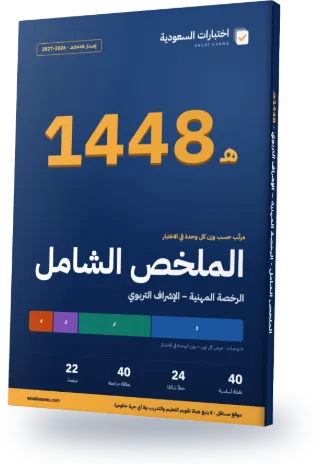
License – Educational Supervision Complete Review Guide 2026–2027
Every exam topic in a 22-page Arabic PDF, ordered from the heaviest unit to the lightest. The first three chapters alone cover about 88% of the exam questions.
- 22Pages
- 40Key points
- 24Common mistakes
- 40Flashcards
Guide map
Each chapter is one exam unit, ordered by its weight in the real exam.
| Chapter | Unit | Weight | Exam questions | Key points |
|---|---|---|---|---|
| 1 | Leadership and supervision | 41% | 31 | 10 |
| 2 | Supporting teaching and learning | 35% | 26 | 10 |
| 3 | Professional development | 12% | 9 | 10 |
| 4 | Values, professional ethics and communication skills | 12% | 9 | 10 |
Chapter 1 in full: Leadership and supervision
41% of the exam, about 31 questions. These are its key points, as in the guide.
- The guide's table gives the five standards 4, 6, 6, 9 and 6 questions (6.25.1 to 6.25.5).
- A strategic plan spans years and sets the vision and aims; the operational plan turns it into yearly programmes.
- In environmental analysis, opportunities and threats are external; strengths and weaknesses are internal.
The rest of chapter 1, on this page
- A remedial strategy uses an external opportunity to fix an internal weakness, as one of the guide's sample questions shows.
- Transformational leadership builds shared motivation through an inspiring mission and values centred on the common good.
- The clinical supervision cycle: pre-observation conference, observation, analysis, post-observation conference.
- Differentiated supervision matches the path to need: intensive for the novice, cooperative for capable peers, self-directed for the expert.
- Johari window: disclosure shrinks the hidden area and feedback shrinks the blind area, so the open area grows.
- Microteaching: a short teaching episode on one skill with a few students, then feedback and a re-teach.
- An effective conference starts with specific evidence, involves the teacher in the analysis and ends with one agreed goal.
Common mistakes in this chapter
- Giving the strategic plan the features of the operational plan (one year, visit dates, programme owners).
- Mixing up transformational leadership (an inspiring mission, shared values, focus on the end goal) with transactional leadership (reward for performance).
- Assuming circulars and formal authority are enough to change practice; the standard ties change to influence, persuasion and involvement.
- Rolling out a change to every school at once without a pilot or impact measure.
- Choosing a group method (a bulletin or general workshop) for one teacher's practical problem; the better fit is a visit with a conference before and after.
- Rating errors: the halo effect (one impression spreading to every item), central tendency, leniency and severity.
The other chapters are in the full guide
One purchase · lifetime access · review guide included
7-day review plan
The chapters are spread over 6 days by weight so each day carries a similar load. Day 7 is a full exam.
Day 1 · 41% of the exam
Chapter 1: Leadership and supervision
Day 2 · 35% of the exam
Chapter 2: Supporting teaching and learning
Day 3 · 12% of the exam
Chapter 3: Professional development
Day 4 · 12% of the exam
Chapter 4: Values, professional ethics and communication skills
Day 5
Full mock exam: 75 questions in 120 minutes, then review the common mistakes in the units where you lost marks.
How many correct answers do you need?
- Practitioner level 50%38 correct out of 75
- Advanced level 70%53 correct out of 75
- Expert level 80%60 correct out of 75
Before you read: see your score today
10 free questions from the main units, no sign-up. Then you know which chapter to start with.
Try 10 free questions and see your levelA look at each chapter
The first three key points of each chapter, as they appear in the guide (in Arabic in the PDF).
Chapter 1: Leadership and supervision
- The guide's table gives the five standards 4, 6, 6, 9 and 6 questions…
- A strategic plan spans years and sets the vision and aims; the operational plan…
- In environmental analysis, opportunities and threats are external; strengths and weaknesses are internal.
Chapter 2: Supporting teaching and learning
- The guide's table
- According to one of the guide's samples, a focus group is a discussion with…
- According to one of the guide's samples, the KWL strategy asks: what do I…
Chapter 3: Professional development
- The guide's table
- A delivery measure counts activities; an impact measure gauges the change they caused.
- The indicator names three feedback sources
Chapter 4: Values, professional ethics and communication skills
- The guide's table
- According to one of the guide's samples, scouts from Ministry staff and students serving…
- Before a programme run by outside volunteers, volunteer vetting and student-safety rules come before…
The full guide comes with lifetime access
The full guide (22 pages) is included with lifetime access to this exam, together with every question and full mock exam. Chapter 1 is free for everyone.
Questions about the guide
Is the guide free?
Chapter 1 is free to read on the guide page. The full guide comes with lifetime access to this exam; 7-day access does not include it.
Is it up to date for 2026–2027?
Yes. Unit weights and exam facts follow what the exam body last published, and the last check date is printed in the guide. If the standards change we update the file and buyers download the new version.
Does the guide have questions?
No. The guide covers key points and common mistakes; scoring, weak-area practice and full mock exams are on the site.
Can I read it on my phone?
Yes. A5 pages in a single column, with chapters linked from the contents.
- Pages
- 22
- Edition
- 1448 AH · 2026–2027
- Language
- Arabic
- Last updated
All Teacher Exams review guides
Back to Professional License – Subject Test: Educational Supervision
Buy this exam
Pick the access that lasts until your test date.
Included
- Full mock exams: 75 questions in 120 minutes, with a score for every unit
- 510 questions, every option explained with its source
- Practice that starts with your weakest units, plus a review of your mistakes
- Complete Review Guide 2026–2027 (PDF), with lifetime access only
Continue with your Google account and you go straight to the payment page.
You pay on the Waffo Pancake checkout page (in English). The amount is in US dollars and your bank converts it to riyals. One payment with no automatic renewal, by Visa, Mastercard (a mada card with either logo works too), Apple Pay or Google Pay. Your statement shows "WAFFO". Purchases are not refundable.