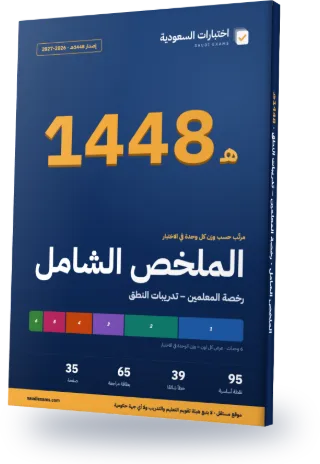
Teacher License – Speech Training Complete Review Guide 2026–2027
Every exam topic in a 35-page Arabic PDF, ordered from the heaviest unit to the lightest. The first three chapters alone cover about 69% of the exam questions.
- 35Pages
- 95Key points
- 39Common mistakes
- 65Flashcards
Guide map
Each chapter is one exam unit, ordered by its weight in the real exam.
| Chapter | Unit | Weight | Exam questions | Key points |
|---|---|---|---|---|
| 1 | Managing and Implementing Therapeutic Speech Plans | 29% | 26 | 15 |
| 2 | General Principles of Special Education | 25% | 22 | 18 |
| 3 | Planning Instruction in Special Education | 15% | 13 | 18 |
| 4 | Planning Speech Training | 13% | 11 | 14 |
| 5 | General Principles of Speech Disorders | 11% | 10 | 14 |
| 6 | Motivating and Supporting Learning in Special Education | 7% | 6 | 16 |
Chapter 1 in full: Managing and Implementing Therapeutic Speech Plans
29% of the exam, about 26 questions. These are its key points, as in the guide.
- A report includes student details, referral reason, history, tools, results, interpretation and recommendations.
- Scores are interpreted against age norms and by the disorder's effect on communication and learning.
- Intelligibility is the share of the child's speech a listener understands, and a key criterion for prioritising goals.
The rest of chapter 1, on this page
- Sounds that develop early or respond to stimulation are targeted before late-developing sounds.
- An individual plan has long-term goals and short-term objectives leading to them.
- A good goal states the behaviour, conditions and mastery criterion (such as 80% across 3 sessions).
- Auditory training teaches the child to hear the difference between correct and incorrect sound.
- Prompts are faded gradually until the child responds independently.
- For stuttering, techniques include easy onset, slowed speech and reducing tension.
- For voice disorders, therapy includes vocal hygiene: avoiding shouting and staying hydrated.
- For language disorders, modelling, expansion (extending the child's utterance) and recasting are used.
- Augmentative and alternative communication (AAC) is considered when functional speech is absent.
- Prognosis depends on age, severity, hearing, intelligence, family support and therapy attendance.
- The plan is reviewed periodically with data and adjusted if there is no progress.
- Training the family in short, regular home activities speeds generalisation.
Common mistakes in this chapter
- Starting with the hardest sounds instead of those affecting intelligibility where the child can succeed.
- Writing vague, unmeasurable goals such as "improves speech."
- Moving to conversation before mastering words and sentences.
- Neglecting generalisation outside the therapy room.
- Writing a report full of jargon the family cannot understand.
The other chapters are in the full guide
One purchase · lifetime access · review guide included
7-day review plan
The chapters are spread over 6 days by weight so each day carries a similar load. Day 7 is a full exam.
Day 1 · 29% of the exam
Chapter 1: Managing and Implementing Therapeutic Speech Plans
Day 2 · 25% of the exam
Chapter 2: General Principles of Special Education
Day 3 · 15% of the exam
Chapter 3: Planning Instruction in Special Education
Day 4 · 13% of the exam
Chapter 4: Planning Speech Training
Day 5 · 11% of the exam
Chapter 5: General Principles of Speech Disorders
Day 6 · 7% of the exam
Chapter 6: Motivating and Supporting Learning in Special Education
Before you read: see your score today
10 free questions from the main units, no sign-up. Then you know which chapter to start with.
Try 10 free questions and see your levelA look at each chapter
The first three key points of each chapter, as they appear in the guide (in Arabic in the PDF).
Chapter 1: Managing and Implementing Therapeutic Speech Plans
- A report includes student details, referral reason, history, tools, results, interpretation and recommendations.
- Scores are interpreted against age norms and by the disorder's effect on communication and…
- Intelligibility is the share of the child's speech a listener understands, and a key…
Chapter 2: General Principles of Special Education
- Groups served by special education usually include
- Inclusion places the student with a disability in the regular school with suitable support…
- The cascade of services, least to most restrictive
Chapter 3: Planning Instruction in Special Education
- Inclusive education
- Universal Access (UA)
- The multi-tiered system of supports (MTSS) has three tiers
Chapter 4: Planning Speech Training
- Screening procedures include teacher observation, checklists and a quick speech and hearing check.
- A positive screening result means referral for full assessment by a specialist.
- Case history covers pregnancy, birth, development, hearing and family.
Chapter 5: General Principles of Speech Disorders
- Babbling begins around 6 months, the first word around 12 months, and two-word combinations…
- By about age 3 a child uses short sentences and follows two-step directions; by…
- Receptive language develops ahead of expressive; understanding comes before production.
Chapter 6: Motivating and Supporting Learning in Special Education
- Consultation
- Collaboration
- Three well-known team models
The full guide comes with lifetime access
The full guide (35 pages) is included with lifetime access to this exam, together with every question and full mock exam. Chapter 1 is free for everyone.
Questions about the guide
Is the guide free?
Chapter 1 is free to read on the guide page. The full guide comes with lifetime access to this exam; 7-day access does not include it.
Is it up to date for 2026–2027?
Yes. Unit weights and exam facts follow what the exam body last published, and the last check date is printed in the guide. If the standards change we update the file and buyers download the new version.
Does the guide have questions?
No. The guide covers key points and common mistakes; scoring, weak-area practice and full mock exams are on the site.
Can I read it on my phone?
Yes. A5 pages in a single column, with chapters linked from the contents.
- Pages
- 35
- Edition
- 1448 AH · 2026–2027
- Language
- Arabic
- Last updated
All Teacher Exams review guides
Back to Teachers' Professional License – Subject Test: Special Education (Speech Training)
Buy this exam
Pick the access that lasts until your test date.
Included
- Timed supplementary practice sessions: 88 questions in 120 minutes
- 519 questions, every option explained with its source
- Practice that starts with your weakest units, plus a review of your mistakes
- Complete Review Guide 2026–2027 (PDF), with lifetime access only
Continue with your Google account and you go straight to the payment page.
You pay on the Waffo Pancake checkout page (in English). The amount is in US dollars and your bank converts it to riyals. One payment with no automatic renewal, by Visa, Mastercard (a mada card with either logo works too), Apple Pay or Google Pay. Your statement shows "WAFFO". Purchases are not refundable.