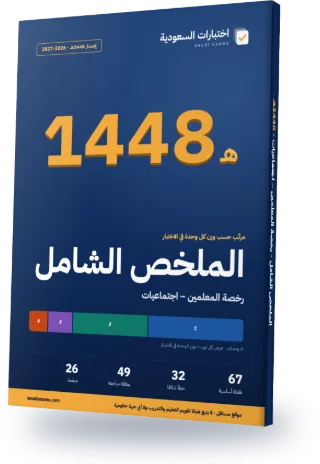
Teacher License – Social Studies Complete Review Guide 2026–2027
Every exam topic in a 26-page Arabic PDF, ordered from the heaviest unit to the lightest. The first three chapters alone cover about 91% of the exam questions.
- 26Pages
- 67Key points
- 32Common mistakes
- 49Flashcards
Guide map
Each chapter is one exam unit, ordered by its weight in the real exam.
| Chapter | Unit | Weight | Exam questions | Key points |
|---|---|---|---|---|
| 1 | Geography | 43% | 32 | 18 |
| 2 | History | 36% | 27 | 17 |
| 3 | Citizenship Education | 12% | 9 | 16 |
| 4 | Teaching Methods and the Curriculum | 9% | 7 | 16 |
Chapter 1 in full: Geography
43% of the exam, about 32 questions. These are its key points, as in the guide.
- Physical features of a place: landforms, climate, water, natural vegetation and soil. Human features: population, housing, roads and economic activities. (6.38.5-1)
- People are shaped by their environment in housing, food and work, and they change it through farming, building and industry. The effect can be positive, such as planting trees, or negative, such as pollution. (6.38.5-3)
- There are four cardinal directions: north, south, east and west, and four intermediate directions: northeast, northwest, southeast and southwest. (6.38.5-4)
The rest of chapter 1, on this page
- The eight planets in order from the Sun: Mercury, Venus, Earth, Mars, Jupiter, Saturn, Uranus, Neptune. Earth is the third. (6.38.6-2)
- Earth makes one full rotation (360 degrees) in about 24 hours, which is 15 degrees of longitude per hour, or one degree every 4 minutes. (6.38.6-3)
- The Equator is latitude 0 and divides Earth into northern and southern hemispheres. The Tropics of Cancer and Capricorn lie at about 23.5 degrees north and south, and the polar circles at 66.5. (6.38.6-4)
- The Greenwich meridian is longitude 0 (the prime meridian). Longitude is measured east and west of it up to 180. The farther east you go, the later the clock time. (6.38.6-4)
- Elements of weather and climate: temperature, air pressure, wind, humidity and rainfall. Temperature depends on latitude, altitude, distance from the sea and ocean currents. (6.38.6-5)
- Population growth has two parts: natural increase (births minus deaths) and net migration. Arithmetic density = population ÷ area. (6.38.7-1, 6.38.7-2)
- Settlement types are rural (villages and farms) and urban (cities). Common urban problems are traffic congestion, pollution and housing demand, and they are handled with urban planning and public transport. (6.38.7-3, 6.38.7-5)
- Economic activities: primary (farming, mining, fishing), secondary (manufacturing) and services (trade, transport, education, tourism). (6.38.7-4)
- Map elements: title, legend (key), scale and north arrow. A scale of 1:1,000,000 means 1 cm stands for 10 km. (6.38.8-1)
- Remote sensing collects information about Earth's surface without touching it, using sensors on satellites or aircraft. Geographic information systems store data in layers and analyse it, and are used in urban planning and resource management. (6.38.8-3, 6.38.8-4)
- Saudi Arabia lies in southwest Asia between roughly latitudes 16 and 32 north, with the Red Sea on the west and the Arabian Gulf on the east. (6.38.9-1)
- Landforms of Saudi Arabia: the Tihama coastal plain, the Sarawat mountains in the west (highest peaks in the south), the Najd plateau in the centre, the eastern plains, the Empty Quarter in the south and the Nafud in the north. (6.38.9-2)
- Most of the Kingdom has a hot desert continental climate, hot and dry in summer. The Asir highlands get summer rain, the north gets winter rain, and the coasts are more humid. (6.38.9-3)
- The Saq layer is the largest aquifer in the Kingdom. Storage dams mainly hold flood water and recharge groundwater; generating electricity is not their purpose. (6.38.9-5)
- Economic resources of the Kingdom include oil, gas, minerals, agriculture and fisheries. The 2022 census counted about 32.2 million residents. (6.38.9-4, 6.38.9-5)
Common mistakes in this chapter
- Mixing up weather and climate: weather is the state of the atmosphere at a given place and time; climate is the general average over many years.
- Mixing up rotation and revolution: day and night come from Earth spinning on its axis; the seasons come from its orbit around the Sun.
- Saying the seasons are caused by Earth being nearer to or farther from the Sun. The cause is the tilt of Earth's axis together with its revolution.
- Confusing parallels and meridians: parallels run side by side and differ in length; meridians meet at the poles and are all the same length.
- Confusing annual and perennial plants: in the guide's sample question lavender is the annual, while acacia (talh), boxthorn (awsaj) and salam are perennials.
- Population density is population divided by area, not the reverse, and the result is persons per square kilometre.
- Mixing up aerial photographs and satellite images: the first are taken from an aircraft at lower altitude, the second from a satellite orbiting Earth.
- With a 1:1,000,000 scale it is easy to forget the unit conversion: 1 cm on the map stands for 10 km on the ground.
The other chapters are in the full guide
One purchase · lifetime access · review guide included
7-day review plan
The chapters are spread over 6 days by weight so each day carries a similar load. Day 7 is a full exam.
Day 1 · 43% of the exam
Chapter 1: Geography
Day 2 · 36% of the exam
Chapter 2: History
Day 3 · 12% of the exam
Chapter 3: Citizenship Education
Day 4 · 9% of the exam
Chapter 4: Teaching Methods and the Curriculum
Day 5
Full mock exam: 75 questions in 120 minutes, then review the common mistakes in the units where you lost marks.
How many correct answers do you need?
- Practitioner level 50%38 correct out of 75
- Advanced level 70%53 correct out of 75
- Expert level 80%60 correct out of 75
Before you read: see your score today
10 free questions from the main units, no sign-up. Then you know which chapter to start with.
Try 10 free questions and see your levelA look at each chapter
The first three key points of each chapter, as they appear in the guide (in Arabic in the PDF).
Chapter 1: Geography
- Physical features of a place
- People are shaped by their environment in housing, food and work, and they change…
- There are four cardinal directions
Chapter 2: History
- The Hijri calendar starts from the Prophet's migration from Mecca to Medina in 622…
- The call in Mecca lasted about 13 years and in Medina 10 years; the…
- Effect of the campaigns
Chapter 3: Citizenship Education
- The Basic Law of Governance was issued by Royal Order No. A/90 on 27/8/1412H…
- The Kingdom of Saudi Arabia is a sovereign Arab Islamic state; its religion is…
- The system of rule is monarchy, based on justice, shura (consultation) and equality in…
Chapter 4: Teaching Methods and the Curriculum
- A teaching method is the set of procedures the teacher follows to reach the…
- The method is chosen by the nature of the subject, the learners' characteristics, and…
- Each method needs an activity that matches it, and carrying out that matching activity…
The full guide comes with lifetime access
The full guide (26 pages) is included with lifetime access to this exam, together with every question and full mock exam. Chapter 1 is free for everyone.
Questions about the guide
Is the guide free?
Chapter 1 is free to read on the guide page. The full guide comes with lifetime access to this exam; 7-day access does not include it.
Is it up to date for 2026–2027?
Yes. Unit weights and exam facts follow what the exam body last published, and the last check date is printed in the guide. If the standards change we update the file and buyers download the new version.
Does the guide have questions?
No. The guide covers key points and common mistakes; scoring, weak-area practice and full mock exams are on the site.
Can I read it on my phone?
Yes. A5 pages in a single column, with chapters linked from the contents.
- Pages
- 26
- Edition
- 1448 AH · 2026–2027
- Language
- Arabic
- Last updated
All Teacher Exams review guides
Back to Teachers' Professional License – Subject Test: Social Studies
Buy this exam
Pick the access that lasts until your test date.
Included
- Full mock exams: 75 questions in 120 minutes, with a score for every unit
- 425 questions, every option explained with its source
- Practice that starts with your weakest units, plus a review of your mistakes
- Complete Review Guide 2026–2027 (PDF), with lifetime access only
Continue with your Google account and you go straight to the payment page.
You pay on the Waffo Pancake checkout page (in English). The amount is in US dollars and your bank converts it to riyals. One payment with no automatic renewal, by Visa, Mastercard (a mada card with either logo works too), Apple Pay or Google Pay. Your statement shows "WAFFO". Purchases are not refundable.