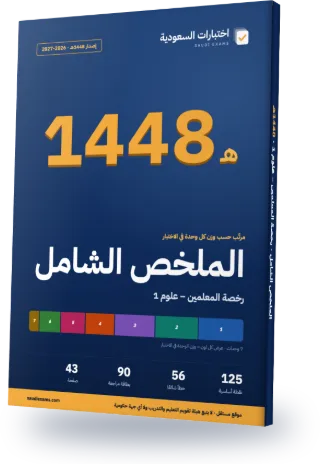
Teacher License – Science 1 Complete Review Guide 2026–2027
Every exam topic in a 43-page Arabic PDF, ordered from the heaviest unit to the lightest. The first three chapters alone cover about 59% of the exam questions.
- 43Pages
- 125Key points
- 56Common mistakes
- 90Flashcards
Guide map
Each chapter is one exam unit, ordered by its weight in the real exam.
| Chapter | Unit | Weight | Exam questions | Key points |
|---|---|---|---|---|
| 1 | Biology | 20% | 18 | 18 |
| 2 | Chemistry | 20% | 17 | 18 |
| 3 | Physics | 19% | 17 | 18 |
| 4 | Earth Science and Astronomy | 14% | 12 | 18 |
| 5 | Science Teaching | 12% | 11 | 17 |
| 6 | History, Nature and Integration of Science | 11% | 9 | 18 |
| 7 | Experimentation, Mathematical Skills and Data Representation | 5% | 4 | 18 |
Chapter 1 in full: Biology
20% of the exam, about 18 questions. These are its key points, as in the guide.
- Characteristics shared by all living things: nutrition, respiration, excretion, growth, reproduction, movement and response to stimuli (6.37.6.5).
- Photosynthesis takes place in chloroplasts: carbon dioxide + water + light gives glucose + oxygen (6CO₂ + 6H₂O → C₆H₁₂O₆ + 6O₂) (6.37.6.1).
- Cellular respiration releases energy from glucose in mitochondria, using oxygen and producing carbon dioxide and water (6.37.6.1).
The rest of chapter 1, on this page
- Path of blood: right atrium, right ventricle, lungs, left atrium, left ventricle, body (6.37.6.2).
- Protoplasm is the living material inside a cell (cytoplasm and nucleus). A tissue is a group of similar cells doing one job, then comes the organ, then the system (6.37.6.3).
- Plant and animal cells share a cell membrane, nucleus, cytoplasm and mitochondria; only plant cells have a cell wall and chloroplasts (6.37.6.4).
- Classification ranks from smallest to largest: species, genus, family, order, class, phylum, kingdom (6.37.7.1).
- A species is a group of organisms that can mate and produce fertile offspring. A scientific name has two parts: genus, then species (6.37.7.1).
- The five kingdoms: bacteria (monera), protists (such as amoeba, paramecium, spirogyra), fungi (such as yeast), plants and animals (6.37.7.2).
- Viruses are non-cellular: genetic material inside a protein coat, and they reproduce only inside a living host cell (6.37.7.3).
- An ecosystem has living parts (producers, consumers, decomposers) and non-living parts (light, water, air, soil, temperature). Levels: organism, population, community, ecosystem (6.37.8.1).
- Innate behavior is present from birth (such as migration and hibernation); learned behavior comes from experience, imitation or trial and error (6.37.8.4).
- A food chain starts with a producer (a plant or alga) followed by consumers; decomposers (bacteria and fungi) return nutrients to the soil (6.37.8.5).
- Human impacts on the environment include pollution, deforestation, overhunting and rising greenhouse gases (6.37.8.7).
- A gene is a section of DNA carrying the information for a trait; chromosomes are structures of DNA and protein in the nucleus. Humans have 46 chromosomes (23 pairs) (6.37.9.2).
- Mitosis: two identical cells for growth and repair. Meiosis: four cells with half the chromosomes, forming gametes (6.37.9.3).
- Females are XX and males XY, and the father determines the baby's sex. Hemophilia and color blindness are recessive and carried on the X chromosome (6.37.9.1).
- Complete metamorphosis: egg, larva, pupa, adult (butterfly). Incomplete: egg, nymph, adult (locust). A frog: egg, tadpole, adult (6.37.9.5).
Common mistakes in this chapter
- Chemical digestion of protein (such as red meat) begins in the stomach with pepsin, starch digestion begins in the mouth, and fat digestion in the small intestine. Chewing is mechanical digestion, not chemical.
- Breathing (gas exchange in the lungs) is not cellular respiration (releasing energy from food inside cells). They are linked, but they are different processes.
- The left ventricle pumps oxygen-rich blood to the whole body; the right ventricle pumps oxygen-poor blood to the lungs only. Do not swap the sides.
- Plant cells have a cell wall, chloroplasts and a large central vacuole; animal cells have none of these. Mitochondria and a nucleus are found in both.
- Commensalism (+/0) benefits one partner while the other is unaffected, as with a remora and a shark. Mutualism benefits both, and parasitism benefits one and harms the other.
- Only about 10% of energy passes from one trophic level to the next, and it flows in one direction. The arrow in a food chain points to the eater, from the food to the consumer.
- Mitosis gives two identical cells with the same chromosome number; meiosis gives four cells with half the number. Do not mix them up or their purposes.
- An acquired trait (a scar, strong muscles, a language) is not passed to children, while an inherited trait (such as eye color) is passed through genes. Sex-linked conditions are more common in males.
The other chapters are in the full guide
One purchase · lifetime access · review guide included
7-day review plan
The chapters are spread over 6 days by weight so each day carries a similar load. Day 7 is a full exam.
Day 1 · 20% of the exam
Chapter 1: Biology
Day 2 · 20% of the exam
Chapter 2: Chemistry
Day 3 · 19% of the exam
Chapter 3: Physics
Day 4 · 14% of the exam
Chapter 4: Earth Science and Astronomy
Day 5 · 12% of the exam
Chapter 5: Science Teaching
Day 6 · 16% of the exam
Chapter 6: History, Nature and Integration of Science
Chapter 7: Experimentation, Mathematical Skills and Data RepresentationDay 7
Full mock exam: 88 questions in 120 minutes, then review the common mistakes in the units where you lost marks.
How many correct answers do you need?
- Practitioner level 50%44 correct out of 88
- Advanced level 70%62 correct out of 88
- Expert level 80%71 correct out of 88
Before you read: see your score today
10 free questions from the main units, no sign-up. Then you know which chapter to start with.
Try 10 free questions and see your levelA look at each chapter
The first three key points of each chapter, as they appear in the guide (in Arabic in the PDF).
Chapter 1: Biology
- Characteristics shared by all living things
- Photosynthesis takes place in chloroplasts
- Cellular respiration releases energy from glucose in mitochondria, using oxygen and producing carbon dioxide…
Chapter 2: Chemistry
- Matter is anything that has mass and takes up space, and it commonly exists…
- A physical change forms no new substance (melting, evaporation, dissolving, tearing), while a chemical…
- A mixture is two or more substances that are not chemically bonded. A homogeneous…
Chapter 3: Physics
- Distance is a scalar and displacement is a vector; average speed = distance ÷…
- Newton's laws
- Friction opposes motion between surfaces in contact and grows with rougher surfaces and larger…
Chapter 4: Earth Science and Astronomy
- The solar system consists of the Sun, eight planets (Mercury, Venus, Earth, Mars, Jupiter…
- The four inner planets are rocky (terrestrial)
- Earth's axis is tilted 23.5° from the perpendicular to its orbital plane. The hemisphere…
Chapter 5: Science Teaching
- Learner-centered learning
- Scientific literacy
- STS links science with society and technology; STEM integrates science, technology, engineering and mathematics…
Chapter 6: History, Nature and Integration of Science
- Science is organized knowledge built through observation and experiment. Its aims are to describe…
- Characteristics of science
- A scientific fact is a confirmed observation that observers agree on, for example that…
Chapter 7: Experimentation, Mathematical Skills and Data Representation
- Common safety equipment
- Warning symbols
- A safety data sheet (SDS) gives a substance's properties, hazards, storage, first aid and…
The full guide comes with lifetime access
The full guide (43 pages) is included with lifetime access to this exam, together with every question and full mock exam. Chapter 1 is free for everyone.
Questions about the guide
Is the guide free?
Chapter 1 is free to read on the guide page. The full guide comes with lifetime access to this exam; 7-day access does not include it.
Is it up to date for 2026–2027?
Yes. Unit weights and exam facts follow what the exam body last published, and the last check date is printed in the guide. If the standards change we update the file and buyers download the new version.
Does the guide have questions?
No. The guide covers key points and common mistakes; scoring, weak-area practice and full mock exams are on the site.
Can I read it on my phone?
Yes. A5 pages in a single column, with chapters linked from the contents.
- Pages
- 43
- Edition
- 1448 AH · 2026–2027
- Language
- Arabic
- Last updated
All Teacher Exams review guides
Back to Teachers' Professional License – Subject Test: Science 1
Buy this exam
Pick the access that lasts until your test date.
Included
- Full mock exams: 88 questions in 120 minutes, with a score for every unit
- 465 questions, every option explained with its source
- Practice that starts with your weakest units, plus a review of your mistakes
- Complete Review Guide 2026–2027 (PDF), with lifetime access only
Continue with your Google account and you go straight to the payment page.
You pay on the Waffo Pancake checkout page (in English). The amount is in US dollars and your bank converts it to riyals. One payment with no automatic renewal, by Visa, Mastercard (a mada card with either logo works too), Apple Pay or Google Pay. Your statement shows "WAFFO". Purchases are not refundable.