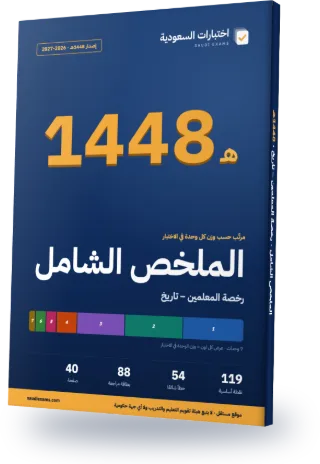
Teacher License – History Complete Review Guide 2026–2027
Every exam topic in a 40-page Arabic PDF, ordered from the heaviest unit to the lightest. The first three chapters alone cover about 77% of the exam questions.
- 40Pages
- 119Key points
- 54Common mistakes
- 88Flashcards
Guide map
Each chapter is one exam unit, ordered by its weight in the real exam.
| Chapter | Unit | Weight | Exam questions | Key points |
|---|---|---|---|---|
| 1 | Islamic History | 27% | 24 | 17 |
| 2 | History Skills and Teaching Methods | 27% | 24 | 17 |
| 3 | Saudi History | 23% | 20 | 18 |
| 4 | Prophets' History and Ancient History | 10% | 9 | 17 |
| 5 | Medieval to Modern World History | 5% | 4 | 17 |
| 6 | Modern Arab History | 5% | 4 | 17 |
| 7 | Development of History as a Discipline | 3% | 3 | 16 |
Chapter 1 in full: Islamic History
27% of the exam, about 24 questions. These are its key points, as in the guide.
- The Prophet ﷺ received the revelation in Mecca at the age of forty. The call was secret for about three years and then made public.
- The Hijra to Medina took place in 1 AH/622 CE. The Hijri calendar starts from it and was adopted later under Umar ibn al-Khattab.
- The Prophet's first steps in Medina: building the Prophet's Mosque, the brotherhood between the Emigrants and the Helpers, and the charter that organised relations among the people of Medina.
The rest of chapter 1, on this page
- Badr 2 AH/624 CE, Uhud 3 AH/625 CE, the Trench (al-Ahzab) 5 AH/627 CE, the Treaty of Hudaybiyyah 6 AH/628 CE, the conquest of Mecca 8 AH/630 CE, the Prophet's death 11 AH/632 CE.
- After the Treaty of Hudaybiyyah the Prophet ﷺ sent letters to kings and rulers inviting them to Islam.
- Abu Bakr al-Siddiq, 11–13 AH/632–634 CE: he led the Ridda wars, and the Quran was collected in his time after the Battle of Yamama.
- Umar ibn al-Khattab, 13–23 AH/634–644 CE: he set up the diwans, dated the calendar from the Hijra, and his reign saw Qadisiyyah, Yarmouk and the conquests of Jerusalem and Egypt.
- Uthman ibn Affan, 23–35 AH/644–656 CE: he unified the codices on one text, and the first Muslim navy was built in his reign (Battle of Dhat al-Sawari, 34 AH/655 CE).
- Ali ibn Abi Talib, 35–40 AH/656–661 CE, with Kufa as his seat. The period of the Rightly Guided Caliphs ends with his reign.
- The Umayyad state, 41–132 AH/661–750 CE: founded by Muawiya ibn Abi Sufyan, capital Damascus. Its last caliph was Marwan ibn Muhammad, and it fell after the Battle of the Zab (132 AH).
- Abd al-Malik ibn Marwan Arabised the diwans and struck the Islamic dinar (around 77 AH/696 CE). Under al-Walid ibn Abd al-Malik the conquests reached their widest extent, including al-Andalus in 92 AH/711 CE.
- The hijaba under the Umayyads: the post of the hajib, who controlled access to the caliph, introduced to protect the caliph.
- The Abbasid state, 132–656 AH/750–1258 CE: it replaced the Umayyads, al-Mansur founded Baghdad in 145 AH/762 CE, and civilisation peaked under Harun al-Rashid and al-Ma'mun (the House of Wisdom and translation).
- The vizierate in the early Abbasid period: the vizier was the caliph's chief aide, his powers grew under the Barmakids, and the office was later divided into delegated and executive vizierates.
- Dynasties became independent of Baghdad, among them the Umayyads in al-Andalus (138 AH/756 CE), the Fatimids (297 AH/909 CE), the Buyids and the Seljuks. The Seljuks defeated the Byzantines at Manzikert in 463 AH/1071 CE.
- The Crusades: the First Crusade began in 1095 CE and Jerusalem fell in 492 AH/1099 CE. The Muslims regained it after Hattin in 583 AH/1187 CE under Saladin al-Ayyubi, and the Crusader presence ended with the fall of Acre in 690 AH/1291 CE under the Mamluks.
- The Mongols under Hulagu took Baghdad in 656 AH/1258 CE. The Mamluks stopped their advance at Ain Jalut in 658 AH/1260 CE under Qutuz, with Baybars taking part.
Common mistakes in this chapter
- Mixing up the dates of the battles: Badr 2, Uhud 3, the Trench 5, Hudaybiyyah 6. Put them in order before you answer.
- Confusing the collection of the Quran under Abu Bakr (into one codex) with the unification of the codices under Uthman (standard copies sent to the provinces).
- Attributing the diwans and the Hijri calendar to Umar, and the Arabisation of the diwans and the Islamic coinage to Abd al-Malik. An option that swaps the two is wrong.
- Confusing the Umayyad capital (Damascus) with the Abbasid capital (Baghdad, with a short period at Samarra), and the Abbasids in the East with the Umayyads in al-Andalus.
- Confusing the Crusades (from Western Europe, from 1095 CE) with the Mongol invasion (from the East, Baghdad in 1258 CE). Each has different motives, battles and results.
- Confusing Hattin (583 AH, against the Crusaders, led by Saladin) with Ain Jalut (658 AH, against the Mongols, led by Qutuz and Baybars).
- Treating the Ayyubids and the Mamluks as one state. The Ayyubid state was founded in 567 AH by Saladin, the Mamluk state in 648 AH.
- Confusing the Battle of Tours (114 AH/732 CE, in France) with the conquest of al-Andalus (92 AH/711 CE, led by Tariq ibn Ziyad).
The other chapters are in the full guide
One purchase · lifetime access · review guide included
7-day review plan
The chapters are spread over 6 days by weight so each day carries a similar load. Day 7 is a full exam.
Day 1 · 27% of the exam
Chapter 1: Islamic History
Day 2 · 27% of the exam
Chapter 2: History Skills and Teaching Methods
Day 3 · 23% of the exam
Chapter 3: Saudi History
Day 4 · 10% of the exam
Chapter 4: Prophets' History and Ancient History
Day 5 · 8% of the exam
Chapter 5: Medieval to Modern World History
Chapter 7: Development of History as a DisciplineDay 6 · 5% of the exam
Chapter 6: Modern Arab History
Day 7
Full mock exam: 88 questions in 120 minutes, then review the common mistakes in the units where you lost marks.
How many correct answers do you need?
- Practitioner level 50%44 correct out of 88
- Advanced level 70%62 correct out of 88
- Expert level 80%71 correct out of 88
Before you read: see your score today
10 free questions from the main units, no sign-up. Then you know which chapter to start with.
Try 10 free questions and see your levelA look at each chapter
The first three key points of each chapter, as they appear in the guide (in Arabic in the PDF).
Chapter 1: Islamic History
- The Prophet ﷺ received the revelation in Mecca at the age of forty. The…
- The Hijra to Medina took place in 1 AH/622 CE. The Hijri calendar starts…
- The Prophet's first steps in Medina
Chapter 2: History Skills and Teaching Methods
- The unit follows five professional standards
- A historical fact can be verified with evidence (an event happened on a given…
- Analysing a historical document means looking for hidden assumptions, bias and whether the evidence…
Chapter 3: Saudi History
- Before the First State, Najd was split into separate emirates and towns with political…
- The First Saudi State was founded in Diriyah in 1139 AH/1727 CE by Imam…
- Founding Day, 22 February, was set by royal order in 2022 to commemorate the…
Chapter 4: Prophets' History and Ancient History
- A prophet receives revelation without being commanded to convey a new law to opposing…
- Allah created Adam from clay by His hand, breathed into him of His spirit…
- Nuh was the first messenger sent to the people of the earth, and one…
Chapter 5: Medieval to Modern World History
- The European Middle Ages begin with the fall of the Western Roman Empire in…
- The feudal system
- The Catholic Church held wide religious and political authority in Western Europe during the…
Chapter 6: Modern Arab History
- The Arab world extends from the Atlantic Ocean in the west to the Arabian…
- Sultan Selim I added the Levant and Egypt to the Ottoman state after the…
- Napoleon's campaign in Egypt (1798) was the first direct clash of the modern Arab…
Chapter 7: Development of History as a Discipline
- History studies the human past, including its events and the development of societies and…
- The appearance of writing separates prehistory (before writing) from the historic periods (after writing);…
- The common periodisation is ancient, medieval and modern; historians devised it to organise study…
The full guide comes with lifetime access
The full guide (40 pages) is included with lifetime access to this exam, together with every question and full mock exam. Chapter 1 is free for everyone.
Questions about the guide
Is the guide free?
Chapter 1 is free to read on the guide page. The full guide comes with lifetime access to this exam; 7-day access does not include it.
Is it up to date for 2026–2027?
Yes. Unit weights and exam facts follow what the exam body last published, and the last check date is printed in the guide. If the standards change we update the file and buyers download the new version.
Does the guide have questions?
No. The guide covers key points and common mistakes; scoring, weak-area practice and full mock exams are on the site.
Can I read it on my phone?
Yes. A5 pages in a single column, with chapters linked from the contents.
- Pages
- 40
- Edition
- 1448 AH · 2026–2027
- Language
- Arabic
- Last updated
All Teacher Exams review guides
Back to Teachers' Professional License – Subject Test: History
Buy this exam
Pick the access that lasts until your test date.
Included
- Full mock exams: 88 questions in 120 minutes, with a score for every unit
- 456 questions, every option explained with its source
- Practice that starts with your weakest units, plus a review of your mistakes
- Complete Review Guide 2026–2027 (PDF), with lifetime access only
Continue with your Google account and you go straight to the payment page.
You pay on the Waffo Pancake checkout page (in English). The amount is in US dollars and your bank converts it to riyals. One payment with no automatic renewal, by Visa, Mastercard (a mada card with either logo works too), Apple Pay or Google Pay. Your statement shows "WAFFO". Purchases are not refundable.