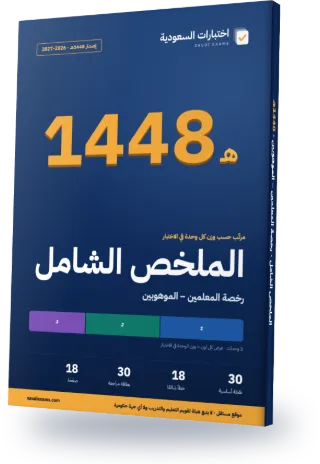
Teacher License – Gifted Complete Review Guide 2026–2027
Every exam topic in a 18-page Arabic PDF, ordered from the heaviest unit to the lightest. The first three chapters alone cover about 100% of the exam questions.
- 18Pages
- 30Key points
- 18Common mistakes
- 30Flashcards
Guide map
Each chapter is one exam unit, ordered by its weight in the real exam.
| Chapter | Unit | Weight | Exam questions | Key points |
|---|---|---|---|---|
| 1 | Planning Instruction | 37% | 32 | 10 |
| 2 | Motivating and Supporting Learning | 35% | 31 | 10 |
| 3 | Structure of Giftedness and Talent | 28% | 25 | 10 |
Chapter 1 in full: Planning Instruction
37% of the exam, about 32 questions. These are its key points, as in the guide.
- A twice-exceptional student is gifted with a co-occurring disability or learning difficulty that can mask the gift.
- Identification goes from nomination to screening, then individual assessment, then the decision.
- Criterion-referenced tests interpret a student's performance against a set standard, not against peers.
The rest of chapter 1, on this page
- The Stanford-Binet and the Wechsler scales are common individual intelligence tests.
- The Iowa Acceleration Scale weighs academic, developmental, social, family and school factors before an acceleration decision.
- Curriculum compacting: a pre-test frees the student from what he has mastered, and the time goes to enrichment or acceleration.
- Renzulli's Enrichment Triad: general exploratory activities, then training in thinking and research skills, then individual or group investigation of real problems.
- The Parallel Curriculum has four parallels: core, connections, practice and identity.
- Modifying the learning environment: choice of resources, learning centres, deferring judgement on ideas, and encouraging independence and openness.
- Mentorship pairs a student with an expert in his field of interest who guides him through real work.
Common mistakes in this chapter
- Requiring high scores on every criterion at once: it excludes twice-exceptional students and underachievers; multiple criteria are meant to widen identification.
- Translating a foreign test and keeping its original norms: better to use non-verbal tools, local norms and several kinds of evidence.
- Confusing acceleration with enrichment: acceleration changes the pace or grade placement, while enrichment deepens and widens learning without moving the student.
- Deciding on grade skipping from one IQ score or age alone: a systematic decision uses a multi-factor tool such as the Iowa Acceleration Scale.
- Treating "more of the same work" as enrichment: real enrichment changes depth and level of thinking, not the amount of work.
- Mixing up the curriculum dimensions: content is what the student learns, process how he thinks, product what he produces, environment where and how he learns.
The other chapters are in the full guide
One purchase · lifetime access · review guide included
7-day review plan
The chapters are spread over 6 days by weight so each day carries a similar load. Day 7 is a full exam.
Day 1 · 37% of the exam
Chapter 1: Planning Instruction
Day 2 · 35% of the exam
Chapter 2: Motivating and Supporting Learning
Day 3 · 28% of the exam
Chapter 3: Structure of Giftedness and Talent
Day 4
Full mock exam: 88 questions in 120 minutes, then review the common mistakes in the units where you lost marks.
How many correct answers do you need?
- Practitioner level 50%44 correct out of 88
- Advanced level 70%62 correct out of 88
- Expert level 80%71 correct out of 88
Before you read: see your score today
10 free questions from the main units, no sign-up. Then you know which chapter to start with.
Try 10 free questions and see your levelA look at each chapter
The first three key points of each chapter, as they appear in the guide (in Arabic in the PDF).
Chapter 1: Planning Instruction
- A twice-exceptional student is gifted with a co-occurring disability or learning difficulty that can…
- Identification goes from nomination to screening, then individual assessment, then the decision.
- Criterion-referenced tests interpret a student's performance against a set standard, not against peers.
Chapter 2: Motivating and Supporting Learning
- Bloom's higher levels
- De Bono's six hats
- Creative thinking skills
Chapter 3: Structure of Giftedness and Talent
- Renzulli's three rings
- Gagné's model separates gifts (potential) from talents (performance), linked by development and personal and…
- Terman ran a famous longitudinal study that followed high-IQ children into adulthood.
The full guide comes with lifetime access
The full guide (18 pages) is included with lifetime access to this exam, together with every question and full mock exam. Chapter 1 is free for everyone.
Questions about the guide
Is the guide free?
Chapter 1 is free to read on the guide page. The full guide comes with lifetime access to this exam; 7-day access does not include it.
Is it up to date for 2026–2027?
Yes. Unit weights and exam facts follow what the exam body last published, and the last check date is printed in the guide. If the standards change we update the file and buyers download the new version.
Does the guide have questions?
No. The guide covers key points and common mistakes; scoring, weak-area practice and full mock exams are on the site.
Can I read it on my phone?
Yes. A5 pages in a single column, with chapters linked from the contents.
- Pages
- 18
- Edition
- 1448 AH · 2026–2027
- Language
- Arabic
- Last updated
All Teacher Exams review guides
Back to Teachers' Professional License – Subject Test: Gifted Education
Buy this exam
Pick the access that lasts until your test date.
Included
- Timed supplementary practice sessions: 88 questions in 120 minutes
- 510 questions, every option explained with its source
- Practice that starts with your weakest units, plus a review of your mistakes
- Complete Review Guide 2026–2027 (PDF), with lifetime access only
Continue with your Google account and you go straight to the payment page.
You pay on the Waffo Pancake checkout page (in English). The amount is in US dollars and your bank converts it to riyals. One payment with no automatic renewal, by Visa, Mastercard (a mada card with either logo works too), Apple Pay or Google Pay. Your statement shows "WAFFO". Purchases are not refundable.