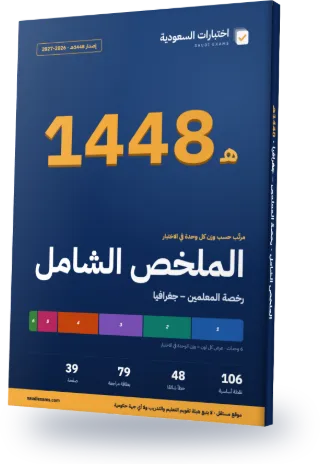
Teacher License – Geography Complete Review Guide 2026–2027
Every exam topic in a 39-page Arabic PDF, ordered from the heaviest unit to the lightest. The first three chapters alone cover about 66% of the exam questions.
- 39Pages
- 106Key points
- 48Common mistakes
- 79Flashcards
Guide map
Each chapter is one exam unit, ordered by its weight in the real exam.
| Chapter | Unit | Weight | Exam questions | Key points |
|---|---|---|---|---|
| 1 | Geographic Skills, Research Methods, Teaching and Learning Resources | 23% | 20 | 18 |
| 2 | Human Geography | 22% | 19 | 18 |
| 3 | Physical Geography | 21% | 18 | 18 |
| 4 | Regional Geography | 20% | 18 | 18 |
| 5 | Cartography and Geographic Information Technology | 10% | 9 | 18 |
| 6 | Geographic Theory, Its Development and Branches | 4% | 4 | 16 |
Chapter 1 in full: Geographic Skills, Research Methods, Teaching and Learning Resources
23% of the exam, about 20 questions. These are its key points, as in the guide.
- Aims of teaching geography include understanding the human-environment relationship, developing geographic skills, linking phenomena to their spatial distribution, and building awareness of environmental and development issues (6.12.19.1).
- Regional approach: studying a defined region and its natural and human phenomena and how they relate (6.12.19.3).
- Systematic (topical) approach: studying one phenomenon, such as climate, relief or population, with its distribution and controlling factors (6.12.19.3).
The rest of chapter 1, on this page
- The quantitative approach uses numerical data and statistical methods to describe and explain a phenomenon. Field study collects data from the real setting by observation, measurement, interview and questionnaire (6.12.19.3).
- Arithmetic mean = sum of values ÷ number of values. The median is the middle value after ordering. The mode is the most frequent value (6.12.19.3).
- Standard deviation measures how spread the values are around the mean: the smaller it is, the closer the values sit to it. The correlation coefficient measures the strength and direction of a relationship between two variables and ranges from -1 to +1 (6.12.19.3).
- Discovery learning suits gifted students because it lets them link several ideas and notice patterns themselves (6.12.20.1).
- Modern strategies that centre the learner include cooperative learning, problem solving, inquiry, role play, brainstorming, concept maps and the flipped classroom (6.12.20.4).
- A well-formed behavioural objective has four ABCD parts: Audience, Behaviour, Condition and Degree (6.12.20.3).
- The revised Bloom levels from lowest to highest: remember, understand, apply, analyse, evaluate, create (6.12.20.3).
- With students who have learning difficulties: split the task into small steps, use visual and hands-on aids, repeat explanations and give immediate feedback (6.12.20.6).
- Primary sources gather data directly from reality (field study, census, interview); secondary sources rely on data gathered by others (books, articles, atlas) (6.12.21.1).
- Learning resources in geography include the atlas, globe, models, digital maps, Google Earth and field trips. Choose the one that fits the objective and the lesson (6.12.21.2).
- Core geographic skills include reading and drawing maps, finding directions, measuring distances, reading charts and tables, field observation and spatial thinking (6.12.22.1).
- Map skills: reading the legend, using the scale to calculate distance, locating places by longitude and latitude, and interpreting contour lines (6.12.22.5).
- The four curriculum elements: objectives, content, teaching methods and activities, and assessment (6.12.23.1).
- Types of curriculum organisation include separate subjects, correlated subjects, fused subjects, broad fields and the core curriculum. In spiral organisation a topic returns in later grades in greater depth (6.12.23.1).
- The scope and sequence matrix is a table showing which geography topics are taught (scope) and their order across grades (sequence) (6.12.23.3).
Common mistakes in this chapter
- Scope is the breadth and depth of content within one stage; sequence is its order across grades. Do not swap them.
- The regional approach studies one region with all its phenomena; the systematic approach studies one phenomenon (such as climate or population) across wider space. They are often confused.
- The mean is affected by extreme values and the median is not, so the median suits data with an outlier. Standard deviation measures spread, not central tendency.
- A correlation between two phenomena does not mean one causes the other. The coefficient describes only the strength and direction of the relationship.
- A modern strategy puts the learner at the centre. An option built on teacher lecturing alone does not meet indicator 6.12.20.4, even if it is acceptable elsewhere.
- A behavioural objective states what the student will do and can be measured (identifies, compares). Verbs such as "understands" and "knows" are too general to measure directly.
- A primary source comes from whoever observed the phenomenon or collected the data directly (field study, census); a secondary source builds on it (textbook, article). A photo or map is classified by who produced it and how.
- The curriculum is not just the textbook. The textbook is one tool; the curriculum includes objectives, content, methods and assessment.
The other chapters are in the full guide
One purchase · lifetime access · review guide included
7-day review plan
The chapters are spread over 6 days by weight so each day carries a similar load. Day 7 is a full exam.
Day 1 · 23% of the exam
Chapter 1: Geographic Skills, Research Methods, Teaching and Learning Resources
Day 2 · 22% of the exam
Chapter 2: Human Geography
Day 3 · 21% of the exam
Chapter 3: Physical Geography
Day 4 · 20% of the exam
Chapter 4: Regional Geography
Day 5 · 10% of the exam
Chapter 5: Cartography and Geographic Information Technology
Day 6 · 4% of the exam
Chapter 6: Geographic Theory, Its Development and Branches
Day 7
Full mock exam: 88 questions in 120 minutes, then review the common mistakes in the units where you lost marks.
How many correct answers do you need?
- Practitioner level 50%44 correct out of 88
- Advanced level 70%62 correct out of 88
- Expert level 80%71 correct out of 88
Before you read: see your score today
10 free questions from the main units, no sign-up. Then you know which chapter to start with.
Try 10 free questions and see your levelA look at each chapter
The first three key points of each chapter, as they appear in the guide (in Arabic in the PDF).
Chapter 1: Geographic Skills, Research Methods, Teaching and Learning Resources
- Aims of teaching geography include understanding the human-environment relationship, developing geographic skills, linking phenomena…
- Regional approach
- Systematic (topical) approach
Chapter 2: Human Geography
- Population geography studies the number, distribution, composition, growth and migration of people and how…
- The Northern Hemisphere has more people because it has more land, and Asia is…
- Population growth has three components
Chapter 3: Physical Geography
- The Earth turns once on its axis in about 24 hours, producing day and…
- The globe spans 360 degrees of longitude, so one hour equals 15 degrees and…
- Geomorphology is the science of the Earth's surface landforms, and it draws on geology…
Chapter 4: Regional Geography
- The Arab world spans Asia and Africa, from the Atlantic Ocean in the west…
- Landforms include the Atlas mountains in north-west Africa, the Zagros in Iran, the Taurus…
- The Nile flows north through Sudan and Egypt to the Mediterranean. The Tigris and…
Chapter 5: Cartography and Geographic Information Technology
- A map is a reduced representation of the Earth's surface, or part of it…
- Maps are classified by scale (large and small), and by purpose and content (general…
- Paper maps are made by collecting data, designing, drawing and printing; digital maps keep…
Chapter 6: Geographic Theory, Its Development and Branches
- The word geography comes from Greek
- Eratosthenes (3rd century BC) used the term geography for an independent science (indicator 1).
- Definitions of geography differ by viewpoint
The full guide comes with lifetime access
The full guide (39 pages) is included with lifetime access to this exam, together with every question and full mock exam. Chapter 1 is free for everyone.
Questions about the guide
Is the guide free?
Chapter 1 is free to read on the guide page. The full guide comes with lifetime access to this exam; 7-day access does not include it.
Is it up to date for 2026–2027?
Yes. Unit weights and exam facts follow what the exam body last published, and the last check date is printed in the guide. If the standards change we update the file and buyers download the new version.
Does the guide have questions?
No. The guide covers key points and common mistakes; scoring, weak-area practice and full mock exams are on the site.
Can I read it on my phone?
Yes. A5 pages in a single column, with chapters linked from the contents.
- Pages
- 39
- Edition
- 1448 AH · 2026–2027
- Language
- Arabic
- Last updated
All Teacher Exams review guides
Back to Teachers' Professional License – Subject Test: Geography
Buy this exam
Pick the access that lasts until your test date.
Included
- Full mock exams: 88 questions in 120 minutes, with a score for every unit
- 484 questions, every option explained with its source
- Practice that starts with your weakest units, plus a review of your mistakes
- Complete Review Guide 2026–2027 (PDF), with lifetime access only
Continue with your Google account and you go straight to the payment page.
You pay on the Waffo Pancake checkout page (in English). The amount is in US dollars and your bank converts it to riyals. One payment with no automatic renewal, by Visa, Mastercard (a mada card with either logo works too), Apple Pay or Google Pay. Your statement shows "WAFFO". Purchases are not refundable.