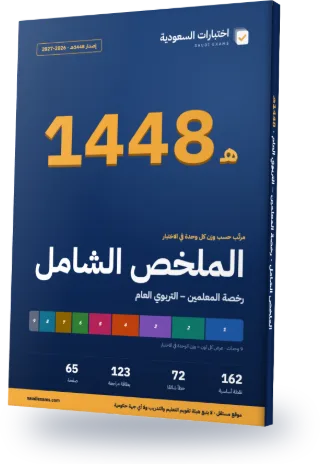
Teacher License – General Complete Review Guide 2026–2027
Every exam topic in a 65-page Arabic PDF, ordered from the heaviest unit to the lightest. The first three chapters alone cover about 47% of the exam questions.
- 65Pages
- 162Key points
- 72Common mistakes
- 123Flashcards
Guide map
Each chapter is one exam unit, ordered by its weight in the real exam.
| Chapter | Unit | Weight | Exam questions | Key points |
|---|---|---|---|---|
| 1 | Language and Quantitative Skills | 17% | 15 | 20 |
| 2 | Knowing Learners and How They Learn | 15% | 13 | 18 |
| 3 | Planning and Delivering Instruction | 15% | 13 | 18 |
| 4 | Assessment | 13% | 12 | 18 |
| 5 | Interactive and Supportive Learning Environments | 11% | 10 | 18 |
| 6 | Islamic Values, Professional Ethics and National Identity | 8% | 7 | 17 |
| 7 | Professional Interaction with Educators and the Community | 8% | 7 | 17 |
| 8 | General Teaching Methods | 8% | 7 | 18 |
| 9 | Continuous Professional Development | 5% | 4 | 18 |
Chapter 1 in full: Language and Quantitative Skills
17% of the exam, about 15 questions. These are its key points, as in the guide.
- A fact can be verified by observation, statistics or sources, e.g. 'Makkah is in Saudi Arabia'. An opinion is a personal judgment people may disagree on, signalled by words such as I think, I believe, the best, the most beautiful, should. A good writer supports an opinion with arguments and evidence.
- The general idea is what the whole text is about and could serve as its title; sub-ideas develop it. Explicit sub-ideas are stated in the paragraphs, and implicit ones are inferred from context without being stated.
- Text types by structure: narrative presents events in time order, as in a story or biography; descriptive paints a picture of a person or place; expository (informative) defines a phenomenon and explains its causes and effects objectively; argumentative (persuasive) states a thesis, supports it with arguments and evidence, and answers opposing views to persuade the reader.
The rest of chapter 1, on this page
- Hamzat al-wasl is pronounced only at the start of speech and drops in connected speech. It occurs in the past, imperative and verbal noun of five- and six-letter verbs (intasara, intisar, istakhraja, istikhraj), the imperative of three-letter verbs (uktub), certain nouns such as ibn, ibna, ism, ithnan, ithnatan, imru', imra'a, and the definite article al-. Hamzat al-qat' is always pronounced: in the three-letter past verb and its verbal noun (akhadha, akhdh), the four-letter verb's past, imperative and verbal noun (akrama, akrim, ikram), the present verb with the first-person hamza (aktubu), all other nouns (Ahmad, ab) and all particles except al- (inna, ila).
- Final soft alif: in three-letter words, go back to the root letter. If it is waw, write a standing alif (da'a/yad'u, 'asa/'asawan); if it is ya', write alif maqsura (hada/yahdi, fata/fatayan). In words longer than three letters write alif maqsura (a'ta, mustashfa) unless a ya' comes before it, then write a standing alif (ahya, dunya). Ta' marbuta is pronounced as ha' when you pause (madrasa, qudat); ta' maftuha stays ta' when you pause and appears in verbs (katabat), sound feminine plurals (mu'allimat) and nouns whose ta' is part of the root (bayt, sawt).
- Numbers and the counted noun: 1 and 2 agree with the noun and follow it (kitab wahid, qissatan ithnatan); 3 to 10 take the opposite gender of the singular noun, which comes as a genitive plural (thalathat kutub, thalath qisas); 11 and 12 agree in both parts (ahada 'ashara kitaban, ihda 'ashrata qissa); 13 to 19 contrast in the first part and agree in the second part 'ashar, with a singular accusative noun (tis' 'ashrata ja'iza, thalathata 'ashara taliban); the tens do not change and take a singular accusative noun ('ishrun kitaban); 100 and 1000 do not change and take a singular genitive noun (mi'at kitab).
- Punctuation: the full stop (.) ends a sentence with complete meaning; the comma (،) separates short related clauses and listed parts and follows a vocative (ya Muhammad, aqbil); the semicolon (؛) separates two sentences where the second gives the reason for the first (the student passed; because he worked hard); the colon (:) follows reported speech verbs and comes before details or lists (the two black things are: dates and water); the question mark (؟) follows a question; the exclamation mark (!) follows exclamation and emotion (how lovely the weather is!); quotation marks «» enclose quoted words.
- Writing a text on a set idea: an introduction that states the idea, a body of paragraphs each with one idea supported by evidence (a Qur'anic verse, a hadith, a statistic, a real example), and a conclusion that sums up and draws the result. Link ideas with suitable connectors: lakinna for contrast, li'anna for cause, lidhalika for result, kullama for 'the more... the more'.
- Functional writing serves a practical purpose in objective, concise, clear language; its types include the report, minutes, official letter, circular, announcement and CV. A report's structure: title, introduction (purpose), body (procedures and results with figures and facts), conclusion (recommendations), then name, signature and date. Meeting minutes: number and title, date, time and place, attendees and absentees, agenda, summary of discussion, decisions and recommendations with who carries them out and by when, and attendees' signatures.
- Oral reading has vocal skills: articulating each letter correctly, correct grammatical vowelling, pausing where the meaning is complete, and varying the voice to match the meaning. Silent reading is faster and focuses on comprehension without voice or lip movement; it is the most used in daily life and includes speed reading (skimming and scanning) to find specific information. In speaking, verbal and non-verbal expression work together: eye contact, facial expressions, gestures that match the words, posture and tone of voice.
- Order of operations: brackets, then multiplication and division in the order they appear, then addition and subtraction: 3 × (4 + 12) ÷ 6 = 3 × 16 ÷ 6 = 8. Mental tricks: × 5 = × 10 then ÷ 2 (35 × 5 = 175); × 25 = × 100 then ÷ 4 (48 × 25 = 1200). For days of the week, divide by 7 and use the remainder: 30 days after a Monday, 30 = 4 × 7 + 2, so it is a Wednesday. Distance = speed × time: a quarter of an hour at 80 km/h is 20 km.
- Percentages: part = whole × rate; rate = part ÷ whole × 100 (12 students out of 80 = 15%); whole = part ÷ rate (240 students are 30%, so the whole is 800). For 10%, move the decimal point one place (10% of 350 = 35). Price after a d% discount = original × (100 − d) ÷ 100: a 1200-riyal phone at 25% off costs 900 riyals.
- Sharing in a ratio: to split 24 students in the ratio 1 : 2 : 5, add the parts (8), then 24 ÷ 8 = 3, giving groups of 3, 6 and 15. Direct proportion by cross-multiplying: 9 riyals every 15 days means 45 riyals takes 75 days. Inverse proportion: if 3 students finish a job in 6 days, finishing it in 1 day needs 3 × 6 = 18 students. A rate is an amount per unit: a printer printing 40 pages a minute prints 280 pages in 7 minutes.
- A prime number has exactly two factors, 1 and itself; 1 is not prime, 2 is the only even prime, and the primes below 30 are 2, 3, 5, 7, 11, 13, 17, 19, 23, 29. Prime factorisation: 36 = 2² × 3² and 27 = 3³. The GCD multiplies the common factors with the lowest powers (GCD(36, 27) = 9); the LCM multiplies all factors with the highest powers (LCM(36, 27) = 2² × 3³ = 108). Check: GCD × LCM = product of the two numbers (9 × 108 = 972 = 36 × 27).
- Metric units: length 1 km = 1000 m, 1 m = 100 cm, 1 cm = 10 mm; mass 1 kg = 1000 g, 1 tonne = 1000 kg; capacity 1 L = 1000 mL (40 L = 40,000 mL). Multiply to convert to a smaller unit and divide to convert to a larger one. A map scale of 1 : 25,000 means 1 cm on the map is 25,000 cm on the ground, so 32 cm = 800,000 cm = 8 km.
- Shape formulas: rectangle perimeter = 2 × (length + width), area = length × width (a 12 m × 8 m field has a perimeter of 40 m); square perimeter = 4 × side, area = side² (an area of 225 m² has a 15 m side and a 60 m fence); triangle area = ½ × base × height (area 6 cm² and base 4 cm give a height of 3 cm); cuboid volume = length × width × height (5 × 4 × 3 = 60 m³); cube volume = edge³ (a volume of 27 m³ has a 3 m edge).
- Questionnaire design criteria: a clear, specific purpose; short, clear items each covering one idea; no leading items or double negatives; a suitable response scale (such as a Likert scale); clear instructions. Scientific control: validity (it measures what it was designed to measure, e.g. by expert review), reliability (consistent results on re-administration or by Cronbach's alpha), and a pilot on a small sample before full use.
- Choosing a graph: a line graph shows change over time and helps predict a trend (average scores over 10 years); a bar graph compares categories or qualitative data (number of students in each grade); a dot plot (a dot above a number line for each value) suits a small data set and shows how often each value occurs, clusters, gaps and outliers. To read any graph, check the title, both axes and the scale before drawing conclusions.
- Central tendency and range for 4, 7, 7, 9, 13: mean = sum ÷ count = 40 ÷ 5 = 8; median = the middle value after ordering = 7; mode = the most frequent value = 7; range = largest − smallest = 13 − 4 = 9. With an even number of values the median is the average of the two middle values: the median of 5, 8, 10, 12 is (8 + 10) ÷ 2 = 9.
- Comparing two data sets: compare their level with the mean or median and their spread with the range; the set with the smaller range has values closer together. When there is an extreme value (e.g. 12, 13, 18, 2500), the median represents the data better than the mean. Adding 3 to every value in 4, 7, 7, 9, 13 makes the mean 11 and the median 10, while the range stays 9.
Common mistakes in this chapter
- The hamza in ibn, ism, intafa'a, intifa' and istikhraj is hamzat al-wasl, while the hamza of a three-letter past verb and its verbal noun (akhadha, akhdh) and of a four-letter verb and its verbal noun (akrama, ikram) is hamzat al-qat'. Judge by the word type and the letter count of its verb, not by how the word looks.
- Numbers 3 to 10 take the opposite gender of the counted noun, and what counts is the singular, not the plural: thalathat kutub because kitab is masculine, and thalath qisas because qissa is feminine. A common error is khamsata 'ashara qissa; the correct form is khams 'ashrata qissa (15 stories).
- The final alif of a three-letter verb is written according to its root: da'a with a standing alif because its present is yad'u, and hada with alif maqsura because its present is yahdi. Pronunciation is the same in both, so it cannot decide the spelling.
- In main-idea questions three wrong options recur: a detail from a single sentence, an idea broader than the text, or an idea the text does not state or contradicts. The right answer covers the whole text and could serve as its title.
- Reversing a percentage: if a price is 75 riyals after a 25% discount, the original is 75 ÷ 0.75 = 100 riyals, not 75 plus 25% of 75, because the discount was taken from the original price, not from the discounted one.
- Mixing up perimeter and area: a fence or walking around a field is perimeter, while painting, tiling or covering a wall is area. When converting area, remember 1 m² = 10,000 cm², not 100 cm².
- The mean is affected by extreme values and the median is not. Adding the same number to every value raises the mean, median and mode by that amount but does not change the range.
- Validity is not reliability: a questionnaire is valid if it measures what it was designed to measure, and reliable if it gives similar results when given again to the same people under similar conditions.
The other chapters are in the full guide
One purchase · lifetime access · review guide included
7-day review plan
The chapters are spread over 6 days by weight so each day carries a similar load. Day 7 is a full exam.
Day 1 · 17% of the exam
Chapter 1: Language and Quantitative Skills
Day 2 · 15% of the exam
Chapter 2: Knowing Learners and How They Learn
Day 3 · 15% of the exam
Chapter 3: Planning and Delivering Instruction
Day 4 · 18% of the exam
Chapter 4: Assessment
Chapter 9: Continuous Professional DevelopmentDay 5 · 19% of the exam
Chapter 5: Interactive and Supportive Learning Environments
Chapter 8: General Teaching MethodsDay 6 · 16% of the exam
Chapter 6: Islamic Values, Professional Ethics and National Identity
Chapter 7: Professional Interaction with Educators and the CommunityDay 7
Full mock exam: 88 questions in 120 minutes, then review the common mistakes in the units where you lost marks.
How many correct answers do you need?
- Practitioner level 50%44 correct out of 88
- Advanced level 70%62 correct out of 88
- Expert level 80%71 correct out of 88
Before you read: see your score today
10 free questions from the main units, no sign-up. Then you know which chapter to start with.
Try 10 free questions and see your levelA look at each chapter
The first three key points of each chapter, as they appear in the guide (in Arabic in the PDF).
Chapter 1: Language and Quantitative Skills
- A fact can be verified by observation, statistics or sources, e.g. 'Makkah is in…
- The general idea is what the whole text is about and could serve as…
- Text types by structure
Chapter 2: Knowing Learners and How They Learn
- Piaget's stages
- Erikson's school-age stages
- Principles of development
Chapter 3: Planning and Delivering Instruction
- Teaching moves through three successive stages
- Objectives run from general to specific
- Parts of a behavioural objective
Chapter 4: Assessment
- A good behavioural objective is learner-centred and contains one observable, measurable action verb, the…
- Bloom's original cognitive levels, lowest to highest
- Affective domain levels (Krathwohl)
Chapter 5: Interactive and Supportive Learning Environments
- Expectancy effect (Pygmalion effect)
- Motivating goals are Specific, Measurable, Achievable, Relevant and Time-bound (SMART); when a lesson is…
- What helps students reach high expectations
Chapter 6: Islamic Values, Professional Ethics and National Identity
- There are three professional domains
- The teacher shows commitment to Islamic values in appearance and conduct and offers experiences…
- The teacher designs activities and learning environments that promote moderation, tolerance and balance and…
Chapter 7: Professional Interaction with Educators and the Community
- Professional learning community
- The four guiding questions commonly used in PLC work
- Productive relations with colleagues
Chapter 8: General Teaching Methods
- General teaching approaches are theoretical frames that guide the choice of method: behavioral (learning…
- Behavioral approach (Skinner, operant conditioning)
- Positive reinforcement adds a desirable stimulus (praise, points) after a behavior to increase it;…
Chapter 9: Continuous Professional Development
- Teacher professional development is a continuous, systematic process that develops the teacher's knowledge, skills…
- A practitioner teacher identifies needs from four sources
- Needs-diagnosis tools
The full guide comes with lifetime access
The full guide (65 pages) is included with lifetime access to this exam, together with every question and full mock exam. Chapter 1 is free for everyone.
Questions about the guide
Is the guide free?
Chapter 1 is free to read on the guide page. The full guide comes with lifetime access to this exam; 7-day access does not include it.
Is it up to date for 2026–2027?
Yes. Unit weights and exam facts follow what the exam body last published, and the last check date is printed in the guide. If the standards change we update the file and buyers download the new version.
Does the guide have questions?
No. The guide covers key points and common mistakes; scoring, weak-area practice and full mock exams are on the site.
Can I read it on my phone?
Yes. A5 pages in a single column, with chapters linked from the contents.
- Pages
- 65
- Edition
- 1448 AH · 2026–2027
- Language
- Arabic
- Last updated
All Teacher Exams review guides
Back to Teachers' Professional License – General Educational Test
Buy this exam
Pick the access that lasts until your test date.
Included
- Full mock exams: 88 questions in 120 minutes, with a score for every unit
- 1008 questions, every option explained with its source
- Practice that starts with your weakest units, plus a review of your mistakes
- Complete Review Guide 2026–2027 (PDF), with lifetime access only
Continue with your Google account and you go straight to the payment page.
You pay on the Waffo Pancake checkout page (in English). The amount is in US dollars and your bank converts it to riyals. One payment with no automatic renewal, by Visa, Mastercard (a mada card with either logo works too), Apple Pay or Google Pay. Your statement shows "WAFFO". Purchases are not refundable.