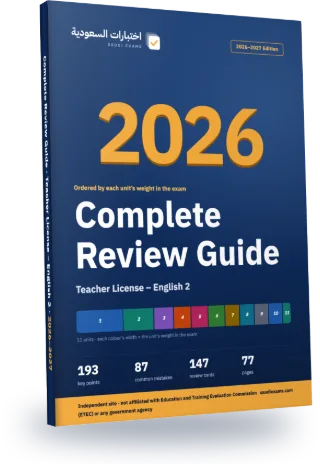
Teacher License – English 2 Complete Review Guide 2026–2027
Every exam topic in a 77-page Arabic PDF, ordered from the heaviest unit to the lightest. The first three chapters alone cover about 44% of the exam questions.
- 77Pages
- 193Key points
- 87Common mistakes
- 147Flashcards
Guide map
Each chapter is one exam unit, ordered by its weight in the real exam.
| Chapter | Unit | Weight | Exam questions | Key points |
|---|---|---|---|---|
| 1 | Teaching Language Skills: Listening, Speaking, Reading, Vocabulary, Writing and Grammar | 21% | 19 | 18 |
| 2 | Applying English Linguistics | 14% | 12 | 18 |
| 3 | Teaching Methods that Engage Learners | 9% | 8 | 18 |
| 4 | Developing and Selecting Assessment Tools | 8% | 7 | 18 |
| 5 | Accessing and Designing L2 Learning Resources | 8% | 7 | 18 |
| 6 | Second Language Acquisition in Teaching | 8% | 7 | 17 |
| 7 | Planning Learning Activities for L2 Objectives and the Curriculum | 7% | 6 | 17 |
| 8 | Setting L2 Learning Objectives | 7% | 6 | 16 |
| 9 | Theoretical and Methodological Developments in TESOL/TEFL | 7% | 6 | 18 |
| 10 | Understanding Language as a System | 7% | 6 | 18 |
| 11 | Planning Lessons Around Students’ Culture, Abilities, Needs and Interests | 4% | 4 | 17 |
Chapter 1 in full: Teaching Language Skills: Listening, Speaking, Reading, Vocabulary, Writing and Grammar
21% of the exam, about 19 questions. These are its key points, as in the guide.
- Bottom-up processing builds meaning from sounds, words and grammar. Top-down processing uses context, background knowledge and prediction. Skilled listeners use both together (6.9.1.1).
- Listening lesson stages: pre-listening (activate prior knowledge, predict, pre-teach key words), while-listening (purposeful tasks, gist first and then detail), post-listening (discussion, follow-up, reflection on strategies) (6.9.1.2).
- Intensive listening focuses on parts of the text and accurate understanding; extensive listening is long listening to self-chosen material for enjoyment and general understanding; selective listening picks out specific information.
The rest of chapter 1, on this page
- The metacognitive approach to listening trains learners to plan, predict, monitor and evaluate: predict content, listen, compare what they understood, then listen again.
- Comprehensible input (i+1) is Krashen's hypothesis that acquisition occurs when learners understand language slightly above their level; it is a hypothesis, not established fact. Long's Interaction Hypothesis: negotiating meaning between speakers makes input comprehensible. Swain's Output Hypothesis: producing language makes learners notice gaps in their own language.
- A fluency activity focuses on meaning and communication, with correction delayed; an accuracy activity focuses on correct form with more control. In an information gap, each learner holds part of the information and they must talk to complete it.
- Corrective feedback types: recast (the correct form without flagging the error), clarification request, explicit correction, and elicitation (prompting the learner to self-correct). Lyster and Ranta found recasts the most frequent type, but the least likely to lead learners to repair the error themselves.
- Classroom speaking techniques: pair and group work raises each learner's talking time (useful in large classes); role-play; think-pair-share, where learners think alone, discuss with a partner, then share with the class.
- Choral drilling lets learners try a word or sentence together in a low-risk way before individual production, which lowers anxiety. For English as a lingua franca, pronunciation teaching prioritises intelligibility over imitating a native accent.
- Skimming gets the gist of a text; scanning finds specific information. Intensive reading studies a short text in detail; extensive reading is large amounts of easy, enjoyable text and is a cornerstone of fluency and vocabulary growth (6.9.1.4).
- Reading lesson stages: pre-reading (activate schema, predict), while-reading (focused comprehension tasks), post-reading (summarising, critical analysis, follow-up reading of similar texts). Metacognitive strategies such as monitoring understanding and repairing problems improve comprehension.
- Receptive vocabulary is what learners understand when listening or reading; productive vocabulary is what they use in speaking and writing. For unassisted comprehension, learners need to know roughly 95-98% of the words in a text (Nation and others).
- Context clues include definition, synonym, antonym or contrast (for example 'unlike ... shy'), and example. Before guessing an unknown word, work out its part of speech from its position in the sentence, then read the surrounding context. Teaching affixes lets learners analyse new words.
- The Lexical Approach (Lewis) holds that language is made of ready-made chunks such as 'I was wondering if...', which should be taught as whole units. Nation's four strands of a balanced vocabulary course: meaning-focused input, meaning-focused output, language-focused learning, and fluency development.
- Presenting meaning: realia or pictures, definition, example. Concept-checking questions test meaning, not repetition (for example 'Is a bargain expensive?'). Learners remember words better when they write their own sentences, and spaced revision works better than cramming in one day.
- Writing approaches: the product approach imitates a model text; the process approach moves through recurring steps (planning, drafting, revising, editing, publishing); the genre approach teaches the structure, purpose and audience of a particular text type (6.9.1.5). Revising reconsiders ideas and organisation; editing corrects spelling, grammar and punctuation.
- Deductive grammar teaching starts with the rule, then examples and practice; inductive teaching gives examples so learners notice the pattern and work out the rule themselves. PPP: Presentation, then controlled Practice, then free Production (6.9.1.6).
- Focus on form draws attention to language form inside a communicative activity without displacing meaning; focus on forms is separate grammar teaching organised by grammar items. A repeated error such as 'I did a mistake' is a collocation problem (make a mistake), so a collocation task fits better than a grammar rule.
Common mistakes in this chapter
- Mixing up top-down and bottom-up: predicting content and using background knowledge is top-down; decoding sounds, linked words and grammar is bottom-up.
- Confusing skimming with scanning: skimming gets the gist or a title; scanning finds one specific detail such as a number or name.
- Confusing intensive and extensive reading: intensive is a short text studied in detail; extensive is large amounts of easy text read for pleasure and fluency.
- Assuming every error should be corrected on the spot. In fluency activities, correction is delayed until after the activity so speech is not interrupted.
- Confusing a recast with explicit correction: a recast gives the correct form naturally without flagging the error; explicit correction says the sentence is wrong and supplies the form.
- Placing free production in the presentation or practice stage of PPP. Practice is controlled; production is free.
- Thinking process writing is just grammar correction. Revising deals with ideas and organisation; editing deals with form, language and spelling.
- Confusing inductive and deductive grammar teaching: inductive means learners notice examples and work out the rule; deductive means the rule is given first and then applied.
The other chapters are in the full guide
One purchase · lifetime access · review guide included
7-day review plan
The chapters are spread over 6 days by weight so each day carries a similar load. Day 7 is a full exam.
Day 1 · 21% of the exam
Chapter 1: Teaching Language Skills: Listening, Speaking, Reading, Vocabulary, Writing and Grammar
Day 2 · 18% of the exam
Chapter 2: Applying English Linguistics
Chapter 11: Planning Lessons Around Students’ Culture, Abilities, Needs and InterestsDay 3 · 16% of the exam
Chapter 3: Teaching Methods that Engage Learners
Chapter 10: Understanding Language as a SystemDay 4 · 15% of the exam
Chapter 4: Developing and Selecting Assessment Tools
Chapter 7: Planning Learning Activities for L2 Objectives and the CurriculumDay 5 · 15% of the exam
Chapter 5: Accessing and Designing L2 Learning Resources
Chapter 8: Setting L2 Learning ObjectivesDay 6 · 15% of the exam
Chapter 6: Second Language Acquisition in Teaching
Chapter 9: Theoretical and Methodological Developments in TESOL/TEFLDay 7
Full mock exam: 88 questions in 120 minutes, then review the common mistakes in the units where you lost marks.
How many correct answers do you need?
- Practitioner level 50%44 correct out of 88
- Advanced level 70%62 correct out of 88
- Expert level 80%71 correct out of 88
Before you read: see your score today
10 free questions from the main units, no sign-up. Then you know which chapter to start with.
Try 10 free questions and see your levelA look at each chapter
The first three key points of each chapter, as they appear in the guide (in Arabic in the PDF).
Chapter 1: Teaching Language Skills: Listening, Speaking, Reading, Vocabulary, Writing and Grammar
- Bottom-up processing builds meaning from sounds, words and grammar. Top-down processing uses context, background…
- Listening lesson stages
- Intensive listening focuses on parts of the text and accurate understanding; extensive listening is…
Chapter 2: Applying English Linguistics
- Consonants are described by three features
- Vowels are described by tongue height (high/mid/low), tongue position (front/back) and lip rounding. Examples…
- A phoneme is the smallest sound unit that distinguishes meaning; an allophone is a…
Chapter 3: Teaching Methods that Engage Learners
- Grammar-Translation
- Direct Method
- Audio-Lingual Method
Chapter 4: Developing and Selecting Assessment Tools
- Formative assessment happens during learning and gives ongoing feedback so teaching can be adjusted…
- Summative assessment comes at the end of a unit, term or year to measure…
- A diagnostic test reveals each learner's specific strengths and weaknesses and is used to…
Chapter 5: Accessing and Designing L2 Learning Resources
- Standard 6.9.6
- Indicator 6.9.6.1
- Indicator 6.9.6.2
Chapter 6: Second Language Acquisition in Teaching
- Behaviorism (Skinner)
- Chomsky
- Acquisition-learning hypothesis (Krashen)
Chapter 7: Planning Learning Activities for L2 Objectives and the Curriculum
- A varied activity set changes interaction pattern (individual, pairs, groups, whole class), skill and…
- A flexible activity can be extended, shortened or adapted during the lesson according to…
- A coherent activity leads into the next one and serves the lesson objective, so…
Chapter 8: Setting L2 Learning Objectives
- A learning objective states what learners will be able to do by the end…
- Objectives are written at two levels
- Goals are broad, long-term statements about a whole course; objectives are specific, short-term statements…
Chapter 9: Theoretical and Methodological Developments in TESOL/TEFL
- Dell Hymes (1972) coined 'communicative competence' in response to Chomsky's linguistic competence: knowing a…
- Canale and Swain's model (1980)
- Grammatical competence
Chapter 10: Understanding Language as a System
- Arbitrariness
- Displacement
- Productivity
Chapter 11: Planning Lessons Around Students’ Culture, Abilities, Needs and Interests
- Standard 6.9.7
- Differentiated instruction (Tomlinson)
- Tiered tasks
The full guide comes with lifetime access
The full guide (77 pages) is included with lifetime access to this exam, together with every question and full mock exam. Chapter 1 is free for everyone.
Questions about the guide
Is the guide free?
Chapter 1 is free to read on the guide page. The full guide comes with lifetime access to this exam; 7-day access does not include it.
Is it up to date for 2026–2027?
Yes. Unit weights and exam facts follow what the exam body last published, and the last check date is printed in the guide. If the standards change we update the file and buyers download the new version.
Does the guide have questions?
No. The guide covers key points and common mistakes; scoring, weak-area practice and full mock exams are on the site.
Can I read it on my phone?
Yes. A5 pages in a single column, with chapters linked from the contents.
- Pages
- 77
- Edition
- 1448 AH · 2026–2027
- Language
- Arabic
- Last updated
All Teacher Exams review guides
Back to Teachers' Professional License – Specialized Test: English Language (2)
Buy this exam
Pick the access that lasts until your test date.
Included
- Full mock exams: 88 questions in 120 minutes, with a score for every unit
- 508 questions, every option explained with its source
- Practice that starts with your weakest units, plus a review of your mistakes
- Complete Review Guide 2026–2027 (PDF), with lifetime access only
Continue with your Google account and you go straight to the payment page.
You pay on the Waffo Pancake checkout page (in English). The amount is in US dollars and your bank converts it to riyals. One payment with no automatic renewal, by Visa, Mastercard (a mada card with either logo works too), Apple Pay or Google Pay. Your statement shows "WAFFO". Purchases are not refundable.