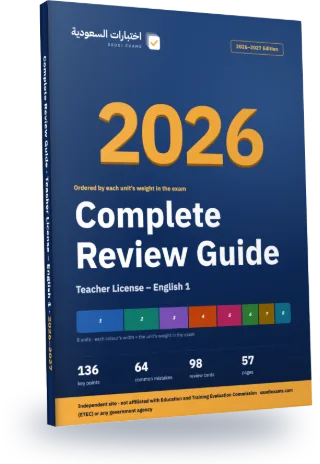
Teacher License – English 1 Complete Review Guide 2026–2027
Every exam topic in a 57-page Arabic PDF, ordered from the heaviest unit to the lightest. The first three chapters alone cover about 51% of the exam questions.
- 57Pages
- 136Key points
- 64Common mistakes
- 98Flashcards
Guide map
Each chapter is one exam unit, ordered by its weight in the real exam.
| Chapter | Unit | Weight | Exam questions | Key points |
|---|---|---|---|---|
| 1 | Teaching Language Skills and Sub-skills to Young L2 Learners | 21% | 18 | 16 |
| 2 | Designing Language Learning Activities for Young L2 Learners | 16% | 14 | 16 |
| 3 | Selecting Teaching Methods for Young L2 Learners | 14% | 12 | 18 |
| 4 | Applying Linguistics in Teaching Young L2 Learners | 14% | 12 | 18 |
| 5 | Developing and Selecting Assessment Tools for Young L2 Learners | 12% | 11 | 17 |
| 6 | Formulating Learning Outcomes for Young L2 Learners | 8% | 7 | 17 |
| 7 | Selecting and Designing Learning Resources for Young L2 Learners | 8% | 7 | 18 |
| 8 | Preparing Learning Experiences Based on Young Learners' Culture, Abilities, Needs and Interests | 8% | 7 | 16 |
Chapter 1 in full: Teaching Language Skills and Sub-skills to Young L2 Learners
21% of the exam, about 18 questions. These are its key points, as in the guide.
- Indicator 6.39.6.1: listening strategies. A lesson has three stages: pre-listening, while-listening and post-listening.
- Pre-listening: activate prior knowledge, predict the content from pictures or the title, and preview key vocabulary that could block understanding.
- While-listening: give learners a task before playing (colour, tick, order pictures, listen and do), and replay the recording more than once, each time with a different purpose.
The rest of chapter 1, on this page
- Bottom-up listening relies on decoding sounds and words; top-down listening relies on prior knowledge and context. A good listener combines the two.
- Total Physical Response (TPR, from Asher's work): the child carries out commands with movement without being required to speak. It suits young beginners.
- Indicator 6.39.6.2: speaking strategies. Accuracy activities include repetition, drills and chants; fluency activities include information gap, role play, and pair and group work.
- Information gap: each learner holds information the partner lacks, so they ask and answer to complete the task. Speaking then has a real purpose.
- Error correction: in accuracy work the teacher corrects immediately; in fluency work the teacher notes common errors and discusses them after the activity (delayed correction). One technique is recasting the child's utterance in correct form.
- Indicator 6.39.6.3: reading strategies. Reading usually starts with phonological awareness and phonics, together with common sight words such as "the" and "said" that cannot be read entirely by sounding out.
- Blending is joining the sounds of a word to say it (/k/ /æ/ /t/ then cat); segmenting a word into its sounds is used for spelling.
- Shared reading: the teacher reads a big book while the children look on and join in. Guided reading: small groups at a similar level read a suitable text with teacher support. Reading graded readers freely builds fluency.
- Reading skills: skimming for the general idea, scanning for specific information, and predicting from the title and pictures (top-down). With young learners, pictures serve as context.
- Indicator 6.39.6.4: writing strategies. For young learners, start with letter formation (left-to-right direction, capital and small letters), then copying, semi-controlled writing, and free writing.
- Process writing: prewriting (gathering ideas), drafting, revising (improving ideas and organisation), then editing (correcting spelling and grammar). A sentence frame such as "I like ___." supports beginners.
- Indicator 6.39.6.5: vocabulary strategies. Present words with real objects, pictures, actions and context; review at spaced intervals; use word cards and games. Teach chunks such as "Can I have...?" as a single unit.
- Indicator 6.39.6.6: grammar strategies. The inductive approach gives examples in context and learners notice the pattern; the deductive approach starts with the rule, then examples. For young learners the first suits better, through stories and songs, with focus on form when needed.
Common mistakes in this chapter
- Confusing phonics (a way of teaching reading by linking sounds to letters) with phonetics (the study of speech sounds). For a question on teaching a child to read words, the answer is phonics.
- Confusing bottom-up listening (from sounds and words up to meaning) with top-down listening (from prior knowledge and context down to meaning). Activating prior knowledge and predicting belong to the second.
- Correcting every mistake at once during a fluency activity. It is better to delay correction until after the activity so communication is not interrupted; immediate correction suits accuracy work.
- Treating drills as a fluency activity. A repetition drill controls form, so it serves accuracy; information gap and role play serve fluency.
- Confusing skimming (reading quickly for the general idea) with scanning (reading quickly to find a specific piece of information such as a name or number).
- Starting grammar by explaining the rule with its terminology to a young child. That is a deductive approach suited to older learners; for young learners, present language in context with examples and let them notice the pattern (inductive).
- Presenting a new word only once. Remembering vocabulary needs spaced repetition, varied activities (recycling) and several occasions of use.
- Asking young learners for free writing before preparing them. The teacher should begin with copying, then guided writing with a sentence frame, and give freedom gradually.
The other chapters are in the full guide
One purchase · lifetime access · review guide included
7-day review plan
The chapters are spread over 6 days by weight so each day carries a similar load. Day 7 is a full exam.
Day 1 · 21% of the exam
Chapter 1: Teaching Language Skills and Sub-skills to Young L2 Learners
Day 2 · 16% of the exam
Chapter 2: Designing Language Learning Activities for Young L2 Learners
Day 3 · 14% of the exam
Chapter 3: Selecting Teaching Methods for Young L2 Learners
Day 4 · 14% of the exam
Chapter 4: Applying Linguistics in Teaching Young L2 Learners
Day 5 · 20% of the exam
Chapter 5: Developing and Selecting Assessment Tools for Young L2 Learners
Chapter 8: Preparing Learning Experiences Based on Young Learners' Culture, Abilities, Needs and InterestsDay 6 · 16% of the exam
Chapter 6: Formulating Learning Outcomes for Young L2 Learners
Chapter 7: Selecting and Designing Learning Resources for Young L2 LearnersDay 7
Full mock exam: 88 questions in 120 minutes, then review the common mistakes in the units where you lost marks.
How many correct answers do you need?
- Practitioner level 50%44 correct out of 88
- Advanced level 70%62 correct out of 88
- Expert level 80%71 correct out of 88
Before you read: see your score today
10 free questions from the main units, no sign-up. Then you know which chapter to start with.
Try 10 free questions and see your levelA look at each chapter
The first three key points of each chapter, as they appear in the guide (in Arabic in the PDF).
Chapter 1: Teaching Language Skills and Sub-skills to Young L2 Learners
- Indicator 6.39.6.1
- Pre-listening
- While-listening
Chapter 2: Designing Language Learning Activities for Young L2 Learners
- Total Physical Response (TPR, developed by James Asher) links language to movement: the learner…
- Songs and chants practise pronunciation, rhythm and intonation and fix vocabulary and chunks through…
- A story presents language in a connected, repeated context. It can be used before…
Chapter 3: Selecting Teaching Methods for Young L2 Learners
- Intrinsic motivation
- A young learner's anxiety is lowered by a safe environment
- Positive reinforcement
Chapter 4: Applying Linguistics in Teaching Young L2 Learners
- Consonants are classified by place of articulation
- Manners of articulation
- Vowels are described by tongue height and position
Chapter 5: Developing and Selecting Assessment Tools for Young L2 Learners
- Formative assessment monitors learning during instruction and gives ongoing feedback to teacher and learner…
- Diagnostic assessment is given at the start of a unit or term to find…
- Summative assessment is given at the end of a unit, term or year to…
Chapter 6: Formulating Learning Outcomes for Young L2 Learners
- SMART stands for five qualities
- A specific outcome names one clear skill and clear language content, for example "the…
- Measurable means the teacher can collect evidence
Chapter 7: Selecting and Designing Learning Resources for Young L2 Learners
- A learning resource is any material that supports learning
- Adaptation means modifying an existing resource to suit the outcome and the learners, and…
- Adding
Chapter 8: Preparing Learning Experiences Based on Young Learners' Culture, Abilities, Needs and Interests
- Indicator 6.39.4.1
- Differentiation is adjusting teaching to the range of learners in one class. It covers…
- Content differentiation is what the learner learns (vocabulary or texts at different levels). Process…
The full guide comes with lifetime access
The full guide (57 pages) is included with lifetime access to this exam, together with every question and full mock exam. Chapter 1 is free for everyone.
Questions about the guide
Is the guide free?
Chapter 1 is free to read on the guide page. The full guide comes with lifetime access to this exam; 7-day access does not include it.
Is it up to date for 2026–2027?
Yes. Unit weights and exam facts follow what the exam body last published, and the last check date is printed in the guide. If the standards change we update the file and buyers download the new version.
Does the guide have questions?
No. The guide covers key points and common mistakes; scoring, weak-area practice and full mock exams are on the site.
Can I read it on my phone?
Yes. A5 pages in a single column, with chapters linked from the contents.
- Pages
- 57
- Edition
- 1448 AH · 2026–2027
- Language
- Arabic
- Last updated
All Teacher Exams review guides
Back to Teachers' Professional License – Specialized Test: English Language (1)
Buy this exam
Pick the access that lasts until your test date.
Included
- Full mock exams: 88 questions in 120 minutes, with a score for every unit
- 521 questions, every option explained with its source
- Practice that starts with your weakest units, plus a review of your mistakes
- Complete Review Guide 2026–2027 (PDF), with lifetime access only
Continue with your Google account and you go straight to the payment page.
You pay on the Waffo Pancake checkout page (in English). The amount is in US dollars and your bank converts it to riyals. One payment with no automatic renewal, by Visa, Mastercard (a mada card with either logo works too), Apple Pay or Google Pay. Your statement shows "WAFFO". Purchases are not refundable.