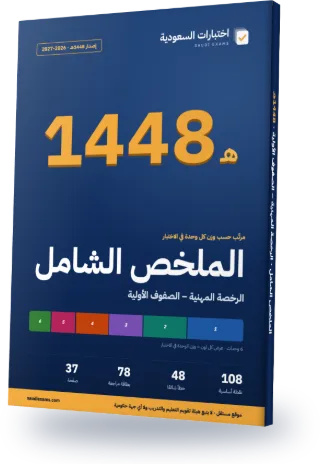
Teacher License – Early Grades Complete Review Guide 2026–2027
Every exam topic in a 37-page Arabic PDF, ordered from the heaviest unit to the lightest. The first three chapters alone cover about 61% of the exam questions.
- 37Pages
- 108Key points
- 48Common mistakes
- 78Flashcards
Guide map
Each chapter is one exam unit, ordered by its weight in the real exam.
| Chapter | Unit | Weight | Exam questions | Key points |
|---|---|---|---|---|
| 1 | Arabic Language | 25% | 22 | 18 |
| 2 | Science | 20% | 18 | 18 |
| 3 | Islamic Studies | 16% | 14 | 18 |
| 4 | Mathematics | 16% | 14 | 18 |
| 5 | Growth Characteristics | 12% | 10 | 18 |
| 6 | Healthy Classroom Environment and Teaching Methods | 11% | 10 | 18 |
Chapter 1 in full: Arabic Language
25% of the exam, about 22 questions. These are its key points, as in the guide.
- A word is a noun, a verb or a particle. Noun signs: the article «ال», tanween, being governed by a preposition, and being called. Verb signs: «قد», the prefix sin, «سوف», the silent feminine ta and the subject ta. A particle accepts none of these signs (6.28.8, indicators 1 and 2).
- An indeclinable word keeps its ending whatever governs it; a declinable word changes its ending with its position. Indeclinable words include the past verb, the imperative, pronouns, demonstratives, relative pronouns, and conditional and interrogative nouns. A present-tense verb is indeclinable when the emphatic nun or the feminine plural nun is attached (6.28.8, indicator 3).
- There are four original markers: damma for nominative, fatha for accusative, kasra for genitive and sukun for jussive. Substitute markers stand in for them: waw, alif, ya, nun, dropping the weak letter and dropping the nun. They include kasra for the accusative of the sound feminine plural and fatha for the genitive of the diptote (6.28.8, indicator 4; 6.28.10, indicator 7).
The rest of chapter 1, on this page
- A definite noun points to something specific. Its types: the pronoun, proper noun, demonstrative, relative pronoun, a noun with «ال», a noun annexed to a definite noun, and the specified called noun. An indefinite noun points to nothing specific and can take «ال» (6.28.8, indicator 5).
- The doer is a nominative noun that follows an active verb and names who performed the action. It can be a noun, an attached pronoun or an implied pronoun. The verb must be feminine when the doer is a real feminine attached to its verb (6.28.9, indicator 2).
- The substitute doer takes the place of the deleted doer and is nominative like it. The passive verb takes a damma on its first letter: in the past the letter before the last takes kasra («كُتِبَ»), and in the present it takes fatha («يُكتَبُ») (6.28.9, indicator 3).
- The five nouns (أب, أخ, حم, فو, ذو) take waw in the nominative, alif in the accusative and ya in the genitive, provided they are annexed to something other than the speaker's ya, as in «أخوك» and «ذو فضل». The dual takes alif and the sound masculine plural takes waw in the nominative (6.28.9, indicator 5).
- The object is an accusative noun that the doer's action falls on. An exception has three parts: the excepted-from noun, the particle and the excepted noun. After «إلا» in a complete positive sentence the excepted noun is accusative, as in «حضر الطلاب إلا زيدًا» (6.28.10, indicators 2 and 3).
- The circumstantial adverb is an accusative description of its owner's state while the action happens; it is normally an indefinite derived word and its owner is definite. The specification is an indefinite accusative noun that clears up the vagueness of what precedes it, as in «اشتريت كيلو تفاحًا» and «أنا أكثر منك مالًا» (6.28.10, indicators 4 and 5).
- A genitive noun comes after a preposition or a first term of an idafa. The idafa links two nouns: the first is annexed and the second is a genitive annexed-to noun. The first term takes neither «ال» nor tanween, and the nun of the dual and sound masculine plural is dropped, as in «هذان لاعبا الفريق» (6.28.11, indicators 2 and 3).
- A nominative present-tense verb takes a damma, overt as in «يكتبُ» or implied on a weak final letter, as in «يرجو» and «يدعو» (implied for heaviness) and «يسعى» (implied because it is impossible to vowel). Its accusative particles are أن, لن, كي and إذن, with fatha as the marker. Its jussive particles are لم, لما, the prohibitive لا, the imperative lam and conditional particles such as «إن» and «من», with sukun as the original marker (6.28.12, indicators 1 to 3).
- Exclamation has two standard forms: «ما أفعلَه» as in «ما أجملَ السماءَ», and «أفعِلْ به» as in «أجمِلْ بالسماءِ». The comparative follows the pattern «أفعل» and takes «من» before the thing compared with, as in «أكثر منك مالًا» (6.28.13, indicator 1).
- Numbers 3 to 10 take the opposite gender of the counted noun, which is a genitive plural. For 13 to 19 the first part takes the opposite gender and the second part agrees, and the counted noun is singular accusative, so «١٨ جزءًا» is read «ثمانيةَ عشرَ جزءًا». For 20 to 99 the counted noun is singular accusative, and «٨٥ ريالًا» is read «خمسةٌ وثمانون ريالًا» (6.28.13, indicators 2 and 3).
- Vocative particles: يا, أيا, هيا, أي and the hamza. A single proper noun or a specified indefinite noun is built on what it would take as nominative, as in «يا محمدُ»; the annexed noun and the unspecified indefinite noun are accusative, as in «يا طالبَ العلمِ». Praise uses «نعم» and «حبذا»; blame uses «بئس» and «لا حبذا» (6.28.13, indicators 4 and 5).
- Dictation has three types: copying (the student copies a text in front of them), seen dictation (the student studies the text, it is covered, and they write it) and test dictation (the student writes what they hear without seeing the text). A medial hamza sits on the letter that fits the stronger of the two vowels, in the order kasra, damma, fatha, sukun (6.28.14, indicators 1 and 2).
- The sun lam is written but not pronounced and the next letter is doubled, as in «الشمس»; the moon lam is written and pronounced, as in «القمر». The closed ta is written in a singular feminine noun such as «مدرسة» and sounds like ha when you stop; the open ta is written in verbs and in the sound feminine plural such as «معلمات» (6.28.14, indicators 3 and 4).
- The final alif: in three-letter verbs and nouns it goes back to its root, so «سعى» is written with ya because its root is ya, and «شكا» with alif because its root is waw. In longer words it is written as ya, as in «مستشفى», unless a ya comes before it, as in «دنيا». The full stop ends a sentence whose meaning is complete, and the comma separates short sentences and listed words (6.28.14, indicators 6 and 8).
- In the common classification reading is oral or silent. Ideas in a text are analysed by separating the overall ideas, which carry the general meaning, from the partial ideas that support each of them, and the view presented is then critiqued with evidence (6.28.15).
Common mistakes in this chapter
- Confusing the doer with the substitute doer: after a passive verb the noun is a substitute doer, not a doer, even if it names the one who acted in meaning.
- Judging the case by meaning instead of by the marker: in «أخوك سندك» the waw is a substitute nominative marker, not an extra letter, because «أخوك» is one of the five nouns.
- Mixing up the circumstantial adverb and the specification: the adverb describes the state of its owner while the action happens, whereas the specification removes vagueness in a preceding noun or sentence, like «مالًا» in «أكثر منك مالًا».
- Forgetting to drop the nun in an idafa: in «هذان لاعبا الفريق» the dual's nun is dropped because «لاعبا» is the first term, so «لاعبان الفريق» is wrong.
- Treating a verb with a weak final letter as if its marker were an overt damma: in «يرجو» and «يسعى» the damma is implied, because it cannot show on the waw (heaviness) or on the alif (impossible to vowel).
- Reversing agreement for numbers 3 to 10: the number takes the opposite gender of the counted noun, so «ثلاثةُ طلاب» (masculine noun) and «ثلاثُ طالبات» (feminine noun), and the counted noun is a genitive plural.
- Mixing up the final alif: a three-letter word goes back to its root letter, so «سعى» is written with ya (root ya, «سعيت») and «شكا» with alif (root waw, «شكوت»).
- Writing a medial hamza by the vowel of the hamza alone instead of the stronger of the two neighbouring vowels: from strongest to weakest the order is kasra, damma, fatha, then sukun.
The other chapters are in the full guide
One purchase · lifetime access · review guide included
7-day review plan
The chapters are spread over 6 days by weight so each day carries a similar load. Day 7 is a full exam.
Day 1 · 25% of the exam
Chapter 1: Arabic Language
Day 2 · 20% of the exam
Chapter 2: Science
Day 3 · 16% of the exam
Chapter 3: Islamic Studies
Day 4 · 16% of the exam
Chapter 4: Mathematics
Day 5 · 12% of the exam
Chapter 5: Growth Characteristics
Day 6 · 11% of the exam
Chapter 6: Healthy Classroom Environment and Teaching Methods
Day 7
Full mock exam: 88 questions in 120 minutes, then review the common mistakes in the units where you lost marks.
How many correct answers do you need?
- Practitioner level 50%44 correct out of 88
- Advanced level 70%62 correct out of 88
- Expert level 80%71 correct out of 88
Before you read: see your score today
10 free questions from the main units, no sign-up. Then you know which chapter to start with.
Try 10 free questions and see your levelA look at each chapter
The first three key points of each chapter, as they appear in the guide (in Arabic in the PDF).
Chapter 1: Arabic Language
- A word is a noun, a verb or a particle. Noun signs
- An indeclinable word keeps its ending whatever governs it; a declinable word changes its…
- There are four original markers
Chapter 2: Science
- The characteristics of living things
- Protoplasm is the living material inside the cell, and it includes the cytoplasm and…
- Cell theory
Chapter 3: Islamic Studies
- The silent nun and tanween have four rules
- The idgham letters are six, collected in «يرملون»
- The silent meem has three rules
Chapter 4: Mathematics
- Natural numbers
- Adding fractions with unlike denominators
- Dividing fractions
Chapter 5: Growth Characteristics
- Piaget's stages
- In the preoperational stage symbolic play and egocentrism appear, and the child cannot conserve…
- In the concrete operational stage the child grasps conservation and reversibility and can classify…
Chapter 6: Healthy Classroom Environment and Teaching Methods
- A learning objective states what the student is expected to learn, written with a…
- Objectives fall in three domains
- Learning technologies drive participation when they are interactive, clear and short, such as images…
The full guide comes with lifetime access
The full guide (37 pages) is included with lifetime access to this exam, together with every question and full mock exam. Chapter 1 is free for everyone.
Questions about the guide
Is the guide free?
Chapter 1 is free to read on the guide page. The full guide comes with lifetime access to this exam; 7-day access does not include it.
Is it up to date for 2026–2027?
Yes. Unit weights and exam facts follow what the exam body last published, and the last check date is printed in the guide. If the standards change we update the file and buyers download the new version.
Does the guide have questions?
No. The guide covers key points and common mistakes; scoring, weak-area practice and full mock exams are on the site.
Can I read it on my phone?
Yes. A5 pages in a single column, with chapters linked from the contents.
- Pages
- 37
- Edition
- 1448 AH · 2026–2027
- Language
- Arabic
- Last updated
All Teacher Exams review guides
Back to Teachers' Professional License – Subject Test: Early Grades
Buy this exam
Pick the access that lasts until your test date.
Included
- Full mock exams: 88 questions in 120 minutes, with a score for every unit
- 474 questions, every option explained with its source
- Practice that starts with your weakest units, plus a review of your mistakes
- Complete Review Guide 2026–2027 (PDF), with lifetime access only
Continue with your Google account and you go straight to the payment page.
You pay on the Waffo Pancake checkout page (in English). The amount is in US dollars and your bank converts it to riyals. One payment with no automatic renewal, by Visa, Mastercard (a mada card with either logo works too), Apple Pay or Google Pay. Your statement shows "WAFFO". Purchases are not refundable.