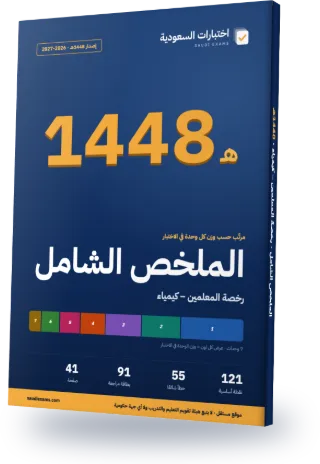
Teacher License – Chemistry Complete Review Guide 2026–2027
Every exam topic in a 41-page Arabic PDF, ordered from the heaviest unit to the lightest. The first three chapters alone cover about 63% of the exam questions.
- 41Pages
- 121Key points
- 55Common mistakes
- 91Flashcards
Guide map
Each chapter is one exam unit, ordered by its weight in the real exam.
| Chapter | Unit | Weight | Exam questions | Key points |
|---|---|---|---|---|
| 1 | Gas Laws, Stoichiometry, Solutions, Acids and Bases | 28% | 25 | 17 |
| 2 | Hydrocarbons and Functional Groups in Organic Compounds | 18% | 16 | 18 |
| 3 | Kinetics, Thermochemistry, Electrochemistry and Equilibrium | 17% | 15 | 18 |
| 4 | History, Nature and Applications of Chemistry and Its Links to Other Sciences | 12% | 10 | 18 |
| 5 | Core Skills and Methods of Teaching Chemistry | 10% | 9 | 17 |
| 6 | Matter, Its Properties and the Periodic Table | 9% | 8 | 17 |
| 7 | Laboratory Work and Basic Mathematical Skills | 6% | 5 | 16 |
Chapter 1 in full: Gas Laws, Stoichiometry, Solutions, Acids and Bases
28% of the exam, about 25 questions. These are its key points, as in the guide.
- One mole contains 6.02 × 10²³ particles, and molar mass in g/mol equals the atomic or molecular mass numerically; n = m / M.
- The empirical formula is the simplest whole-number ratio of atoms; find it by converting masses or percentages to moles and dividing by the smallest value.
- Molecular formula = empirical formula × a whole number, where the number = molar mass of the compound ÷ empirical formula mass.
The rest of chapter 1, on this page
- To balance an equation, make the atoms of each element equal on both sides by changing coefficients only, never the subscripts inside formulas.
- Main reaction types: combination, decomposition, single displacement, double displacement (including neutralisation and precipitation), and combustion.
- The limiting reagent is used up first and sets the amount of product; percent yield = (actual yield ÷ theoretical yield) × 100.
- Boyle's law: P₁V₁ = P₂V₂ at constant T and n. Charles's law: V₁/T₁ = V₂/T₂ at constant P and n. Gay-Lussac's law: P₁/T₁ = P₂/T₂ at constant V and n (T in kelvin).
- The ideal gas law is PV = nRT, and one mole of an ideal gas occupies 22.4 L at STP (0°C and 1 atm).
- Dalton's law: total pressure = sum of partial pressures, and partial pressure = mole fraction × total pressure. Graham's law: rate of diffusion is inversely proportional to the square root of molar mass.
- Molarity \(M = \dfrac{n}{V}\) (V in litres), molality \(m = \dfrac{n_{solute}}{kg_{solvent}}\), and mole fraction of a component = its moles ÷ total moles in the solution.
- In dilution the moles of solute stay constant: M₁V₁ = M₂V₂. Diluting from 10 M to 0.2 M needs a dilution factor of 50.
- Solubility: a gas dissolves more as pressure rises (Henry's law) and less as temperature rises; most solids dissolve more when heated; like dissolves like (polar dissolves polar).
- Colligative properties: ΔT_f = i·K_f·m, ΔT_b = i·K_b·m, and osmotic pressure π = i·M·R·T; for water K_f = 1.86 °C·kg/mol and K_b = 0.512 °C·kg/mol.
- Arrhenius: an acid gives H⁺ in water and a base gives OH⁻. Brønsted-Lowry: an acid donates a proton and a base accepts one. Lewis: an acid accepts an electron pair and a base donates one.
- pH = −log[H⁺], pOH = −log[OH⁻], and pH + pOH = 14 at 25°C. A strong acid ionises completely, so 1.0 × 10⁻⁵ M HCl has pH = 5. Strong acids: HCl, HBr, HI, HNO₃, HClO₄ and the first ionisation of H₂SO₄.
- At the equivalence point \(M_a V_a \times n_b = M_b V_b \times n_a\), where n is the number of protons or hydroxides per formula unit. The pH there is 7 (strong with strong), above 7 (weak acid with strong base), or below 7 (weak base with strong acid).
- A buffer is a weak acid with its conjugate base (or the reverse) and resists pH change when a small amount of acid or base is added; pH = pKa + log([A⁻]/[HA]).
Common mistakes in this chapter
- Confusing molarity (mol per litre of solution) with molality (mol per kilogram of solvent). Molality does not change with temperature; molarity does.
- Forgetting to convert temperature to kelvin (K = °C + 273) or volume to litres when using PV = nRT with R = 0.0821.
- Calculating the yield from the excess reactant instead of the limiting reagent, or using masses directly without converting to moles.
- Forgetting the van 't Hoff factor i for electrolytes in colligative problems: a 1 m NaCl solution gives about twice the particles of a 1 m sugar solution, so its freezing-point depression is larger.
- Forgetting that a diprotic acid such as H₂SO₄ supplies 2 mol of H⁺ per mole of acid in a titration, which gives a concentration that is half or double the correct one.
- Assuming the equivalence point always means pH = 7. That holds only for a strong acid with a strong base; with a weak acid pH is above 7, and with a weak base it is below 7.
- Mixing up strong with concentrated: strength means complete ionisation, while concentration means how much solute is present. Ethanoic acid is weak even when concentrated.
- Assuming a real gas always behaves ideally. Deviation grows at high pressure and low temperature, when molecular volume and intermolecular forces can no longer be ignored.
The other chapters are in the full guide
One purchase · lifetime access · review guide included
7-day review plan
The chapters are spread over 6 days by weight so each day carries a similar load. Day 7 is a full exam.
Day 1 · 28% of the exam
Chapter 1: Gas Laws, Stoichiometry, Solutions, Acids and Bases
Day 2 · 18% of the exam
Chapter 2: Hydrocarbons and Functional Groups in Organic Compounds
Day 3 · 17% of the exam
Chapter 3: Kinetics, Thermochemistry, Electrochemistry and Equilibrium
Day 4 · 12% of the exam
Chapter 4: History, Nature and Applications of Chemistry and Its Links to Other Sciences
Day 5 · 10% of the exam
Chapter 5: Core Skills and Methods of Teaching Chemistry
Day 6 · 15% of the exam
Chapter 6: Matter, Its Properties and the Periodic Table
Chapter 7: Laboratory Work and Basic Mathematical SkillsDay 7
Full mock exam: 88 questions in 120 minutes, then review the common mistakes in the units where you lost marks.
How many correct answers do you need?
- Practitioner level 50%44 correct out of 88
- Advanced level 70%62 correct out of 88
- Expert level 80%71 correct out of 88
Before you read: see your score today
10 free questions from the main units, no sign-up. Then you know which chapter to start with.
Try 10 free questions and see your levelA look at each chapter
The first three key points of each chapter, as they appear in the guide (in Arabic in the PDF).
Chapter 1: Gas Laws, Stoichiometry, Solutions, Acids and Bases
- One mole contains 6.02 × 10²³ particles, and molar mass in g/mol equals the…
- The empirical formula is the simplest whole-number ratio of atoms; find it by converting…
- Molecular formula = empirical formula × a whole number, where the number = molar…
Chapter 2: Hydrocarbons and Functional Groups in Organic Compounds
- Organic chemistry is the chemistry of carbon compounds; most contain C and H joined…
- General formulas
- Aliphatic hydrocarbons include alkanes (saturated) and alkenes and alkynes (unsaturated); aromatic hydrocarbons contain a…
Chapter 3: Kinetics, Thermochemistry, Electrochemistry and Equilibrium
- Reaction rate is the change in concentration of a reactant or product per unit…
- Rate law
- Collision theory states that a reaction occurs when particles collide with at least the…
Chapter 4: History, Nature and Applications of Chemistry and Its Links to Other Sciences
- Characteristics of science
- Chemistry is the science that studies matter, its composition, properties and changes, and the…
- Jabir ibn Hayyan is regarded as a pioneer of the experimental approach in chemistry…
Chapter 5: Core Skills and Methods of Teaching Chemistry
- Learner-centred learning
- Scientific literacy is a main aim of science education
- STS links science with technology and society (for example plastics, energy and water issues)…
Chapter 6: Matter, Its Properties and the Periodic Table
- Matter is anything that has mass and occupies space. Physical properties can be measured…
- In a solid the particles vibrate in fixed positions, in a liquid they slide…
- Melting, evaporation, freezing, condensation and sublimation are physical changes; combustion, rusting and the formation…
Chapter 7: Laboratory Work and Basic Mathematical Skills
- A safety data sheet (SDS) gives a substance's hazards, how to store it, first…
- Safety goggles, a lab coat and suitable gloves are required; no eating or drinking…
- Every container that a chemical is transferred into must carry a label with the…
The full guide comes with lifetime access
The full guide (41 pages) is included with lifetime access to this exam, together with every question and full mock exam. Chapter 1 is free for everyone.
Questions about the guide
Is the guide free?
Chapter 1 is free to read on the guide page. The full guide comes with lifetime access to this exam; 7-day access does not include it.
Is it up to date for 2026–2027?
Yes. Unit weights and exam facts follow what the exam body last published, and the last check date is printed in the guide. If the standards change we update the file and buyers download the new version.
Does the guide have questions?
No. The guide covers key points and common mistakes; scoring, weak-area practice and full mock exams are on the site.
Can I read it on my phone?
Yes. A5 pages in a single column, with chapters linked from the contents.
- Pages
- 41
- Edition
- 1448 AH · 2026–2027
- Language
- Arabic
- Last updated
All Teacher Exams review guides
Back to Teachers' Professional License – Subject Test: Chemistry
Buy this exam
Pick the access that lasts until your test date.
Included
- Full mock exams: 88 questions in 120 minutes, with a score for every unit
- 469 questions, every option explained with its source
- Practice that starts with your weakest units, plus a review of your mistakes
- Complete Review Guide 2026–2027 (PDF), with lifetime access only
Continue with your Google account and you go straight to the payment page.
You pay on the Waffo Pancake checkout page (in English). The amount is in US dollars and your bank converts it to riyals. One payment with no automatic renewal, by Visa, Mastercard (a mada card with either logo works too), Apple Pay or Google Pay. Your statement shows "WAFFO". Purchases are not refundable.