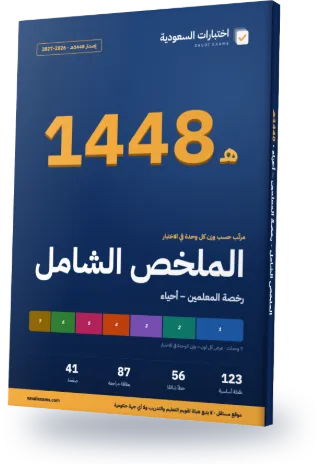
Teacher License – Biology Complete Review Guide 2026–2027
Every exam topic in a 41-page Arabic PDF, ordered from the heaviest unit to the lightest. The first three chapters alone cover about 51% of the exam questions.
- 41Pages
- 123Key points
- 56Common mistakes
- 87Flashcards
Guide map
Each chapter is one exam unit, ordered by its weight in the real exam.
| Chapter | Unit | Weight | Exam questions | Key points |
|---|---|---|---|---|
| 1 | Life Processes, Immunity and Disease | 21% | 19 | 18 |
| 2 | Structural and Functional Organisation of Living Things | 15% | 13 | 18 |
| 3 | Genetics | 15% | 13 | 18 |
| 4 | History and Nature of Biology and Its Links to Other Sciences | 13% | 11 | 18 |
| 5 | Ecology and Biodiversity | 13% | 11 | 18 |
| 6 | Classification of Living Things | 12% | 11 | 16 |
| 7 | Teaching Biology and Laboratory Safety | 11% | 10 | 17 |
Chapter 1 in full: Life Processes, Immunity and Disease
21% of the exam, about 19 questions. These are its key points, as in the guide.
- Life processes include digestion, breathing, excretion, reproduction, photosynthesis, transpiration and hormonal regulation (6.8.6, indicator 1).
- Aerobic cellular respiration: glucose + oxygen gives carbon dioxide + water + energy (ATP). Glycolysis occurs in the cytoplasm, the Krebs cycle in the mitochondrial matrix, and the electron transport chain on the inner mitochondrial membrane (6.8.6, indicator 2).
- Without oxygen, fermentation follows glycolysis: lactic acid in muscle cells, ethanol and carbon dioxide in yeast. Far less energy is released than in aerobic respiration (6.8.6, indicator 2).
The rest of chapter 1, on this page
- Photosynthesis: carbon dioxide + water + light gives glucose + oxygen. The oxygen released comes from water, and the process takes place in chloroplasts (6.8.6, indicator 2).
- Transpiration is the loss of water vapour from leaves, mostly through stomata controlled by guard cells. It pulls water up through the xylem (6.8.6, indicator 1).
- Digestion is mechanical and chemical: salivary amylase starts starch digestion, stomach pepsin digests protein in acid, and most digestion and absorption occur in the small intestine. Bile from the liver breaks fat into small droplets (6.8.6, indicator 3).
- Humans cannot digest cellulose because they lack the enzyme cellulase (6.8.6, indicator 3).
- Gas exchange happens in the alveoli: oxygen enters the blood and carbon dioxide leaves. Air is drawn in when the diaphragm contracts. Birds have air sacs that give a one-way flow of air through the lungs (6.8.6, indicator 3).
- Human circulation is double and the heart has four chambers. Arteries carry blood away from the heart, veins return it, and haemoglobin in red blood cells carries oxygen (6.8.6, indicator 3).
- Excretion: the kidney filters blood and forms urine in nephrons, the liver removes harmful substances and converts ammonia to urea, the lungs expel carbon dioxide, and the skin excretes sweat (6.8.6, indicator 3).
- The nervous and endocrine systems work together to maintain internal balance, often through negative feedback (6.8.6, indicator 4).
- Hormone examples: insulin (pancreas) lowers blood glucose, glucagon raises it, thyroxine (thyroid) regulates metabolic rate, and adrenaline (adrenal gland) prepares the body for a rapid response (6.8.6, indicator 6).
- Innate immunity is non-specific and includes skin, mucus, phagocytes, inflammation and fever. Acquired immunity is specific with memory and relies on B cells and T cells (6.8.7, indicator 1).
- B cells differentiate into plasma cells that secrete antibodies, and some remain as memory cells. Helper T cells coordinate the response and cytotoxic T cells kill infected cells (6.8.7, indicator 1).
- Active immunity: the body makes its own antibodies after an infection or a vaccine, and it lasts long. Passive immunity: the body receives ready-made antibodies (through the placenta, breast milk or an antiserum) and it lasts a short time (6.8.7, indicator 1).
- A vaccine contains a weakened or killed pathogen, or part of one, so the body makes antibodies and memory cells without getting ill (6.8.7, indicator 2).
- Pathogens include bacteria, viruses, fungi, protozoa and parasitic worms. They are controlled by hygiene, sterilisation, safe drinking water and vaccination, with antibiotics for bacteria only (6.8.7, indicator 3).
- Inherited diseases come from changes in genes or chromosomes and pass from parents to children, such as sickle cell anaemia and cystic fibrosis, and colour blindness and haemophilia (X-linked recessive). Non-inherited diseases include infections, nutritional deficiencies and injuries (6.8.7, indicator 4).
Common mistakes in this chapter
- A vaccine gives artificial active immunity, not passive immunity, because the body makes its own antibodies. Passive immunity means receiving ready-made antibodies (from the mother or from an antiserum).
- Innate immunity is non-specific and has no memory. Acquired immunity is specific and remembers the antigen. Do not attribute immune memory to the skin or to phagocytes.
- Antibiotics act on bacteria and have no effect on viruses, so they do not treat influenza or the common cold.
- An antigen and an antibody are different things. The antigen is a foreign molecule that triggers the response. The antibody is a protein secreted by plasma cells (which come from B cells), not by T cells.
- An inherited disease is not passed on by infection; it comes from a change in genes or chromosomes. Equally, a condition present at birth is not always inherited.
- Breathing (gas exchange in the lungs) is different from cellular respiration (making ATP inside cells). Plants carry out cellular respiration day and night, not only photosynthesis.
- The light reactions in the thylakoids make ATP, NADPH and oxygen. Fixing carbon dioxide and building sugar happen in the stroma. Do not swap the location of the two stages.
- Hormones travel in the blood, so their effect is slower and lasts longer. Nerve impulses are faster and shorter-lived. A question about speed of response usually points to the nervous system.
The other chapters are in the full guide
One purchase · lifetime access · review guide included
7-day review plan
The chapters are spread over 6 days by weight so each day carries a similar load. Day 7 is a full exam.
Day 1 · 21% of the exam
Chapter 1: Life Processes, Immunity and Disease
Day 2 · 15% of the exam
Chapter 2: Structural and Functional Organisation of Living Things
Day 3 · 15% of the exam
Chapter 3: Genetics
Day 4 · 13% of the exam
Chapter 4: History and Nature of Biology and Its Links to Other Sciences
Day 5 · 13% of the exam
Chapter 5: Ecology and Biodiversity
Day 6 · 23% of the exam
Chapter 6: Classification of Living Things
Chapter 7: Teaching Biology and Laboratory SafetyDay 7
Full mock exam: 88 questions in 120 minutes, then review the common mistakes in the units where you lost marks.
How many correct answers do you need?
- Practitioner level 50%44 correct out of 88
- Advanced level 70%62 correct out of 88
- Expert level 80%71 correct out of 88
Before you read: see your score today
10 free questions from the main units, no sign-up. Then you know which chapter to start with.
Try 10 free questions and see your levelA look at each chapter
The first three key points of each chapter, as they appear in the guide (in Arabic in the PDF).
Chapter 1: Life Processes, Immunity and Disease
- Life processes include digestion, breathing, excretion, reproduction, photosynthesis, transpiration and hormonal regulation (6.8.6, indicator…
- Aerobic cellular respiration
- Without oxygen, fermentation follows glycolysis
Chapter 2: Structural and Functional Organisation of Living Things
- Cell theory
- Characteristics of life
- Protoplasm is the living content of the cell and includes the cytoplasm and the…
Chapter 3: Genetics
- A gene is a segment of DNA that carries the information for a protein…
- Mendel worked on pea plants and followed clear contrasting traits. He concluded that each…
- Law of independent assortment
Chapter 4: History and Nature of Biology and Its Links to Other Sciences
- Science is organised knowledge built on observation and sensory evidence. It can be revised…
- Biology is the study of living things
- Ibn al-Nafis described the pulmonary (lesser) circulation. Al-Zahrawi was a pioneer of surgery and…
Chapter 5: Ecology and Biodiversity
- Ecology is the study of how organisms interact with each other and with their…
- Levels of organization
- Biotic components are producers, consumers and decomposers; abiotic components include light, temperature, water, soil…
Chapter 6: Classification of Living Things
- Taxonomy is the science of naming living things and arranging them into groups according…
- The ranks from largest to smallest
- Moving down from kingdom towards species, members of a group share more features and…
Chapter 7: Teaching Biology and Laboratory Safety
- Chemical on skin
- Chemical in the eye
- Clothing on fire
The full guide comes with lifetime access
The full guide (41 pages) is included with lifetime access to this exam, together with every question and full mock exam. Chapter 1 is free for everyone.
Questions about the guide
Is the guide free?
Chapter 1 is free to read on the guide page. The full guide comes with lifetime access to this exam; 7-day access does not include it.
Is it up to date for 2026–2027?
Yes. Unit weights and exam facts follow what the exam body last published, and the last check date is printed in the guide. If the standards change we update the file and buyers download the new version.
Does the guide have questions?
No. The guide covers key points and common mistakes; scoring, weak-area practice and full mock exams are on the site.
Can I read it on my phone?
Yes. A5 pages in a single column, with chapters linked from the contents.
- Pages
- 41
- Edition
- 1448 AH · 2026–2027
- Language
- Arabic
- Last updated
All Teacher Exams review guides
Back to Teachers' Professional License – Subject Test: Biology
Buy this exam
Pick the access that lasts until your test date.
Included
- Full mock exams: 88 questions in 120 minutes, with a score for every unit
- 482 questions, every option explained with its source
- Practice that starts with your weakest units, plus a review of your mistakes
- Complete Review Guide 2026–2027 (PDF), with lifetime access only
Continue with your Google account and you go straight to the payment page.
You pay on the Waffo Pancake checkout page (in English). The amount is in US dollars and your bank converts it to riyals. One payment with no automatic renewal, by Visa, Mastercard (a mada card with either logo works too), Apple Pay or Google Pay. Your statement shows "WAFFO". Purchases are not refundable.