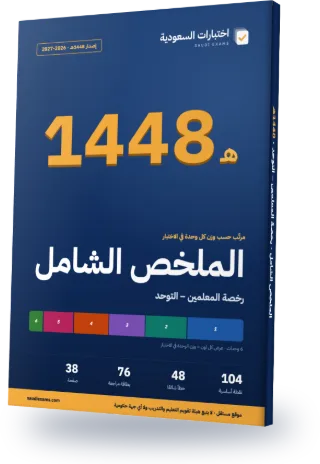
Teacher License – Autism Complete Review Guide 2026–2027
Every exam topic in a 38-page Arabic PDF, ordered from the heaviest unit to the lightest. The first three chapters alone cover about 61% of the exam questions.
- 38Pages
- 104Key points
- 48Common mistakes
- 76Flashcards
Guide map
Each chapter is one exam unit, ordered by its weight in the real exam.
| Chapter | Unit | Weight | Exam questions | Key points |
|---|---|---|---|---|
| 1 | General Principles of Special Education | 25% | 22 | 18 |
| 2 | Planning Instruction for Students with Autism | 19% | 17 | 18 |
| 3 | General Principles of Autism | 17% | 15 | 17 |
| 4 | Motivating and Supporting Learners with Autism | 17% | 15 | 17 |
| 5 | Planning Instruction in Special Education | 15% | 13 | 18 |
| 6 | Motivating and Supporting Learning in Special Education | 7% | 6 | 16 |
Chapter 1 in full: General Principles of Special Education
25% of the exam, about 22 questions. These are its key points, as in the guide.
- Groups served by special education usually include: intellectual, hearing and visual disabilities, learning disabilities, autism, communication disorders, behavioural and emotional disorders, physical and health disabilities, and multiple disabilities (6.17.1.1 / indicator 6).
- Inclusion places the student with a disability in the regular school with suitable support. Its basis is the least restrictive environment: the student moves to a more restrictive setting only when support in the less restrictive one is not enough (6.17.1.1 / 4).
- The cascade of services, least to most restrictive: general class with consultation, general class with a support service, resource room, special class in a regular school, special school or institute, then home or hospital (6.17.1.1 / 7).
The rest of chapter 1, on this page
- In the resource room the student receives support in specific skills for part of the school day and spends the rest of the day in the general class (6.17.1.1 / 7).
- Related services enable the student to benefit from education. They include speech-language therapy, physical therapy, occupational therapy, psychological and social services, and assistive technology (6.17.1.1 / 7).
- The Convention on the Rights of Persons with Disabilities was adopted by the UN in 2006 and ratified by Saudi Arabia in 2008. It affirms the right to inclusive education and non-discrimination (6.17.1.1 / 4).
- Locally, the teacher refers to the Organisational and Procedural Guide for Special Education of the Ministry of Education, and to the Disability Care Authority (هيئة رعاية الأشخاص ذوي الإعاقة) as the body responsible for care of this group (6.17.1.1 / 4).
- Task analysis breaks a skill into small sequential steps that are easy to master, which raises student success. It is a behavioural teaching method that shapes how students with disabilities are taught (6.17.1.1 / 5).
- Prenatal causes: genetic and chromosomal factors (such as Down syndrome, with advanced maternal age as a risk factor), maternal infections such as rubella, alcohol or drug use (fetal alcohol syndrome), and Rh incompatibility (6.17.1.2 / 1).
- Perinatal causes: oxygen deprivation (asphyxia), premature birth and low birth weight, and birth injuries. Postnatal causes: meningitis and high fever, head injuries, malnutrition, and lead poisoning (6.17.1.2 / 1).
- A basic development principle: growth runs head to toe, centre outward and general to specific, in a predictable sequence whose pace differs between children (6.17.1.2 / 2).
- Examples of needs: cognitive (support for attention, memory and generalisation), social (social skills training), psychological (self-esteem) and physical (mobility and health care) (6.17.1.2 / 5).
- Informal assessment tools include observation, interviews, checklists, curriculum-based measurement, portfolios and analysis of work samples (6.17.1.3 / 2).
- The multidisciplinary assessment team includes the family, teacher, psychologist, speech-language pathologist and physical or occupational therapist, and may add the social worker, physician and school principal as the case requires (6.17.1.3 / 3).
- Professional ethics in assessment: informed parental consent, confidentiality, culturally and linguistically fair assessment, and never relying on one instrument (6.17.1.3 / 5).
- Early intervention is organised services for preschool children at risk of, or with, a developmental delay or disability, and for their families. It matters because the early years are the fastest and most responsive period of development (6.17.1.5 / 1).
- Early intervention groups: children with an established condition (such as Down syndrome), children at biological risk (such as prematurity) and children at environmental risk (such as poverty and deprivation) (6.17.1.5 / 4).
- Early intervention delivery models: home-based, centre-based and combined. Current practice is family-centred and set in the child's natural environments (6.17.1.5 / 5).
Common mistakes in this chapter
- Intellectual disability is the accepted term in Saudi special education. Do not pick "mental retardation" when a current term is offered.
- "Slow learners" (المتأخرون دراسيًا) are not a special education category. Low achievement caused by environment or teaching does not mean disability or a learning disability.
- Do not mix impairment, disability and handicap: impairment is a loss or defect in an organ or function, disability is a limit in performing an activity, handicap is the barrier that society or the environment places on the person.
- Measurement, assessment and diagnosis differ: measurement assigns numbers to a trait, assessment gathers varied information for a decision, diagnosis identifies the nature and causes of a problem.
- Do not choose a norm-referenced test for writing IEP goals. It belongs to the eligibility stage, while goals are built on criterion-referenced tests and checklists.
- Primary prevention comes before disability occurs (vaccination, premarital screening, prenatal care); early diagnosis and treatment is secondary, and rehabilitation or reducing effects is tertiary.
- Not every developmental difference means a disability: a mild delay in one area with typical abilities elsewhere is met in the general class with a support service, not a special class.
- A common trap in cause questions: advanced maternal age is linked to Down syndrome, alcohol use in pregnancy to fetal alcohol syndrome; do not swap them.
The other chapters are in the full guide
One purchase · lifetime access · review guide included
7-day review plan
The chapters are spread over 6 days by weight so each day carries a similar load. Day 7 is a full exam.
Day 1 · 25% of the exam
Chapter 1: General Principles of Special Education
Day 2 · 19% of the exam
Chapter 2: Planning Instruction for Students with Autism
Day 3 · 17% of the exam
Chapter 3: General Principles of Autism
Day 4 · 17% of the exam
Chapter 4: Motivating and Supporting Learners with Autism
Day 5 · 15% of the exam
Chapter 5: Planning Instruction in Special Education
Day 6 · 7% of the exam
Chapter 6: Motivating and Supporting Learning in Special Education
Day 7
Full mock exam: 88 questions in 120 minutes, then review the common mistakes in the units where you lost marks.
How many correct answers do you need?
- Practitioner level 50%44 correct out of 88
- Advanced level 70%62 correct out of 88
- Expert level 80%71 correct out of 88
Before you read: see your score today
10 free questions from the main units, no sign-up. Then you know which chapter to start with.
Try 10 free questions and see your levelA look at each chapter
The first three key points of each chapter, as they appear in the guide (in Arabic in the PDF).
Chapter 1: General Principles of Special Education
- Groups served by special education usually include
- Inclusion places the student with a disability in the regular school with suitable support…
- The cascade of services, least to most restrictive
Chapter 2: Planning Instruction for Students with Autism
- Planning uses the student's interests. A special interest (trains, numbers) can serve as a…
- Effective planning
- An IEP includes the present level of performance, measurable annual and short-term goals, related…
Chapter 3: General Principles of Autism
- Autism spectrum disorder is a neurodevelopmental disorder. It appears in the early developmental period…
- DSM-5 criterion A has three parts
- Criterion B requires at least two of four
Chapter 4: Motivating and Supporting Learners with Autism
- Good teaching practice chooses the method by each student's characteristics: support level, language, interests…
- Students with autism often benefit from visual support, a stable routine, and advance notice…
- Classroom management tools include a visual schedule for the lesson, simple picture-based class rules…
Chapter 5: Planning Instruction in Special Education
- Inclusive education
- Universal Access (UA)
- The multi-tiered system of supports (MTSS) has three tiers
Chapter 6: Motivating and Supporting Learning in Special Education
- Consultation
- Collaboration
- Three well-known team models
The full guide comes with lifetime access
The full guide (38 pages) is included with lifetime access to this exam, together with every question and full mock exam. Chapter 1 is free for everyone.
Questions about the guide
Is the guide free?
Chapter 1 is free to read on the guide page. The full guide comes with lifetime access to this exam; 7-day access does not include it.
Is it up to date for 2026–2027?
Yes. Unit weights and exam facts follow what the exam body last published, and the last check date is printed in the guide. If the standards change we update the file and buyers download the new version.
Does the guide have questions?
No. The guide covers key points and common mistakes; scoring, weak-area practice and full mock exams are on the site.
Can I read it on my phone?
Yes. A5 pages in a single column, with chapters linked from the contents.
- Pages
- 38
- Edition
- 1448 AH · 2026–2027
- Language
- Arabic
- Last updated
All Teacher Exams review guides
Back to Teachers' Professional License – Subject Test: Special Education (Autism)
Buy this exam
Pick the access that lasts until your test date.
Included
- Full mock exams: 88 questions in 120 minutes, with a score for every unit
- 470 questions, every option explained with its source
- Practice that starts with your weakest units, plus a review of your mistakes
- Complete Review Guide 2026–2027 (PDF), with lifetime access only
Continue with your Google account and you go straight to the payment page.
You pay on the Waffo Pancake checkout page (in English). The amount is in US dollars and your bank converts it to riyals. One payment with no automatic renewal, by Visa, Mastercard (a mada card with either logo works too), Apple Pay or Google Pay. Your statement shows "WAFFO". Purchases are not refundable.