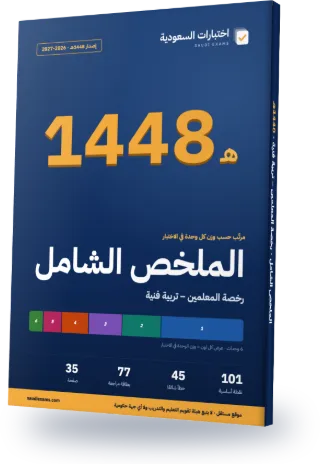
Teacher License – Art Education Complete Review Guide 2026–2027
Every exam topic in a 35-page Arabic PDF, ordered from the heaviest unit to the lightest. The first three chapters alone cover about 71% of the exam questions.
- 35Pages
- 101Key points
- 45Common mistakes
- 77Flashcards
Guide map
Each chapter is one exam unit, ordered by its weight in the real exam.
| Chapter | Unit | Weight | Exam questions | Key points |
|---|---|---|---|---|
| 1 | Art Curriculum, Teaching Methods, Thinking and Assessment | 37% | 33 | 18 |
| 2 | Producing Visual Arts | 18% | 16 | 17 |
| 3 | History of Art Education and New Technologies | 16% | 14 | 17 |
| 4 | Responding to Art | 13% | 11 | 18 |
| 5 | Local and Global Information Sources for Art Education | 9% | 8 | 15 |
| 6 | Nature of Art Education and Its Links to Other Subjects | 7% | 6 | 16 |
Chapter 1 in full: Art Curriculum, Teaching Methods, Thinking and Assessment
37% of the exam, about 33 questions. These are its key points, as in the guide.
- Curriculum elements: objectives, content, teaching methods, activities, technologies, assessment; the teacher links them, so no objective is written that assessment does not measure (6.20.6 indicator 2).
- The systematic curriculum is content-focused and rests on four areas: art production, art history, art appreciation, art criticism (6.20.7 indicator 1).
- The progressive curriculum puts the learning process, the child's needs and self-expression ahead of content.
The rest of chapter 1, on this page
- Curriculum planning starts from big ideas, then facts, then art concepts in the fields of art and design (6.20.7 indicator 3).
- Curriculum evaluation covers all its elements and ends with a report of findings and improvement proposals (6.20.7 indicator 4).
- Methods for making art: demonstration (the teacher shows the steps), learning by example, experimentation (students try materials and techniques), augmented reality, design thinking, play-based learning (6.20.8 indicator 1).
- The five common design thinking stages: empathise, define the problem, ideate, prototype, test.
- Methods for responding to art: dialogue and discussion, questioning (questions that lead students to describe and analyse), modelling, cooperative learning (6.20.8 indicator 2).
- Lowenfeld's stages with approximate ages: scribbling (2 to 4 years), preschematic (4 to 7), schematic (7 to 9), dawning realism (9 to 12), pseudo-naturalism (12 to 14), the decision period (14 to 17).
- In inclusive teaching, the teacher enriches gifted students' learning with deeper, more challenging tasks, adapts tools, activities and space for students with disabilities, and keeps the same learning goal (6.20.8 indicator 3).
- Individual differences in art come from the student's artistic development, visual perception and cultural identity, so one child's drawing is not judged against another child's standard (6.20.8 indicator 4).
- An engaging classroom boosts motivation, curiosity and creativity: displaying student work, keeping materials organised and within reach, and encouraging experimentation and expression (6.20.8 indicator 5).
- Thinking types in art education: creative, critical, design, reflective, and problem solving (6.20.9 indicator 1).
- Mental processes linked to learning: observation, visualisation, imagination, perception, attention, analysis, synthesis, deduction (6.20.9 indicator 2).
- Torrance's creativity components: fluency (number of ideas), flexibility (variety), originality (novelty), elaboration (enriching an idea); each creative activity is designed to develop one of them (6.20.9 indicator 3).
- Objective assessment tools: a rubric describes performance levels for each criterion, a checklist records whether a behaviour is present or absent, and self and peer assessment are added (6.20.10 indicator 1).
- Purposeful assessment fits individual differences and covers individual and group tasks; students are told the criteria before they start work (6.20.10 indicator 2).
- Documented exhibitions, portfolios and test scores show how effective programmes and activities are so they can be improved (6.20.10 indicator 3). Results are explained to students and parents in clear language, and teachers review their own practice regularly.
Common mistakes in this chapter
- Mixing up the systematic curriculum (content: production, history, appreciation, criticism), the progressive one (the learning process and the child's self-expression) and aesthetic education (developing aesthetic sense).
- Crediting the drawing stages to someone other than Lowenfeld; Piaget and Gardner theorised cognitive development and multiple intelligences, not drawing stages.
- Choosing a hard or dangerous material for young students; the best answer is the simplest and safest for their age (paper and glue, not a hammer and wood, for a first grader).
- Confusing methods for making art (demonstration, experimentation) with methods for responding to art (dialogue, questioning); the first produces a work, the second analyses an existing one.
- Mixing up fluency (many ideas), flexibility (varied categories of ideas), originality (rare, new ideas) and elaboration (enriching and extending an idea).
- Confusing a rubric (performance levels for each criterion) with a checklist (only whether a feature is present or absent).
- Relying on the final grade alone; purposeful assessment respects individual differences and covers both process and product.
- Ignoring the classroom situation in the question: a gifted student needs enrichment and challenge, a student with a disability needs adapted tools and activities, and the option that treats everyone the same is usually wrong.
The other chapters are in the full guide
One purchase · lifetime access · review guide included
7-day review plan
The chapters are spread over 6 days by weight so each day carries a similar load. Day 7 is a full exam.
Day 1 · 37% of the exam
Chapter 1: Art Curriculum, Teaching Methods, Thinking and Assessment
Day 2 · 18% of the exam
Chapter 2: Producing Visual Arts
Day 3 · 16% of the exam
Chapter 3: History of Art Education and New Technologies
Day 4 · 13% of the exam
Chapter 4: Responding to Art
Day 5 · 9% of the exam
Chapter 5: Local and Global Information Sources for Art Education
Day 6 · 7% of the exam
Chapter 6: Nature of Art Education and Its Links to Other Subjects
Day 7
Full mock exam: 88 questions in 120 minutes, then review the common mistakes in the units where you lost marks.
How many correct answers do you need?
- Practitioner level 50%44 correct out of 88
- Advanced level 70%62 correct out of 88
- Expert level 80%71 correct out of 88
Before you read: see your score today
10 free questions from the main units, no sign-up. Then you know which chapter to start with.
Try 10 free questions and see your levelA look at each chapter
The first three key points of each chapter, as they appear in the guide (in Arabic in the PDF).
Chapter 1: Art Curriculum, Teaching Methods, Thinking and Assessment
- Curriculum elements
- The systematic curriculum is content-focused and rests on four areas: art production, art history…
- The progressive curriculum puts the learning process, the child's needs and self-expression ahead of…
Chapter 2: Producing Visual Arts
- Standard 6.20.1 has eight indicators
- The fields of art and design include drawing, painting, printmaking, ceramics, sculpture, woodwork, metalwork…
- The four basic printmaking types
Chapter 3: History of Art Education and New Technologies
- Indicator 1 of 6.20.3
- The indicators call for discussing the development through educational theories and analysing it through…
- Art education in Western schools began in the 19th century with industrial, skill-based drawing…
Chapter 4: Responding to Art
- Aesthetics is the branch of philosophy that studies the nature of beauty and art…
- Imitationalism
- Formalism
Chapter 5: Local and Global Information Sources for Art Education
- Standard 6.20.5
- Indicator 1
- Specialist sources include books and references, academic journals, conferences and workshops, specialist websites, professional…
Chapter 6: Nature of Art Education and Its Links to Other Subjects
- Standard 6.20.6 is "knowing the nature of art education and its relation to other…
- Indicator 1
- Indicator 2
The full guide comes with lifetime access
The full guide (35 pages) is included with lifetime access to this exam, together with every question and full mock exam. Chapter 1 is free for everyone.
Questions about the guide
Is the guide free?
Chapter 1 is free to read on the guide page. The full guide comes with lifetime access to this exam; 7-day access does not include it.
Is it up to date for 2026–2027?
Yes. Unit weights and exam facts follow what the exam body last published, and the last check date is printed in the guide. If the standards change we update the file and buyers download the new version.
Does the guide have questions?
No. The guide covers key points and common mistakes; scoring, weak-area practice and full mock exams are on the site.
Can I read it on my phone?
Yes. A5 pages in a single column, with chapters linked from the contents.
- Pages
- 35
- Edition
- 1448 AH · 2026–2027
- Language
- Arabic
- Last updated
All Teacher Exams review guides
Back to Teachers' Professional License – Subject Test: Art Education
Buy this exam
Pick the access that lasts until your test date.
Included
- Full mock exams: 88 questions in 120 minutes, with a score for every unit
- 479 questions, every option explained with its source
- Practice that starts with your weakest units, plus a review of your mistakes
- Complete Review Guide 2026–2027 (PDF), with lifetime access only
Continue with your Google account and you go straight to the payment page.
You pay on the Waffo Pancake checkout page (in English). The amount is in US dollars and your bank converts it to riyals. One payment with no automatic renewal, by Visa, Mastercard (a mada card with either logo works too), Apple Pay or Google Pay. Your statement shows "WAFFO". Purchases are not refundable.