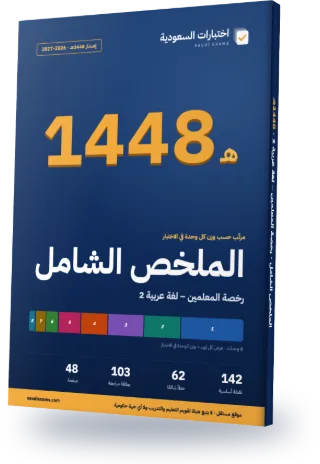
Teacher License – Arabic 2 Complete Review Guide 2026–2027
Every exam topic in a 48-page Arabic PDF, ordered from the heaviest unit to the lightest. The first three chapters alone cover about 62% of the exam questions.
- 48Pages
- 142Key points
- 62Common mistakes
- 103Flashcards
Guide map
Each chapter is one exam unit, ordered by its weight in the real exam.
| Chapter | Unit | Weight | Exam questions | Key points |
|---|---|---|---|---|
| 1 | Syntax (Nahw) | 28% | 25 | 18 |
| 2 | Literature and Criticism | 17% | 15 | 18 |
| 3 | Teaching Arabic | 17% | 15 | 18 |
| 4 | Rhetoric (Balagha) | 13% | 11 | 18 |
| 5 | Language Skills | 11% | 10 | 17 |
| 6 | Morphology (Sarf) | 6% | 5 | 17 |
| 7 | Linguistics | 5% | 4 | 18 |
| 8 | Prosody and Rhyme | 3% | 3 | 18 |
Chapter 1 in full: Syntax (Nahw)
28% of the exam, about 25 questions. These are its key points, as in the guide.
- The five nouns (ab, akh, ḥam, fū, dhū) take wāw in the nominative, alif in the accusative and yāʾ in the genitive, provided they are singular, not diminutive and added to something other than the speaker's yāʾ: akhūka, akhāka, akhīka. (Standard 6.2.1)
- The dual is raised with alif and takes yāʾ in the accusative and genitive. The sound masculine plural is raised with wāw and takes yāʾ in the accusative and genitive. The sound feminine plural takes kasra in the accusative in place of fatḥa. The diptote takes fatḥa in the genitive instead of kasra unless it is annexed or has al-. (Standard 6.2.1)
- Case is of three kinds: apparent (a visible marker), assumed (marker not shown because of impossibility or heaviness, such as maqṣūr al-fatā and manqūṣ al-qāḍī in the nominative and genitive), and positional (for mabnī words and clauses). (Standard 6.2.1)
The rest of chapter 1, on this page
- Kāna and its sisters raise the subject, called their ism, and put the predicate in the accusative. Example «ṣāra akhūka baṭalan»: akhūka is the ism of ṣāra, raised with wāw, and baṭalan is its predicate in the accusative. Inna and its sisters put the subject in the accusative and raise the predicate: «inna l-ʿilma nūrun». (Standard 6.2.2)
- The absolute object is an accusative verbal noun that emphasises its verb, shows its kind or its number: «fariḥtu faraḥan», «sirtu sayra l-musāfirīna», «ḍarabtuhu ḍarbatayni». The object of purpose is an accusative heart-action verbal noun giving the reason for the act: «zurtuka maḥabbatan laka». (Standard 6.2.3)
- Meanings of prepositions: bāʾ for attachment «akhadhtu bi-yadika», fī for containment, min for starting point, ilā for end point, ʿan for moving away, ʿalā for being on top, lām for ownership or specific belonging. (Standard 6.2.4)
- The real construct (maʿnawiyya) gives definiteness or specification «kitābu ṭ-ṭālibi»; the verbal construct (lafẓiyya) annexes an adjective to its object and does not give definiteness «rajulun ḥasanu l-khuluqi». The first term loses nunation and the dual or plural nūn: «muʿallimā l-madrasati». (Standard 6.2.4)
- The imperfect is raised when free of a subjunctive or jussive particle; it is subjunctive after an, lan, kay and idhan; jussive after lam, lammā, the prohibitive lā, the lām of command and conditional particles. The five verbs (such as yafʿalāni) are raised by keeping the nūn and are subjunctive or jussive by dropping it. (Standard 6.2.5)
- The particle an is implied obligatorily after the lām of negation (mā kāna li-yafʿala), after ḥattā, and after fāʾ of causation and wāw of accompaniment in the answer to a request; it is implied optionally after the lām of purpose: «jiʾtu li-tataʿallama», that is li-an tataʿallama. (Standard 6.2.5)
- Jussive conditional particles put two verbs in the jussive: the protasis and the apodosis, as in «in tajtahid tanjaḥ». The apodosis takes fāʾ obligatorily when it cannot stand as a condition, such as a nominal or request clause: «in tajtahid fa-anta nājiḥun». (Standard 6.2.5)
- The real adjective follows its noun in case, definiteness, gender and number: «jāʾa rajulun karīmun». The causal adjective follows it in case and definiteness, and agrees in gender with what comes after: «jāʾa rajulun karīmatun ummuhu». (Standard 6.2.6)
- Apposition (badal) is of four kinds: whole for whole «jāʾa akhūka Muḥammadun», part for whole «akaltu r-raghīfa thuluthahu», inclusion «aʿjabanī l-ustādhu ʿilmuhu», and substitution of a different word. Verbal emphasis repeats the word; semantic emphasis uses words like nafs, ʿayn, kull, jamīʿ: «jāʾa ṭ-ṭullābu kulluhum». (Standard 6.2.6)
- The comparative noun is of the pattern afʿal with three cases: bare, it stays singular and masculine and is followed by min «huwa akbaru min akhīhi»; with al- it agrees «al-akbaru, al-kubrā»; annexed to an indefinite noun it stays singular and masculine, annexed to a definite noun both agreement and non-agreement are allowed. (Standard 6.2.7)
- Numbers 3 to 10 take the opposite gender to the counted noun, which is a genitive plural: «thalāthatu rijālin, thalāthu nisāʾin». In 11 to 19 both parts are built on fatḥa (except ithnā ʿashar) and the counted noun is a singular accusative. The tens 20 to 90 have one form for both genders and a singular accusative counted noun. The hundred and the thousand take a singular genitive counted noun. (Standard 6.2.7)
- A vocative that is a single proper name or a specific indefinite noun is built on what it would be raised with «yā Muḥammadu, yā rajulu»; the annexed noun, the noun resembling an annexed one and the non-specific indefinite noun are accusative «yā ṭāliba l-ʿilmi, yā ghāfilan tanabbah». Appeal for help: «yā la-llāhi li-l-maẓlūmi». Lament: «wā Muḥammadāh». (Standard 6.2.7)
- Exception: after illā in a complete positive clause the excepted noun is obligatorily accusative «fa-sharibū minhu illā qalīlan». In a complete negative clause both accusative and agreement are allowed «mā ḥaḍara ṭ-ṭullābu illā Zaydun». The noun after ghayr or siwā is genitive by annexation. After khalā, ʿadā and ḥāshā both accusative and genitive are allowed; after mā khalā and mā ʿadā only accusative. (Standard 6.2.7)
- Niʿma and biʾsa are two fixed, non-derived perfect verbs for praise and blame. Their doer is a noun with al-, a noun annexed to one with al-, or a hidden pronoun explained by a tamyīz. The specified noun follows: «niʿma r-rajulu Muḥammadun», where it is a postponed subject whose predicate is the preceding clause. (Standard 6.2.7)
- Clauses with a case position are seven: those in the place of a predicate, ḥāl, adjective, object or annexed noun; the apodosis of a jussive condition joined by fāʾ; and a clause following one that has a position. Clauses without a position: opening, resumptive, explanatory, relative (ṣila), parenthetical and the answer to an oath. (Standard 6.2.8)
Common mistakes in this chapter
- Object of purpose vs absolute object: the first is a heart-action verbal noun answering «why?» (zurtuka maḥabbatan laka), the second is a verbal noun from the verb's own root that emphasises, specifies the kind or gives the number (fariḥtu faraḥan).
- Wāw of accompaniment vs wāw of conjunction: in «sirtu wa-n-Nīla» the noun after wāw is an accusative object of accompaniment; in «jāʾa Muḥammadun wa-Khālidun» it is a conjunct that follows the preceding noun's case.
- Kāna and inna work in opposite ways: kāna raises the subject (its ism) and puts the predicate in the accusative, while inna puts the subject (its ism) in the accusative and raises the predicate. Candidates often raise inna's ism or put its predicate in the accusative.
- Case of the excepted noun: after a complete positive clause the noun after illā is obligatorily accusative (fa-sharibū minhu illā qalīlan); after a complete negative clause both accusative and agreement with the excepted-from noun are allowed, with agreement preferred; in a reduced clause it takes the case the governor requires.
- Numbers 3 to 10 take the opposite gender to the counted noun and the counted noun is a genitive plural (thalāthatu rijālin, thalāthu nisāʾin); from 11 to 99 the counted noun is a singular accusative (aḥada ʿashara rajulan).
- Ḥāl vs tamyīz: the ḥāl is usually a derived adjective-like word giving the state of its owner (jāʾa aṭ-ṭālibu musriʿan); the tamyīz is usually a non-derived noun that removes vagueness from the word before it (ishtaraytu riṭlan zaytan).
- The real adjective agrees with its noun in case, definiteness, number and gender; the causal adjective agrees in case and definiteness only and takes its gender from the noun after it (jāʾa rajulun karīmatun ummuhu).
- A clause after an indefinite noun is an adjective and after a definite noun is a ḥāl: in «qadima rajulun yatahallalu wajhuhu» the clause is in the position of a nominative adjective. A relative-clause (ṣila) and a resumptive clause have no case position.
The other chapters are in the full guide
One purchase · lifetime access · review guide included
7-day review plan
The chapters are spread over 6 days by weight so each day carries a similar load. Day 7 is a full exam.
Day 1 · 28% of the exam
Chapter 1: Syntax (Nahw)
Day 2 · 17% of the exam
Chapter 2: Literature and Criticism
Day 3 · 17% of the exam
Chapter 3: Teaching Arabic
Day 4 · 13% of the exam
Chapter 4: Rhetoric (Balagha)
Day 5 · 14% of the exam
Chapter 5: Language Skills
Chapter 8: Prosody and RhymeDay 6 · 11% of the exam
Chapter 6: Morphology (Sarf)
Chapter 7: LinguisticsDay 7
Full mock exam: 88 questions in 120 minutes, then review the common mistakes in the units where you lost marks.
How many correct answers do you need?
- Practitioner level 50%44 correct out of 88
- Advanced level 70%62 correct out of 88
- Expert level 80%71 correct out of 88
Before you read: see your score today
10 free questions from the main units, no sign-up. Then you know which chapter to start with.
Try 10 free questions and see your levelA look at each chapter
The first three key points of each chapter, as they appear in the guide (in Arabic in the PDF).
Chapter 1: Syntax (Nahw)
- The five nouns (ab, akh, ḥam, fū, dhū) take wāw in the nominative, alif…
- The dual is raised with alif and takes yāʾ in the accusative and genitive…
- Case is of three kinds
Chapter 2: Literature and Criticism
- The eras on the common reckoning
- Leading Pre-Islamic poets
- The Mu'allaqat
Chapter 3: Teaching Arabic
- The general aims of teaching Arabic
- The integrated (unity) approach treats language as one whole around a text or theme…
- In a child's language growth, listening and speaking come before reading and writing: a…
Chapter 4: Rhetoric (Balagha)
- Rhetoric in speech is its fit to the situation together with its eloquence. It…
- Ma'ani studies the states of Arabic speech by which it fits the situation; bayan…
- Well-known works of rhetoric
Chapter 5: Language Skills
- The elements of oral communication
- A good listener hears the speaker without interrupting, keeps focus, picks out the main…
- A good speaker has a clear voice, correct language, well-ordered ideas and awareness of…
Chapter 6: Morphology (Sarf)
- The mizan is f-ʿ-l
- A quadriliteral takes a second lām
- The added letters in mustakhrij are mīm, sīn and tā' and its pattern is…
Chapter 7: Linguistics
- In al-Khaṣāʾiṣ, Ibn Jinnī defined language as "sounds by which every people express their…
- General features of language
- Functions of language include communication, thinking, expressing feelings, and preserving and transmitting heritage across…
Chapter 8: Prosody and Rhyme
- ʿIlm al-ʿarūḍ is the science of the metres of Arabic poetry; ʿilm al-qāfiya is…
- A line has two hemistichs
- Taṣrīʿ is when the ʿarūḍ of a line matches its ḍarb in metre and…
The full guide comes with lifetime access
The full guide (48 pages) is included with lifetime access to this exam, together with every question and full mock exam. Chapter 1 is free for everyone.
Questions about the guide
Is the guide free?
Chapter 1 is free to read on the guide page. The full guide comes with lifetime access to this exam; 7-day access does not include it.
Is it up to date for 2026–2027?
Yes. Unit weights and exam facts follow what the exam body last published, and the last check date is printed in the guide. If the standards change we update the file and buyers download the new version.
Does the guide have questions?
No. The guide covers key points and common mistakes; scoring, weak-area practice and full mock exams are on the site.
Can I read it on my phone?
Yes. A5 pages in a single column, with chapters linked from the contents.
- Pages
- 48
- Edition
- 1448 AH · 2026–2027
- Language
- Arabic
- Last updated
All Teacher Exams review guides
Back to Teachers' Professional License – Subject Test: Arabic Language 2
Buy this exam
Pick the access that lasts until your test date.
Included
- Full mock exams: 88 questions in 120 minutes, with a score for every unit
- 482 questions, every option explained with its source
- Practice that starts with your weakest units, plus a review of your mistakes
- Complete Review Guide 2026–2027 (PDF), with lifetime access only
Continue with your Google account and you go straight to the payment page.
You pay on the Waffo Pancake checkout page (in English). The amount is in US dollars and your bank converts it to riyals. One payment with no automatic renewal, by Visa, Mastercard (a mada card with either logo works too), Apple Pay or Google Pay. Your statement shows "WAFFO". Purchases are not refundable.