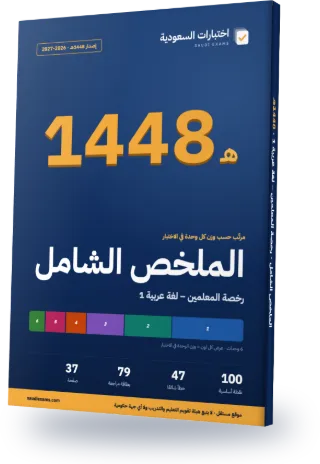
Teacher License – Arabic 1 Complete Review Guide 2026–2027
Every exam topic in a 37-page Arabic PDF, ordered from the heaviest unit to the lightest. The first three chapters alone cover about 72% of the exam questions.
- 37Pages
- 100Key points
- 47Common mistakes
- 79Flashcards
Guide map
Each chapter is one exam unit, ordered by its weight in the real exam.
| Chapter | Unit | Weight | Exam questions | Key points |
|---|---|---|---|---|
| 1 | Grammar and morphology | 32% | 28 | 18 |
| 2 | Teaching Arabic in primary school | 22% | 19 | 17 |
| 3 | Literature and appreciation | 18% | 16 | 17 |
| 4 | Receiving language (reading and listening) | 10% | 9 | 15 |
| 5 | Producing language (speaking and writing) | 10% | 9 | 17 |
| 6 | Language and vocabulary | 8% | 7 | 16 |
Chapter 1 in full: Grammar and morphology
32% of the exam, about 28 questions. These are its key points, as in the guide.
- Marks of the noun: al-, tanwīn, the genitive, the vocative, and being the subject of predication. Marks of the verb: qad, sa- and sawfa, the doer's tāʾ, the silent feminine tāʾ, the addressed-feminine yāʾ, the emphatic nūn. A particle has neither kind of mark (6.36.1, indicators 1 and 2).
- Verbs fall into three kinds: past, indeclinable; imperfect, usually declinable, beginning with one of the letters of «anaytu»; imperative, built on whatever the jussive imperfect would end in (6.36.1, indicator 3).
- A declinable word changes its ending with its role in the sentence; an indeclinable word keeps one form. Indeclinable: past and imperative verbs, particles, pronouns, demonstratives, relatives and interrogative nouns (6.36.1, indicator 4).
The rest of chapter 1, on this page
- Primary markers: damma for nominative, fatḥa for accusative, kasra for genitive, sukūn for jussive. Secondary markers: alif, wāw, yāʾ and nūn; kasra in place of fatḥa for the sound feminine plural; fatḥa in place of kasra for diptotes (6.36.1, indicator 5).
- The seven definite nouns: pronoun, proper name, demonstrative, relative, noun with al-, noun annexed to a definite noun, specified vocative. Everything else is indefinite (6.36.1, indicators 6 and 7).
- Subject and predicate are nominative: by damma in the singular, alif in the dual, wāw in the sound masculine plural. The five nouns take wāw (abūka, akhūka) when annexed to anything but the first-person yāʾ (6.36.2, indicator 1).
- Kāna and its sisters keep the subject nominative as their noun and put the predicate in the accusative; inna and its sisters put the subject in the accusative and keep the predicate nominative (6.36.2, indicator 2).
- The doer is a nominative noun after an active verb. If the verb is made passive, the doer is dropped and the object takes its place as the deputy doer, in the nominative (6.36.2, indicator 3).
- The absolute object is an accusative verbal noun from the verb's own root, of three kinds: emphasising (ḍarabtuhu ḍarban), specifying the manner (taʿallaqtu taʿalluqan shadīdan), specifying the number (ḍarabtuhu ḍarbatayn). The object of purpose is an accusative verbal noun of feeling giving the reason (6.36.3, indicators 2 and 3).
- Adverbs of time (ṣabāḥan, yawman) and place (amāma, fawqa, ʿinda) are accusative and carry the sense of «in». Ḥāl is an accusative indefinite noun giving the state of its owner; tamyīz is an accusative indefinite noun removing vagueness in a number or measure (6.36.3, indicators 4 and 5).
- A genitive noun is governed by a preposition or by a first term. Meanings: min for starting point, ilā for end point, fī for containment, ʿalā for being upon, bi- for attachment or instrument, li- for ownership, ka- for likeness, wa- for an oath (6.36.4, indicators 1 and 2).
- The imperfect is nominative when free of both kinds of particle; accusative after an, lan, kay and idhan; jussive after lam, lammā, prohibitive lā, the lām of command and jussive conditionals. The five verbs are nominative with the nūn kept and accusative or jussive with it dropped (6.36.5, indicators 1 to 3).
- Common conjunctions: wa (mere joining), fa (sequence with immediacy), thumma (sequence with delay), aw and am (choice or doubt), bal, lākin and lā (turning away, correction, negation). The conjoined word follows the earlier word's case (6.36.6, indicators 1 and 2).
- The adjective follows the described noun in case, definiteness, number and gender (for the real adjective). Verbal emphasis repeats the word; semantic emphasis uses words such as nafs, ʿayn, kull, jamīʿ, kilā and kiltā (6.36.6, indicators 3 and 4).
- The comparative pattern afʿal is formed from a full triliteral active verb that is not negated and does not denote a colour or defect. Otherwise use ashadd or akthar plus the verbal noun. The two regular exclamation patterns are mā afʿalahu! and afʿil bihi! (6.36.7, indicators 6 and 10).
- Numbers 3 to 10 take the opposite gender of the counted noun, which is a genitive plural (thalāthatu rijālin, thalāthu nisāʾin); numbers 11 to 99 take a singular accusative counted noun (aḥada ʿashara rajulan). Numbers 1 and 2 agree with the counted noun (6.36.7, indicator 7).
- A sound verb has no weak letter (w, ā, y) in its root; this includes hamzated (saʾala) and doubled (madda). Weak verbs: assimilated (waʿada), hollow (qāla), defective (ramā), doubly weak (ṭawā). The morphological scale is faʿala, and extra letters stay in the pattern (6.36.8, indicators 2 and 6).
- A maqṣūr noun ends in a fixed alif (fatā, ʿaṣā); a manqūṣ in a fixed yāʾ preceded by kasra (al-qāḍī); a mamdūd in a hamza after an extra alif (ṣaḥrāʾ). The relative adjective adds a doubled yāʾ with kasra before it; diminutive patterns: fuʿayl, fuʿayʿil, fuʿayʿīl (6.36.8, indicators 8 and 9).
Common mistakes in this chapter
- The silent feminine tāʾ (qāmat) is not the vowelled tāʾ at the end of a noun (muʿallima): the first marks a past verb, the second belongs to a noun. Do not treat every tāʾ as a verb mark.
- The past verb is always indeclinable (mabnī); the imperfect is declinable except when the feminine plural nūn or the direct emphatic nūn attaches. Reject both «every verb is mabnī» and «every verb is muʿrab».
- In a construct phrase the first term takes neither al- nor tanwīn, so we say muʿallimū al-madrasa with the nūn dropped, and al- stays on the second term only.
- The absolute object is a verbal noun from the verb's own root (taʿallaqtu taʿalluqan shadīdan); the object of purpose is a verbal noun of feeling that gives the reason and answers «why?». A bare accusative verbal noun is not automatically an object of purpose.
- Ḥāl is an indefinite descriptor of the state of its owner and answers «how?»; tamyīz is an indefinite noun that removes vagueness in a number, measure or kind. Ḥāl can be a clause or a prepositional phrase; tamyīz cannot.
- The negating lā does not jussive; the prohibitive lā does. Negation reports and prohibition requests that something be left. Check the verb's ending and the meaning before deciding which lā you have.
- Idhā and law are non-jussive conditionals, while in, man, mā, mahmā, matā, aynamā and ḥaythumā jussive two verbs. Lammā jussives one verb and is not a jussive conditional.
- Numbers 3 to 10 take the opposite gender of the counted noun and annex to a genitive plural; numbers 11 to 99 take a singular accusative counted noun. Mixing these two rules is the commonest error in number questions.
The other chapters are in the full guide
One purchase · lifetime access · review guide included
7-day review plan
The chapters are spread over 6 days by weight so each day carries a similar load. Day 7 is a full exam.
Day 1 · 32% of the exam
Chapter 1: Grammar and morphology
Day 2 · 22% of the exam
Chapter 2: Teaching Arabic in primary school
Day 3 · 18% of the exam
Chapter 3: Literature and appreciation
Day 4 · 10% of the exam
Chapter 4: Receiving language (reading and listening)
Day 5 · 10% of the exam
Chapter 5: Producing language (speaking and writing)
Day 6 · 8% of the exam
Chapter 6: Language and vocabulary
Day 7
Full mock exam: 88 questions in 120 minutes, then review the common mistakes in the units where you lost marks.
How many correct answers do you need?
- Practitioner level 50%44 correct out of 88
- Advanced level 70%62 correct out of 88
- Expert level 80%71 correct out of 88
Before you read: see your score today
10 free questions from the main units, no sign-up. Then you know which chapter to start with.
Try 10 free questions and see your levelA look at each chapter
The first three key points of each chapter, as they appear in the guide (in Arabic in the PDF).
Chapter 1: Grammar and morphology
- Marks of the noun
- Verbs fall into three kinds
- A declinable word changes its ending with its role in the sentence; an indeclinable…
Chapter 2: Teaching Arabic in primary school
- Listening is a deliberate skill built on attention, understanding and recall, unlike hearing, which…
- Listening strategies for beginners include reading a story aloud with expression and then asking…
- Speaking strategies include picture description (the teacher shows a picture and pupils describe it)…
Chapter 3: Literature and appreciation
- Pre-Islamic
- Early Islamic
- Umayyad
Chapter 4: Receiving language (reading and listening)
- Reading is a mental process in which the reader recognizes written symbols, pronounces them…
- By manner of performance, reading is of two kinds
- Reading aloud aims at correct pronunciation and expressing meaning with the voice. Silent reading…
Chapter 5: Producing language (speaking and writing)
- The elements of oral communication
- Foundations of oral communication include a clear aim, a message suited to the listener…
- Skills of effective speaking
Chapter 6: Language and vocabulary
- In Ibn Jinni's definition (al-Khasa'is), language is sounds by which each people express their…
- Traits of language
- Language is a system of vocal symbols, and the link between a word and…
The full guide comes with lifetime access
The full guide (37 pages) is included with lifetime access to this exam, together with every question and full mock exam. Chapter 1 is free for everyone.
Questions about the guide
Is the guide free?
Chapter 1 is free to read on the guide page. The full guide comes with lifetime access to this exam; 7-day access does not include it.
Is it up to date for 2026–2027?
Yes. Unit weights and exam facts follow what the exam body last published, and the last check date is printed in the guide. If the standards change we update the file and buyers download the new version.
Does the guide have questions?
No. The guide covers key points and common mistakes; scoring, weak-area practice and full mock exams are on the site.
Can I read it on my phone?
Yes. A5 pages in a single column, with chapters linked from the contents.
- Pages
- 37
- Edition
- 1448 AH · 2026–2027
- Language
- Arabic
- Last updated
All Teacher Exams review guides
Back to Teachers' Professional License – Subject Test: Arabic Language 1
Buy this exam
Pick the access that lasts until your test date.
Included
- Full mock exams: 88 questions in 120 minutes, with a score for every unit
- 484 questions, every option explained with its source
- Practice that starts with your weakest units, plus a review of your mistakes
- Complete Review Guide 2026–2027 (PDF), with lifetime access only
Continue with your Google account and you go straight to the payment page.
You pay on the Waffo Pancake checkout page (in English). The amount is in US dollars and your bank converts it to riyals. One payment with no automatic renewal, by Visa, Mastercard (a mada card with either logo works too), Apple Pay or Google Pay. Your statement shows "WAFFO". Purchases are not refundable.