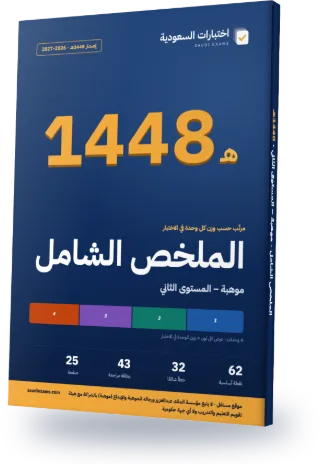
Mawhiba Level 2 Complete Review Guide 2026–2027
Every exam topic in a 25-page Arabic PDF, ordered from the heaviest unit to the lightest. The first three chapters alone cover about 75% of the exam questions.
- 25Pages
- 62Key points
- 32Common mistakes
- 43Flashcards
Guide map
Each chapter is one exam unit, ordered by its weight in the real exam.
| Chapter | Unit | Weight | Exam questions | Key points |
|---|---|---|---|---|
| 1 | Verbal Reasoning and Reading Comprehension | 25% | 24 | 15 |
| 2 | Mathematical and Spatial Reasoning | 25% | 24 | 16 |
| 3 | Scientific and Mechanical Reasoning | 25% | 24 | 15 |
| 4 | Mental Flexibility | 25% | 24 | 16 |
Chapter 1 in full: Verbal Reasoning and Reading Comprehension
25% of the exam, about 24 questions. These are its key points, as in the guide.
- Common analogy relations: tool and use, part and whole, cause and effect, job and place, opposites, material and product, and degree (warm : hot).
- Method: build a sentence linking the two words and test every option with it; if it fits more than one option, make the sentence more precise by adding a word that pins down the relation.
- Linking words: 'but', 'while' and 'although' signal contrast; 'so', 'because' and 'as a result' signal cause and effect; 'and' continues the same idea.
The rest of chapter 1, on this page
- With two blanks: try the whole option in both blanks together; the first may fit while the second does not, which rules the option out.
- Skip the words you do not know first and eliminate the options that contradict the sentence; often one option is left even if you do not know every word.
- In contextual error the sentence holds two linked ideas: ask whether the word fits the other idea. Example: 'he took an umbrella because the sky was clear' - the contradicting word is 'clear'.
- Synonyms are close in meaning but can differ in strength; 'furious' is stronger than 'annoyed', so notice how strong the word is in the sentence.
- A word with several meanings is understood from the sentence: it may be a body part or a spring of water; read what comes before and after it.
- In word classification there is often more than one possible basis; the one you want is the basis that makes exactly one word different.
- Reading order: question, passage, then back to the supporting sentence. Do not try to memorise the passage; it stays on screen the whole time.
- The main idea is what every paragraph is about; it covers the details and is never itself one of the details.
- A question like 'which cannot be inferred' has three options the passage supports and one it does not; check each option separately.
- A question on the writer's purpose is answered by what the passage does: explain, compare, tell a story or argue a view.
- Word meaning in a passage: substitute the option for the word and reread the sentence; it must still make sense.
- Time: about 75 seconds per question on average (120 minutes for 96 questions); read a long passage once with focus and answer its two or three questions together.
Common mistakes in this chapter
- Picking a pair from the same topic with a different relation: 'doctor : hospital' and 'doctor : medicine' are both about medicine, but only the first is a job and its workplace.
- Reversing the order of the pair: if the relation is part : whole, a pair written whole : part is wrong even when the two words are right.
- Ignoring the linking word: 'although the weather was cold' needs an opposite idea, and students fall for the option that agrees with the cold.
- Choosing the word that sounds nicest rather than the one the meaning needs; try the option in the sentence and reread the whole thing.
- In odd-word-out: assuming a surface feature (like the number of letters) is the basis, when the grouping is about meaning.
- An answer that is true in real life but not in the passage: an option that is generally correct but unsupported by the text is not the answer.
- An option that copies a phrase from the passage but changes or exaggerates the meaning with words like 'always', 'all' and 'no one'.
- Choosing a title that covers only one paragraph; the best title covers the whole passage, and the main idea is never a minor detail.
The other chapters are in the full guide
One purchase · lifetime access · review guide included
7-day review plan
The chapters are spread over 6 days by weight so each day carries a similar load. Day 7 is a full exam.
Day 1 · 25% of the exam
Chapter 1: Verbal Reasoning and Reading Comprehension
Day 2 · 25% of the exam
Chapter 2: Mathematical and Spatial Reasoning
Day 3 · 25% of the exam
Chapter 3: Scientific and Mechanical Reasoning
Day 4 · 25% of the exam
Chapter 4: Mental Flexibility
Day 5
Full mock exam: 96 questions in 120 minutes, then review the common mistakes in the units where you lost marks.
Before you read: see your score today
10 free questions from the main units, no sign-up. Then you know which chapter to start with.
Try 10 free questions and see your levelA look at each chapter
The first three key points of each chapter, as they appear in the guide (in Arabic in the PDF).
Chapter 1: Verbal Reasoning and Reading Comprehension
- Common analogy relations
- Method
- Linking words
Chapter 2: Mathematical and Spatial Reasoning
- Percentages
- Ratio and proportion
- Average = total ÷ count. If you know the average and the count, the…
Chapter 3: Scientific and Mechanical Reasoning
- A fair test
- Heat moves from hotter to cooler in three ways
- Metal feels colder to the touch because it is a good conductor and draws…
Chapter 4: Mental Flexibility
- Common code rules
- In a compound code two rules may be applied one after the other: work…
- Solving two equations
The full guide comes with lifetime access
The full guide (25 pages) is included with lifetime access to this exam, together with every question and full mock exam. Chapter 1 is free for everyone.
Questions about the guide
Is the guide free?
Chapter 1 is free to read on the guide page. The full guide comes with lifetime access to this exam; 7-day access does not include it.
Is it up to date for 2026–2027?
Yes. Unit weights and exam facts follow what the exam body last published, and the last check date is printed in the guide. If the standards change we update the file and buyers download the new version.
Does the guide have questions?
No. The guide covers key points and common mistakes; scoring, weak-area practice and full mock exams are on the site.
Can I read it on my phone?
Yes. A5 pages in a single column, with chapters linked from the contents.
- Pages
- 25
- Edition
- 1448 AH · 2026–2027
- Language
- Arabic
- Last updated
Buy this exam
Pick the access that lasts until your test date.
Included
- Full mock exams: 96 questions in 120 minutes, with a score for every unit
- 511 questions, every option explained with its source
- Practice that starts with your weakest units, plus a review of your mistakes
- Complete Review Guide 2026–2027 (PDF), with lifetime access only
Continue with your Google account and you go straight to the payment page.
You pay on the Waffo Pancake checkout page (in English). The amount is in US dollars and your bank converts it to riyals. One payment with no automatic renewal, by Visa, Mastercard (a mada card with either logo works too), Apple Pay or Google Pay. Your statement shows "WAFFO". Purchases are not refundable.