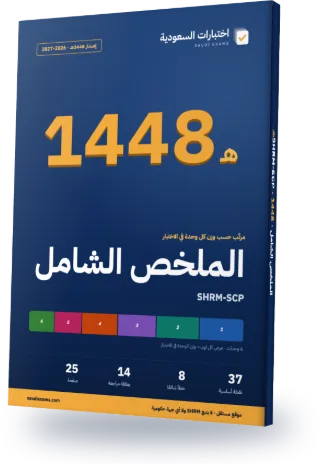
SHRM-SCP Complete Review Guide 2026–2027
Every exam topic in a 25-page Arabic PDF, ordered from the heaviest unit to the lightest. The first three chapters alone cover about 57% of the exam questions.
- 25Pages
- 37Key points
- 8Common mistakes
- 14Flashcards
Guide map
Each chapter is one exam unit, ordered by its weight in the real exam.
| Chapter | Unit | Weight | Exam questions | Key points |
|---|---|---|---|---|
| 1 | Leadership | 19% | 26 | 7 |
| 2 | People | 19% | 26 | 6 |
| 3 | Organization | 18% | 24 | 6 |
| 4 | Business | 17% | 23 | 6 |
| 5 | Interpersonal | 13% | 18 | 6 |
| 6 | Workplace | 13% | 17 | 6 |
Chapter 1 in full: Leadership
19% of the exam, about 26 questions. These are its key points, as in the guide.
- Use formal governance and informal influence together. A sponsor can mobilize support, but the body holding the relevant decision right still authorizes the action. Source: SHRM BASK 2026, pp. 13, Navigating the Organization.
- Define the future capabilities the business needs, compare them with the current state, and secure executive input on priorities. A changed market assumption can justify revising the HR strategy rather than preserving an obsolete plan. Source: SHRM BASK 2026, pp. 14, Vision.
- Translate strategy into a funded portfolio with owners, milestones and outcome measures. When resources conflict, evaluate enterprise value and dependencies rather than treating every sponsor’s project as equally urgent. Source: SHRM BASK 2026, pp. 15, Managing HR Initiatives.
The rest of chapter 1, on this page
- Build executive consensus around evidence and business consequences. Establish room for responsible experimentation through agreed risk limits and accountability. Source: SHRM BASK 2026, pp. 16, Influence.
- Create controls that protect reporting, preserve appropriate confidentiality and provide impartial oversight. When a powerful leader is implicated, their rank does not justify controlling the investigation or retaliating against reporters. Source: SHRM BASK 2026, pp. 18–20, Ethical Practice.
- Link inclusion strategy to organizational performance while testing access barriers. Use measures tied to the process and lawful local context; a single aggregate metric can hide unequal access at individual stages. Source: SHRM BASK 2026, pp. 22–24 and 26, Inclusive Mindset.
- Design a consistent global intent with justified local adaptation. Cultural awareness supports inquiry into actual needs; it is not evidence that every individual from a country has the same preferences. Source: SHRM BASK 2026, pp. 25–26, Inclusive Mindset.
Common mistakes in this chapter
- Do not delay urgent protection while seeking complete information. Conversely, avoid irreversible enterprise action when a critical assumption remains untested.
- Executive agreement does not override ethical controls or applicable legal duties. Consult the appropriate independent governance body when senior leaders have conflicts.
- A workforce demographic target alone does not establish inclusion or fair access. Examine opportunity, participation and outcomes in the relevant process.
The other chapters are in the full guide
One purchase · lifetime access · review guide included
7-day review plan
The chapters are spread over 6 days by weight so each day carries a similar load. Day 7 is a full exam.
Day 1 · 19% of the exam
Chapter 1: Leadership
Day 2 · 19% of the exam
Chapter 2: People
Day 3 · 18% of the exam
Chapter 3: Organization
Day 4 · 17% of the exam
Chapter 4: Business
Day 5 · 13% of the exam
Chapter 5: Interpersonal
Day 6 · 13% of the exam
Chapter 6: Workplace
Day 7
Full mock exam: 134 questions in 220 minutes, then review the common mistakes in the units where you lost marks.
Before you read: see your score today
10 free questions from the main units, no sign-up. Then you know which chapter to start with.
Try 10 free questions and see your levelA look at each chapter
The first three key points of each chapter, as they appear in the guide (in Arabic in the PDF).
Chapter 1: Leadership
- Use formal governance and informal influence together. A sponsor can mobilize support, but the…
- Define the future capabilities the business needs, compare them with the current state, and…
- Translate strategy into a funded portfolio with owners, milestones and outcome measures. When resources…
Chapter 2: People
- Set HR priorities from the business strategy and required organizational capabilities. A set of…
- Build a talent acquisition strategy around future capability, labor supply and selection quality. Faster…
- Target retention efforts using evidence about critical capability and reasons for leaving. A blanket…
Chapter 3: Organization
- Choose an HR operating model that fits the organization’s scale, strategy and service needs…
- Assess structures, processes, culture and incentives together when diagnosing organizational effectiveness. A restructuring can…
- Compare future demand for work with the available supply of capability. Use scenarios and…
Chapter 4: Business
- Connect the people strategy to the business model. Compare labor-market conditions, competitive priorities and…
- A business case should identify relevant incremental costs, benefits, uncertainty and evaluation criteria. Include…
- Consultation begins with the actual business challenge and available evidence. Agree the intended outcome…
Chapter 5: Interpersonal
- Build a network that provides relevant insight and mutual trust across organizational boundaries. A…
- Align cross-functional teams on a shared enterprise outcome, decision rights and accountability. Local performance…
- In negotiation, distinguish stated positions from underlying interests. Evaluate packages against objectives and constraints…
Chapter 6: Workplace
- Choose global workforce arrangements that fit the business purpose and local conditions. Consider capability…
- Integrate people risks into enterprise risk decisions. Assess likelihood, impact, controls and ownership; a…
- Plan business continuity for critical roles and dependencies. Exercises should test assumptions and recovery…
The full guide comes with lifetime access
The full guide (25 pages) is included with lifetime access to this exam, together with every question and full mock exam. Chapter 1 is free for everyone.
Questions about the guide
Is the guide free?
Chapter 1 is free to read on the guide page. The full guide comes with lifetime access to this exam; 7-day access does not include it.
Is it up to date for 2026–2027?
Yes. Unit weights and exam facts follow what the exam body last published, and the last check date is printed in the guide. If the standards change we update the file and buyers download the new version.
Does the guide have questions?
No. The guide covers key points and common mistakes; scoring, weak-area practice and full mock exams are on the site.
Can I read it on my phone?
Yes. A5 pages in a single column, with chapters linked from the contents.
- Pages
- 25
- Edition
- 1448 AH · 2026–2027
- Language
- Arabic
- Last updated
Buy this exam
Pick the access that lasts until your test date.
Included
- Timed supplementary practice sessions: 134 questions in 220 minutes
- 500 questions, every option explained with its source
- Practice that starts with your weakest units, plus a review of your mistakes
- Complete Review Guide 2026–2027 (PDF), with lifetime access only
Continue with your Google account and you go straight to the payment page.
You pay on the Waffo Pancake checkout page (in English). The amount is in US dollars and your bank converts it to riyals. One payment with no automatic renewal, by Visa, Mastercard (a mada card with either logo works too), Apple Pay or Google Pay. Your statement shows "WAFFO". Purchases are not refundable.