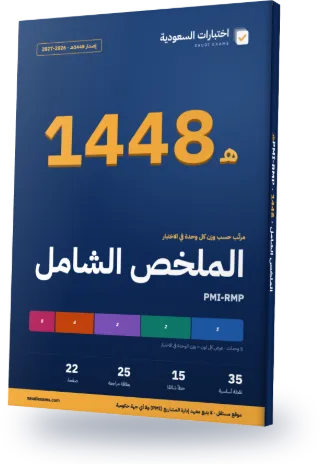
PMI-RMP Complete Review Guide 2026–2027
Every exam topic in a 22-page Arabic PDF, ordered from the heaviest unit to the lightest. The first three chapters alone cover about 68% of the exam questions.
- 22Pages
- 35Key points
- 15Common mistakes
- 25Flashcards
Guide map
Each chapter is one exam unit, ordered by its weight in the real exam.
| Chapter | Unit | Weight | Exam questions | Key points |
|---|---|---|---|---|
| 1 | Risk Identification | 23% | 27 | 7 |
| 2 | Risk Analysis | 23% | 26 | 7 |
| 3 | Risk Strategy and Planning | 22% | 25 | 7 |
| 4 | Monitor and Close Risks | 19% | 22 | 7 |
| 5 | Risk Response | 13% | 15 | 7 |
Chapter 1 in full: Risk Identification
23% of the exam, about 27 questions. These are its key points, as in the guide.
- Use interviews, workshops, documents and operational data to find different perspectives. A workshop dominated by one senior stakeholder can miss uncertainty that quieter specialists understand. (Source: Domain II, Tasks 1–4, printed page 7).
- Challenge assumptions and constraints and link them to objectives. An assumed approval date can affect procurement, commissioning and benefits through a chain of dependencies. (Source: Domain II, Tasks 1–4, printed page 7).
- Separate a cause, an uncertain event and its consequence. A supplier capacity shortage is not the same as the future missed delivery or the resulting commissioning delay. (Source: Domain II, Tasks 1–4, printed page 7).
The rest of chapter 1, on this page
- Document observable triggers, timing and thresholds in context. An indicator that arrives after the response deadline may describe harm without enabling action. (Source: Domain II, Tasks 1–4, printed page 7).
- The register needs valid risks, owners and relevant attributes such as probability, impact and urgency. Preserve traceability when merging duplicates; do not erase distinct consequences or responsibilities. (Source: Domain II, Tasks 1–4, printed page 7).
- A factory assumes that an external inspection will occur before a shutdown window. Challenge the assumption, trace the dependency and identify an early observable signal. Waiting until the shutdown starts removes response time.
- Quick reference: cause → uncertain event → objective effect; trigger → observable signal; owner → accountable follow-up; register → traceable risk attributes.
Common mistakes in this chapter
- Recording only threats and overlooking favorable uncertainty.
- Calling an already realized event a future uncertain event.
- Confusing an observed trigger with the authorized acceptance threshold.
The other chapters are in the full guide
One purchase · lifetime access · review guide included
7-day review plan
The chapters are spread over 6 days by weight so each day carries a similar load. Day 7 is a full exam.
Day 1 · 23% of the exam
Chapter 1: Risk Identification
Day 2 · 23% of the exam
Chapter 2: Risk Analysis
Day 3 · 22% of the exam
Chapter 3: Risk Strategy and Planning
Day 4 · 19% of the exam
Chapter 4: Monitor and Close Risks
Day 5 · 13% of the exam
Chapter 5: Risk Response
Day 6
Full mock exam: 115 questions in 150 minutes, then review the common mistakes in the units where you lost marks.
Before you read: see your score today
10 free questions from the main units, no sign-up. Then you know which chapter to start with.
Try 10 free questions and see your levelA look at each chapter
The first three key points of each chapter, as they appear in the guide (in Arabic in the PDF).
Chapter 1: Risk Identification
- Use interviews, workshops, documents and operational data to find different perspectives. A workshop dominated…
- Challenge assumptions and constraints and link them to objectives. An assumed approval date can…
- Separate a cause, an uncertain event and its consequence. A supplier capacity shortage is…
Chapter 2: Risk Analysis
- Nominal classification groups risks by category; ordinal ranking orders them. A category label is…
- Include urgency and timing when prioritizing. Two risks with similar probability and impact may…
- For mutually exclusive outcomes, expected value is the sum of probability multiplied by outcome…
Chapter 3: Risk Strategy and Planning
- Review historical records for relevance and provenance. A similar project is useful evidence only…
- Assess organizational assets, environmental factors and lifecycle. In a hybrid project, review risks at…
- Translate appetite into explicit thresholds for relevant objectives. Agree who can accept exposure and…
Chapter 4: Monitor and Close Risks
- Compare data on a consistent basis before interpreting variance. Different reporting dates, baseline versions…
- Monitor the risk response and its residual and secondary effects. Reassess their impact on…
- Update the register, lessons, plans and change records consistently. A response adjustment that changes…
Chapter 5: Risk Response
- Choose responses against the stated objectives and constraints. Threat avoidance changes the plan to…
- For opportunities, consider actions that increase the likelihood or benefit and arrangements that help…
- Specify action owners, completion dates, resources and effectiveness measures. If the action finishes after…
The full guide comes with lifetime access
The full guide (22 pages) is included with lifetime access to this exam, together with every question and full mock exam. Chapter 1 is free for everyone.
Questions about the guide
Is the guide free?
Chapter 1 is free to read on the guide page. The full guide comes with lifetime access to this exam; 7-day access does not include it.
Is it up to date for 2026–2027?
Yes. Unit weights and exam facts follow what the exam body last published, and the last check date is printed in the guide. If the standards change we update the file and buyers download the new version.
Does the guide have questions?
No. The guide covers key points and common mistakes; scoring, weak-area practice and full mock exams are on the site.
Can I read it on my phone?
Yes. A5 pages in a single column, with chapters linked from the contents.
- Pages
- 22
- Edition
- 1448 AH · 2026–2027
- Language
- Arabic
- Last updated
Buy this exam
Pick the access that lasts until your test date.
Included
- Timed supplementary practice sessions: 115 questions in 150 minutes
- 500 questions, every option explained with its source
- Practice that starts with your weakest units, plus a review of your mistakes
- Complete Review Guide 2026–2027 (PDF), with lifetime access only
Continue with your Google account and you go straight to the payment page.
You pay on the Waffo Pancake checkout page (in English). The amount is in US dollars and your bank converts it to riyals. One payment with no automatic renewal, by Visa, Mastercard (a mada card with either logo works too), Apple Pay or Google Pay. Your statement shows "WAFFO". Purchases are not refundable.