PMI-ACP
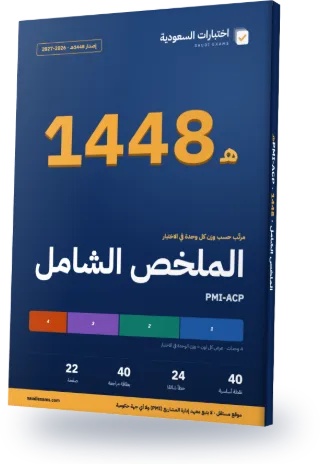
PMI-ACP Complete Review Guide 2026–2027
Every exam topic in a 22-page Arabic PDF, ordered from the heaviest unit to the lightest. The first three chapters alone cover about 81% of the exam questions.
- 22Pages
- 40Key points
- 24Common mistakes
- 40Flashcards
Guide map
Each chapter is one exam unit, ordered by its weight in the real exam.
| Chapter | Unit | Weight | Exam questions | Key points |
|---|---|---|---|---|
| 1 | Mindset | 28% | 34 | 10 |
| 2 | Delivery | 28% | 33 | 10 |
| 3 | Leadership | 25% | 30 | 10 |
| 4 | Product | 19% | 23 | 10 |
Chapter 1 in full: Mindset
28% of the exam, about 34 questions. These are its key points, as in the guide.
- A minimum viable product is a learning tool: it tests the key assumption with the least effort.
- A failed experiment is useful because it gives cheap learning that guides the next decision.
- Stacey matrix: high agreement and certainty = simple; strong disagreement and new technology = near chaos.
The rest of chapter 1, on this page
- Shu-Ha-Ri: start with clear, standard practices (Shu), then adapt (Ha), then innovate (Ri).
- A cross-functional team designs, builds and tests together, so there is less waiting between specialties.
- A T-shaped person has depth in one specialty and can help outside it.
- Osmotic communication: overhearing and joining nearby conversations in a co-located team.
- A distributed team needs overlap time or a fair rotation, plus asynchronous tools.
- Team development stages: forming, storming, norming, then performing.
- Late change is welcome if it serves the customer's competitive advantage (the second Agile Manifesto principle).
Common mistakes in this chapter
- Picking "build the full feature, then measure". The question usually wants the smallest experiment that tests the assumption first.
- Assuming agile suits every project. Work with known steps may suit predictive planning; the unknown suits experiments.
- Accepting two versions of the board to please management. Transparency means one honest picture that shows blockers.
- Handling conflict by handing the decision to one person. The storming stage needs coaching the team through the conflict.
- Mixing up dialogue and debate: dialogue seeks shared understanding; debate seeks to win.
- Answering a late change with a refusal or an extension request. The default is to reorder by value within the timebox.
The other chapters are in the full guide
One purchase · lifetime access · review guide included
7-day review plan
The chapters are spread over 6 days by weight so each day carries a similar load. Day 7 is a full exam.
Day 1 · 28% of the exam
Chapter 1: Mindset
Day 2 · 28% of the exam
Chapter 2: Delivery
Day 3 · 25% of the exam
Chapter 3: Leadership
Day 4 · 19% of the exam
Chapter 4: Product
Day 5
Full mock exam: 120 questions in 180 minutes, then review the common mistakes in the units where you lost marks.
Before you read: see your score today
10 free questions from the main units, no sign-up. Then you know which chapter to start with.
Try 10 free questions and see your levelA look at each chapter
The first three key points of each chapter, as they appear in the guide (in Arabic in the PDF).
Chapter 1: Mindset
- A minimum viable product is a learning tool
- A failed experiment is useful because it gives cheap learning that guides the next…
- Stacey matrix
Chapter 2: Delivery
- Little's Law
- A risk's expected monetary value = probability × impact.
- Cycle time runs from start to finish; lead time runs from request to delivery.
Chapter 3: Leadership
- Training
- Coaching
- Mentoring
Chapter 4: Product
- The backlog is ordered by value; near-term items are smaller and clearer than distant…
- Relative sizing (story points) is faster and more consistent than estimating hours.
- Weighted shortest job first = cost of delay ÷ duration; the highest result goes…
The full guide comes with lifetime access
The full guide (22 pages) is included with lifetime access to this exam, together with every question and full mock exam. Chapter 1 is free for everyone.
Questions about the guide
Is the guide free?
Chapter 1 is free to read on the guide page. The full guide comes with lifetime access to this exam; 7-day access does not include it.
Is it up to date for 2026–2027?
Yes. Unit weights and exam facts follow what the exam body last published, and the last check date is printed in the guide. If the standards change we update the file and buyers download the new version.
Does the guide have questions?
No. The guide covers key points and common mistakes; scoring, weak-area practice and full mock exams are on the site.
Can I read it on my phone?
Yes. A5 pages in a single column, with chapters linked from the contents.
- Pages
- 22
- Edition
- 1448 AH · 2026–2027
- Language
- Arabic
- Last updated
Buy this exam
Pick the access that lasts until your test date.
Included
- Full mock exams: 120 questions in 180 minutes, with a score for every unit
- 692 questions, every option explained with its source
- Practice that starts with your weakest units, plus a review of your mistakes
- Complete Review Guide 2026–2027 (PDF), with lifetime access only
Continue with your Google account and you go straight to the payment page.
You pay on the Waffo Pancake checkout page (in English). The amount is in US dollars and your bank converts it to riyals. One payment with no automatic renewal, by Visa, Mastercard (a mada card with either logo works too), Apple Pay or Google Pay. Your statement shows "WAFFO". Purchases are not refundable.