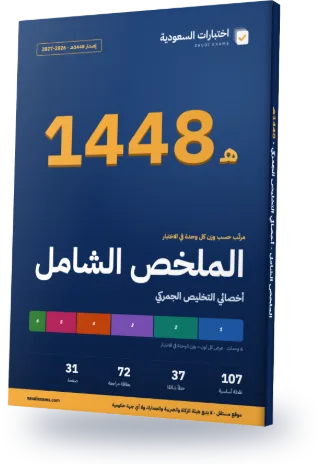
Customs Clearance Specialist Complete Review Guide 2026–2027
Every exam topic in a 31-page Arabic PDF, ordered from the heaviest unit to the lightest. The first three chapters alone cover about 60% of the exam questions.
- 31Pages
- 107Key points
- 37Common mistakes
- 72Flashcards
Guide map
Each chapter is one exam unit, ordered by its weight in the real exam.
| Chapter | Unit | Weight | Exam questions | Key points |
|---|---|---|---|---|
| 1 | Customs clearance practice rules | 20% | 20 | 21 |
| 2 | GCC Unified Customs Law and customs regimes | 20% | 20 | 20 |
| 3 | Tariff classification (Harmonized System) | 20% | 20 | 17 |
| 4 | Customs valuation and rules of origin | 17% | 17 | 17 |
| 5 | Clearance procedures, documents and platforms | 15% | 15 | 17 |
| 6 | Prohibited/restricted goods, smuggling and violations | 8% | 8 | 15 |
Chapter 1 in full: Customs clearance practice rules
20% of the exam, about 20 questions. These are its key points, as in the guide.
- The Rules were issued under Article 113 of the Unified Customs Law; they are issued and amended by the Governor's decision and take effect 60 days after publication in the Official Gazette (Art. 20).
- Matters the Rules do not cover fall under the Unified Customs Law and its Implementing Regulations (Art. 18(3)).
- The clearance firm holds the licence; it is activated after proof of a premises licensed by the competent authority (Art. 3).
The rest of chapter 1, on this page
- For a general licence the firm adds one or more activities and meets the conditions of each (Art. 3(1)(c)).
- Added activities are renewed for a period that does not go beyond the licence's validity date (Art. 4(3)).
- The Authority may refuse renewal based on the firm's performance measurement results (Art. 4(2)).
- Special representative: licence of one year, renewable for the same period; he submits a release letter if he previously worked at another clearance firm (Art. 7).
- When adding an activity the firm specifies the customs offices or deposit zones and provides a documentary guarantee for the activity's financial obligations (Art. 9(1)).
- At least one clearance specialist and one classification specialist are required per activity, for one office or several (Art. 9(1)(c)).
- A transit firm recovers the extra guarantee given to cover a shortfall after proving the goods left the office complete and intact, and cooperates with the Authority if transit goods overstay (Art. 9(2)).
- An express firm keeps records proving clients paid the actual value of goods for five years and meets express warehouse operating requirements inside the customs area (Art. 9(3)).
- Firm obligations: obtain the client's electronic authorisation before clearance (10(1)), keep system login data confidential and never let others use it (10(3)), and provide electronic payment means (10(6)).
- After clearance the firm gives the owner its fee invoice, a copy of the declaration and receipts (Art. 10(10)).
- The firm may agree with the client to provide transport with clearance (10(11)) and must cooperate with Authority staff on inspection and provide documents (10(12)).
- The firm may delegate work to an outsider only with the goods owner's consent (10(13)); after lab results for restricted goods it settles its undertakings within 15 working days of notifying the owner (10(16)).
- Authority obligations: grant specialists and representatives system login details and permissions (Art. 13(1)); it may run periodic tests, courses and workshops for them (Art. 8).
- An employee's transfer request is filed through the Authority's approved channels (Art. 12(3)).
- Grounds for suspension include skipping Authority-mandated training (15(2)) and repeated violations of the Law or Rules (15(7)).
- A clearance employee must report any suspected client violation (Art. 11(5)).
- The Authority may impose fines and disciplinary penalties for breaching the Rules, the Law or its Regulations (Art. 18(1)); notice goes through approved channels with a right to object (Art. 19).
- If a firm refuses without reason to finish clearance, the Authority may, at the owner's request, transfer the authorisation to another firm (Art. 17(1)).
Common mistakes in this chapter
- Mixing up cancellation (Art. 14: 180 consecutive days of non-practice, or the firm's own request) with strike-off (Art. 16: final custodial sentence, renting or covering for the licence, two years' suspension without correcting the position).
- "A university degree is the minimum" is wrong; the minimum is secondary school or equivalent, with no degree required.
- A non-Saudi resident cannot be a classification or clearance specialist whatever the qualification; a 17-year-old Saudi fails the age condition.
- Customs consulting is not an activity under the general clearance licence; it needs a separate customs consulting licence.
- A specialist works for his own firm only; clearing a client's goods personally outside the firm is not allowed (Art. 11).
- A special representative acts only for the authorising entity and must not own a licensed clearance firm.
The other chapters are in the full guide
One purchase · lifetime access · review guide included
7-day review plan
The chapters are spread over 6 days by weight so each day carries a similar load. Day 7 is a full exam.
Day 1 · 20% of the exam
Chapter 1: Customs clearance practice rules
Day 2 · 20% of the exam
Chapter 2: GCC Unified Customs Law and customs regimes
Day 3 · 20% of the exam
Chapter 3: Tariff classification (Harmonized System)
Day 4 · 17% of the exam
Chapter 4: Customs valuation and rules of origin
Day 5 · 15% of the exam
Chapter 5: Clearance procedures, documents and platforms
Day 6 · 8% of the exam
Chapter 6: Prohibited/restricted goods, smuggling and violations
Before you read: see your score today
10 free questions from the main units, no sign-up. Then you know which chapter to start with.
Try 10 free questions and see your levelA look at each chapter
The first three key points of each chapter, as they appear in the guide (in Arabic in the PDF).
Chapter 1: Customs clearance practice rules
- The Rules were issued under Article 113 of the Unified Customs Law; they are…
- Matters the Rules do not cover fall under the Unified Customs Law and its…
- The clearance firm holds the licence; it is activated after proof of a premises…
Chapter 2: GCC Unified Customs Law and customs regimes
- The GCC customs union rests on a common external tariff and duty-free movement of…
- GCC national products meeting origin rules move between member states exempt from customs duty.
- Foreign goods duty-paid in one GCC state and moved to another do not pay…
Chapter 3: Tariff classification (Harmonized System)
- The body that created and maintains the HS is the World Customs Organization (WCO).
- The Explanatory Notes are the WCO's official international interpretation and a key reference, though…
- GIR 2(a)
Chapter 4: Customs valuation and rules of origin
- Value is the price actually paid or payable; a low invoice is rejected only…
- The price paid can be shown by a documented purchase contract and matching bank…
- If several identical-goods values exist, the lowest is used (Art. 2(3)); the goods must…
Chapter 5: Clearance procedures, documents and platforms
- Incoterms 2020 has 11 rules.
- FAS
- DDP
Chapter 6: Prohibited/restricted goods, smuggling and violations
- Pork and its products, alcoholic drinks, counterfeit currency, gambling equipment and material offending public…
- Wireless and telecom devices are restricted and subject to Communications, Space and Technology Commission…
- Counterfeit goods infringing trademarks may be seized and refused entry through border measures.
The full guide comes with lifetime access
The full guide (31 pages) is included with lifetime access to this exam, together with every question and full mock exam. Chapter 1 is free for everyone.
Questions about the guide
Is the guide free?
Chapter 1 is free to read on the guide page. The full guide comes with lifetime access to this exam; 7-day access does not include it.
Is it up to date for 2026–2027?
Yes. Unit weights and exam facts follow what the exam body last published, and the last check date is printed in the guide. If the standards change we update the file and buyers download the new version.
Does the guide have questions?
No. The guide covers key points and common mistakes; scoring, weak-area practice and full mock exams are on the site.
Can I read it on my phone?
Yes. A5 pages in a single column, with chapters linked from the contents.
- Pages
- 31
- Edition
- 1448 AH · 2026–2027
- Language
- Arabic
- Last updated
Buy this exam
Pick the access that lasts until your test date.
Included
- Timed supplementary practice sessions: 100 questions in 90 minutes
- 500 questions, every option explained with its source
- Practice that starts with your weakest units, plus a review of your mistakes
- Complete Review Guide 2026–2027 (PDF), with lifetime access only
Continue with your Google account and you go straight to the payment page.
You pay on the Waffo Pancake checkout page (in English). The amount is in US dollars and your bank converts it to riyals. One payment with no automatic renewal, by Visa, Mastercard (a mada card with either logo works too), Apple Pay or Google Pay. Your statement shows "WAFFO". Purchases are not refundable.