CSCP
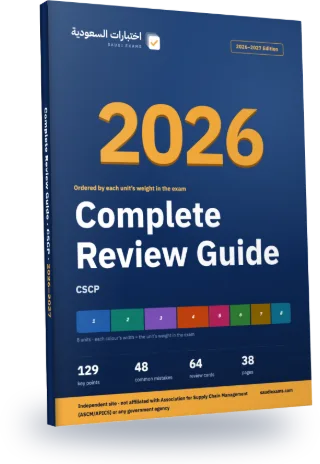
CSCP Complete Review Guide 2026–2027
Every exam topic in a 38-page Arabic PDF, ordered from the heaviest unit to the lightest. The first three chapters alone cover about 45% of the exam questions.
- 38Pages
- 129Key points
- 48Common mistakes
- 64Flashcards
Guide map
Each chapter is one exam unit, ordered by its weight in the real exam.
| Chapter | Unit | Weight | Exam questions | Key points |
|---|---|---|---|---|
| 1 | Supply Chains, Demand Management, and Forecasting | 15% | 23 | 17 |
| 2 | Sourcing Products and Services | 15% | 22 | 16 |
| 3 | Internal Operations and Inventory | 15% | 23 | 17 |
| 4 | Forward and Reverse Logistics | 15% | 22 | 16 |
| 5 | Global Supply Chain Networks | 10% | 15 | 16 |
| 6 | Supply Chain Relationships | 10% | 15 | 16 |
| 7 | Supply Chain Risk | 10% | 15 | 16 |
| 8 | Optimization, Sustainability, and Technology | 10% | 15 | 15 |
Chapter 1 in full: Supply Chains, Demand Management, and Forecasting
15% of the exam, about 23 questions. These are its key points, as in the guide.
- A supply chain is the network of organizations, resources, activities and information that moves a product from supplier to customer.
- Functional products (stable demand) fit efficient chains; innovative products (uncertain demand) fit responsive chains.
- Strategic fit means the chain's capabilities match what the target customers value (cost, speed, quality, flexibility).
The rest of chapter 1, on this page
- Bullwhip effect: small demand changes at retail grow into large swings upstream because of order batching, price fluctuations, rationing and long lead times.
- Reduce the bullwhip effect by sharing point-of-sale data, shortening lead times, stabilizing prices and using collaborative planning.
- Demand management has demand planning, demand sensing and demand shaping (promotion, pricing and channel decisions).
- Qualitative forecasting (expert opinion, Delphi, market research) fits new products; quantitative methods use history.
- Time-series methods: moving average, weighted moving average and exponential smoothing; a higher smoothing constant reacts faster but is noisier.
- Causal methods such as regression relate demand to drivers like price or advertising.
- Forecast error is actual minus forecast; MAD is the mean of absolute errors; MAPE is the mean absolute error as a percentage of actual.
- Bias is the average signed error; a tracking signal (cumulative error divided by MAD) outside about ±4 suggests the model needs review.
- Aggregate forecasts are more accurate than item-level forecasts, and shorter horizons are more accurate than longer ones.
- Sales and operations planning balances demand and supply monthly at an aggregate level and reconciles plans with finance and strategy.
- S&OP steps: data gathering, demand planning, supply planning, pre-S&OP reconciliation, executive meeting and decision.
- Aggregate planning strategies: chase (adjust capacity to demand), level (steady output with inventory) and hybrid.
- Customer requirements are translated into service levels, lead times and order-winning versus order-qualifying criteria.
- The SCOR model organizes processes as plan, source, make, deliver, return (and enable).
Common mistakes in this chapter
- A forecast is always wrong; the point is to quantify and manage error.
- Bias and MAD measure different things: direction versus size.
- S&OP is not an annual budgeting exercise.
- Efficiency and responsiveness trade off; one chain rarely maximizes both.
- Chase strategy does not mean carrying more inventory.
- Demand sensing uses short-term signals; demand planning is longer-range.
The other chapters are in the full guide
One purchase · lifetime access · review guide included
7-day review plan
The chapters are spread over 6 days by weight so each day carries a similar load. Day 7 is a full exam.
Day 1 · 15% of the exam
Chapter 1: Supply Chains, Demand Management, and Forecasting
Day 2 · 15% of the exam
Chapter 2: Sourcing Products and Services
Day 3 · 15% of the exam
Chapter 3: Internal Operations and Inventory
Day 4 · 15% of the exam
Chapter 4: Forward and Reverse Logistics
Day 5 · 20% of the exam
Chapter 5: Global Supply Chain Networks
Chapter 7: Supply Chain RiskDay 6 · 20% of the exam
Chapter 6: Supply Chain Relationships
Chapter 8: Optimization, Sustainability, and TechnologyDay 7
Full mock exam: 150 questions in 210 minutes, then review the common mistakes in the units where you lost marks.
Before you read: see your score today
10 free questions from the main units, no sign-up. Then you know which chapter to start with.
Try 10 free questions and see your levelA look at each chapter
The first three key points of each chapter, as they appear in the guide (in Arabic in the PDF).
Chapter 1: Supply Chains, Demand Management, and Forecasting
- A supply chain is the network of organizations, resources, activities and information that moves…
- Functional products (stable demand) fit efficient chains; innovative products (uncertain demand) fit responsive chains.
- Strategic fit means the chain's capabilities match what the target customers value (cost, speed…
Chapter 2: Sourcing Products and Services
- Make when the item is core, confidential or uniquely capable; buy when suppliers are…
- Outsourcing reduces cost and capital but risks loss of control, quality and intellectual property.
- Kraljic matrix
Chapter 3: Internal Operations and Inventory
- The planning hierarchy runs from business plan to S&OP, master production schedule, material requirements…
- The MPS states what end items will be produced and when, within capacity and…
- MRP inputs
Chapter 4: Forward and Reverse Logistics
- Road is flexible and door-to-door; rail is cheap for heavy bulk over land; sea…
- Intermodal transport moves a container across several modes without handling the cargo itself.
- Truckload suits full loads; less-than-truckload consolidates smaller shipments at higher unit cost.
Chapter 5: Global Supply Chain Networks
- Network design decisions include the number, location, size and role of plants, warehouses and…
- Centralizing inventory lowers total stock through risk pooling but lengthens delivery distance.
- Location factors
Chapter 6: Supply Chain Relationships
- Customer relationship management collects customer data to segment, serve and retain profitable customers.
- Customer segmentation by profitability, needs and potential supports differentiated service levels.
- Customer service elements include pre-transaction, transaction and post-transaction activities.
Chapter 7: Supply Chain Risk
- Supply chain risk is the possibility of an event that disrupts flows of goods…
- Risk sources
- Identify risk with mapping, supplier tiers visibility, scenario analysis and incident history.
Chapter 8: Optimization, Sustainability, and Technology
- Good metrics are aligned with strategy, measurable, balanced and actionable; avoid measuring only local…
- Inventory turnover equals cost of goods sold divided by average inventory; days of supply…
- Cash-to-cash cycle time equals days of inventory plus days of receivables minus days of…
The full guide comes with lifetime access
The full guide (38 pages) is included with lifetime access to this exam, together with every question and full mock exam. Chapter 1 is free for everyone.
Questions about the guide
Is the guide free?
Chapter 1 is free to read on the guide page. The full guide comes with lifetime access to this exam; 7-day access does not include it.
Is it up to date for 2026–2027?
Yes. Unit weights and exam facts follow what the exam body last published, and the last check date is printed in the guide. If the standards change we update the file and buyers download the new version.
Does the guide have questions?
No. The guide covers key points and common mistakes; scoring, weak-area practice and full mock exams are on the site.
Can I read it on my phone?
Yes. A5 pages in a single column, with chapters linked from the contents.
- Pages
- 38
- Edition
- 1448 AH · 2026–2027
- Language
- Arabic
- Last updated
Buy this exam
Pick the access that lasts until your test date.
Included
- Timed supplementary practice sessions: 150 questions in 210 minutes
- 750 questions, every option explained with its source
- Practice that starts with your weakest units, plus a review of your mistakes
- Complete Review Guide 2026–2027 (PDF), with lifetime access only
Continue with your Google account and you go straight to the payment page.
You pay on the Waffo Pancake checkout page (in English). The amount is in US dollars and your bank converts it to riyals. One payment with no automatic renewal, by Visa, Mastercard (a mada card with either logo works too), Apple Pay or Google Pay. Your statement shows "WAFFO". Purchases are not refundable.