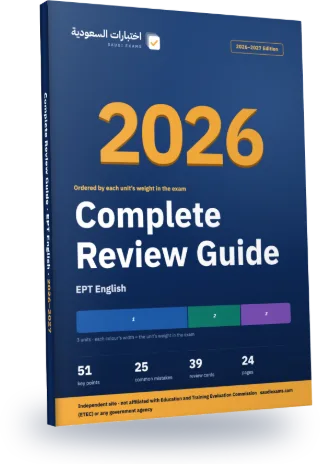
EPT English Complete Review Guide 2026–2027
Every exam topic in a 24-page Arabic PDF, ordered from the heaviest unit to the lightest. The first three chapters alone cover about 100% of the exam questions.
- 24Pages
- 51Key points
- 25Common mistakes
- 39Flashcards
Guide map
Each chapter is one exam unit, ordered by its weight in the real exam.
| Chapter | Unit | Weight | Exam questions | Key points |
|---|---|---|---|---|
| 1 | Structure | 50% | 40 | 18 |
| 2 | Listening Comprehension | 25% | 20 | 16 |
| 3 | Reading Comprehension | 25% | 20 | 17 |
Chapter 1 in full: Structure
50% of the exam, about 40 questions. These are its key points, as in the guide.
- Tenses and time words: use the present perfect with since, for, ever and yet; use the past simple with yesterday, last year and ago. Example: "She has worked here since 2020." and "She started working here in 2020."
- Use the past perfect for an event before another past event, and after by the time. Example: "When we arrived, the film had already started." Also: "By the time he called, I had left."
- Modals (can, must, should, may) are followed by the base verb with no to and no -s. Example: "She can speak three languages." For a negative deduction: "He can't be at home; his car isn't here."
The rest of chapter 1, on this page
- Conditionals: zero for facts (if + present, present), first for the possible (if + present, will), second for the unreal present (if + past, would), third for the finished past (if + past perfect, would have). Example: "If I had studied more, I would have passed." wish is for regrets: "I wish I had more time."
- Passive: be + past participle, with be in the tense of the sentence, and only from a transitive verb. Example: "The results will be sent by email." The common mistake is "The accident was happened".
- Verb patterns: enjoy, avoid, finish and keep take -ing; want, decide, hope and plan take to + verb. Example: "He avoids eating late, and he decided to start running."
- used to is a past habit; be used to means accustomed to and takes -ing. Causative: have + object + past participle. Example: "I used to play football." "I'm used to waking up early." "I had my car repaired."
- Countable and uncountable: many and few go with countable nouns, much and little with uncountable. Example: "There isn't much information, but there are a few good books." Use a before a consonant sound and an before a vowel sound: "a university", "an hour".
- Subject-verb agreement: each, every and everyone are singular, the number of is singular, a number of is plural. Example: "Each of the students has a book." "A number of students are absent." Pronouns: "My brother and I went." "She hurt herself."
- Comparison: -er and than for short adjectives, more and than for long ones, the + -est or the most for the superlative, the more... the more for parallel change. Example: "This exam is easier than the last one." "The more you practise, the better you get."
- An adjective goes before the noun and an adverb after the verb; a frequency adverb goes before the main verb. Example: "She always speaks English fluently." Note hard (with effort) and hardly (almost not): "He works hard." "He hardly works."
- Prepositions are learned with the word: in for months and years, on for days and dates, at for clock times; also interested in, depend on, good at. Example: "The test is on Monday at 9 a.m." and "It starts in May."
- Connectors: although and despite never come with but; because gives a reason and so a result; however is followed by a comma. Example: "Although it was raining, we went out." "Despite the rain, we went out."
- Relative clauses: who for people, which for things, whose for possession. Reported speech moves the tense back one step and does not use question order. Example: "The student who won the prize said she had studied daily." "She asked me where I lived."
- Vocabulary and collocation: learn verbs with their nouns: make a decision, do homework, take a risk, have a break. Example: "We need to make a decision before Friday." We do not say "do a decision".
- Word forms: decide what is needed (noun, adjective, adverb or verb) then add the suffix: decide, decision; success, successful, successfully; possible, impossible. Example: "Her success surprised everyone."
- Error spotting: check the verb and subject first, then tense, preposition, word form. Example: in "Each of the students have a book" the error is have; it should be has. For word order: subject, verb, object: "Maha reads novels every night."
- Punctuation, spelling and sentence order: a comma after an introductory clause, it's means it is while its shows possession, and capitals for days and languages. In sentence order, look for the opening sentence that does not start with a pronoun. Example: "On Monday, we study English; it's my favourite lesson."
Common mistakes in this chapter
- Putting will after when, if, before or as soon as. Use the present simple: "I will call you when I arrive", not "when I will arrive".
- Using the present simple with since or for instead of the present perfect. Correct: "I have lived here for two years".
- Pluralising uncountable nouns or putting a before them: information, advice, furniture and news have no plural. Correct: "some advice", not "an advice".
- Matching the verb to a nearby word instead of the subject: in "The box of pens is on the desk", the subject is box.
- Mixing -ed and -ing: "I am boring" says you are the dull one. For the feeling, use "I am bored".
- Double comparison such as "more taller" or "most easiest". A short adjective takes -er or -est only.
- Using question word order in an embedded question: correct is "Do you know where the library is?", not "where is the library".
- A preposition carried over from Arabic: "married with" is wrong, use "married to"; "discuss about" is wrong, use "discuss" with no preposition.
- Choosing a word by meaning and ignoring its position: after the and an adjective comes a noun (decision); after a verb comes an adverb (carefully).
The other chapters are in the full guide
One purchase · lifetime access · review guide included
7-day review plan
The chapters are spread over 6 days by weight so each day carries a similar load. Day 7 is a full exam.
Day 1 · 50% of the exam
Chapter 1: Structure
Day 2 · 25% of the exam
Chapter 2: Listening Comprehension
Day 3 · 25% of the exam
Chapter 3: Reading Comprehension
Day 4
Full mock exam: 80 questions in 90 minutes, then review the common mistakes in the units where you lost marks.
Before you read: see your score today
10 free questions from the main units, no sign-up. Then you know which chapter to start with.
Try 10 free questions and see your levelA look at each chapter
The first three key points of each chapter, as they appear in the guide (in Arabic in the PDF).
Chapter 1: Structure
- Tenses and time words
- Use the past perfect for an event before another past event, and after by…
- Modals (can, must, should, may) are followed by the base verb with no to…
Chapter 2: Listening Comprehension
- Read the question and the four options before the audio, so you know whether…
- For a purpose question, listen for opening phrases that reveal why the person speaks…
- Announcements often end with what the listener must do. Example: Please proceed to gate…
Chapter 3: Reading Comprehension
- Read the questions before the passage, so you read knowing what to look for…
- A main idea question is answered after reading the passage, and its answer recurs…
- The first and last sentences of a paragraph often carry its idea. Example: Sleep…
The full guide comes with lifetime access
The full guide (24 pages) is included with lifetime access to this exam, together with every question and full mock exam. Chapter 1 is free for everyone.
Questions about the guide
Is the guide free?
Chapter 1 is free to read on the guide page. The full guide comes with lifetime access to this exam; 7-day access does not include it.
Is it up to date for 2026–2027?
Yes. Unit weights and exam facts follow what the exam body last published, and the last check date is printed in the guide. If the standards change we update the file and buyers download the new version.
Does the guide have questions?
No. The guide covers key points and common mistakes; scoring, weak-area practice and full mock exams are on the site.
Can I read it on my phone?
Yes. A5 pages in a single column, with chapters linked from the contents.
- Pages
- 24
- Edition
- 1448 AH · 2026–2027
- Language
- Arabic
- Last updated
Buy this exam
Pick the access that lasts until your test date.
Included
- Full mock exams: 80 questions in 90 minutes, with a score for every unit
- 476 questions, every option explained with its source
- Practice that starts with your weakest units, plus a review of your mistakes
- Complete Review Guide 2026–2027 (PDF), with lifetime access only
Continue with your Google account and you go straight to the payment page.
You pay on the Waffo Pancake checkout page (in English). The amount is in US dollars and your bank converts it to riyals. One payment with no automatic renewal, by Visa, Mastercard (a mada card with either logo works too), Apple Pay or Google Pay. Your statement shows "WAFFO". Purchases are not refundable.