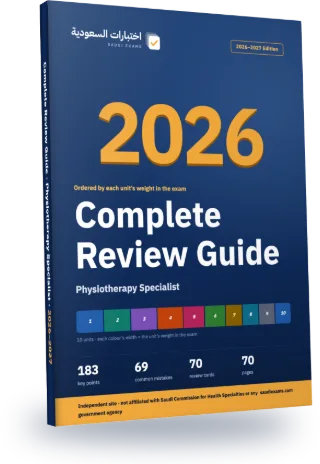
Physiotherapy Specialist Complete Review Guide 2026–2027
Every exam topic in a 70-page Arabic PDF, ordered from the heaviest unit to the lightest. The first three chapters alone cover about 36% of the exam questions.
- 70Pages
- 183Key points
- 69Common mistakes
- 70Flashcards
Guide map
Each chapter is one exam unit, ordered by its weight in the real exam.
| Chapter | Unit | Weight | Exam questions | Key points |
|---|---|---|---|---|
| 1 | Anatomy and Physiology | 12% | 18 | 13 |
| 2 | Physical Therapy in Special Populations | 12% | 18 | 36 |
| 3 | Neurorehabilitation | 12% | 18 | 19 |
| 4 | Musculoskeletal Rehabilitation | 12% | 18 | 20 |
| 5 | Physical Agents | 10% | 15 | 18 |
| 6 | Therapeutic Exercises and Techniques | 10% | 15 | 21 |
| 7 | Kinesiology, Biomechanics and Ergonomics | 8% | 12 | 16 |
| 8 | Clinical Decision Making and Differential Diagnosis | 8% | 12 | 12 |
| 9 | Cardiopulmonary Physical Therapy | 8% | 12 | 14 |
| 10 | Sports Physical Therapy | 8% | 12 | 14 |
Chapter 1 in full: Anatomy and Physiology
12% of the exam, about 18 questions. These are its key points, as in the guide.
- Acetylcholine initiates excitation at the motor end plate; the sarcoplasmic reticulum releases calcium. Relaxation includes ATP-dependent calcium return to this store. Source: NISMAT, Muscle Physiology Primer, motor end plate/SR release and Muscle Contraction, ATP-dependent calcium return.
- Bone is continually maintained: osteoblasts form bone, osteoclasts resorb it, and osteocytes are mature bone cells. Source: NCI SEER, Structure of Bone Tissue, opening cell-role paragraphs.
- In a synovial joint, articular cartilage reduces friction, while the synovial membrane supplies lubricating fluid. Tendons connect muscle to bone; ligaments connect bones. Source: Johns Hopkins, Anatomy of a Joint, Cartilage/Synovial membrane/Ligaments/Tendons bullets.
The rest of chapter 1, on this page
- Example: if resorption exceeds formation over time, bone tissue is lost. This compares remodeling processes; it does not establish a diagnosis or an exercise load. Source: NCI SEER, Structure of Bone Tissue, opening cell-role paragraphs.
- Afferent signals travel toward the CNS; efferent signals travel from it. One skeletal-muscle motor unit comprises one alpha motor neuron and the muscle fibers it supplies. Source: NCI SEER, The Nervous System, Peripheral Nervous System. UTHealth Neuroscience Online, §1.6 and §1.8.
- Muscle spindles report muscle length and its change; Golgi tendon organs report force/load. These are complementary proprioceptive signals. Source: UTHealth Neuroscience Online, §1.6 and §1.8.
- Example: turning the head chiefly engages semicircular-canal rotation signals; linear head movement and orientation to gravity involve the utricle and saccule. Balance also uses vision and body sensation. Source: NIDCD, Balance Disorders, How does my body keep its balance?, canal and otolithic-organ paragraphs.
- Inspiration: the diaphragm contracts downward, enlarging the chest. Quiet healthy expiration mainly follows relaxation. At alveoli, oxygen moves into blood and carbon dioxide moves into alveolar air. Source: NHLBI, What Breathing Does for the Body, Breathing in/Gas exchange/Breathing out.
- The right heart sends oxygen-poor blood through pulmonary arteries to the lungs; pulmonary veins return oxygen-rich blood to the left heart. Source: NHLBI, How Blood Flows, Adding oxygen to blood.
- Example: after the SA-node signal activates the atria, a brief AV-node delay allows ventricular filling before ventricular contraction. Electrical timing supports effective pumping. Source: NHLBI, How the Heart Beats, Electrical activity.
- Hormones act on cells with matching receptors. Negative feedback opposes a disturbance in a regulated variable, helping maintain homeostasis. Source: NCI SEER, Characteristics of Hormones, Mechanism/Control of Hormone Action.
- High blood glucose stimulates pancreatic beta cells to release insulin; low glucose stimulates alpha cells to release glucagon. Keep the cell, stimulus and hormone paired. Source: NCI SEER, Pancreas—Islets of Langerhans, alpha/beta-cell paragraph.
- Example: low blood calcium stimulates PTH secretion, which raises calcium. A response can increase a substance and still be negative feedback because it opposes the initial fall. Source: NCI SEER, Thyroid & Parathyroid Glands, Parathyroid Gland, secretion/effect paragraph. NCI SEER, Characteristics of Hormones, Mechanism/Control of Hormone Action.
Common mistakes in this chapter
- Relaxation is not energy-free: calcium reuptake into the sarcoplasmic reticulum uses ATP. Source: NISMAT, Muscle Physiology Primer, motor end plate/SR release and Muscle Contraction, ATP-dependent calcium return.
- Do not reverse tendon and ligament attachments, or confuse synovial membrane with the cartilage covering bone. Source: Johns Hopkins, Anatomy of a Joint, Cartilage/Synovial membrane/Ligaments/Tendons bullets.
- A motor unit is not every motor neuron supplying a whole muscle; spindle length feedback is not tendon-organ force feedback. Source: UTHealth Neuroscience Online, §1.6 and §1.8.
- “Artery” does not always mean oxygen-rich: pulmonary arteries carry oxygen-poor blood toward the lungs. Source: NHLBI, How Blood Flows, Adding oxygen to blood.
- “Negative” describes opposition to the disturbance, not an instruction that every hormone must lower every measured value. Source: NCI SEER, Characteristics of Hormones, Mechanism/Control of Hormone Action. NCI SEER, Thyroid & Parathyroid Glands, Parathyroid Gland, secretion/effect paragraph.
The other chapters are in the full guide
One purchase · lifetime access · review guide included
7-day review plan
The chapters are spread over 6 days by weight so each day carries a similar load. Day 7 is a full exam.
Day 1 · 20% of the exam
Chapter 1: Anatomy and Physiology
Chapter 9: Cardiopulmonary Physical TherapyDay 2 · 20% of the exam
Chapter 2: Physical Therapy in Special Populations
Chapter 10: Sports Physical TherapyDay 3 · 12% of the exam
Chapter 3: Neurorehabilitation
Day 4 · 12% of the exam
Chapter 4: Musculoskeletal Rehabilitation
Day 5 · 18% of the exam
Chapter 5: Physical Agents
Chapter 7: Kinesiology, Biomechanics and ErgonomicsDay 6 · 18% of the exam
Chapter 6: Therapeutic Exercises and Techniques
Chapter 8: Clinical Decision Making and Differential DiagnosisDay 7
Full mock exam: 150 questions in 180 minutes, then review the common mistakes in the units where you lost marks.
How many correct answers do you need?
- Pass mark 60%90 correct out of 150
Before you read: see your score today
10 free questions from the main units, no sign-up. Then you know which chapter to start with.
Try 10 free questions and see your levelA look at each chapter
The first three key points of each chapter, as they appear in the guide (in Arabic in the PDF).
Chapter 1: Anatomy and Physiology
- Acetylcholine initiates excitation at the motor end plate; the sarcoplasmic reticulum releases calcium. Relaxation…
- Bone is continually maintained
- In a synovial joint, articular cartilage reduces friction, while the synovial membrane supplies lubricating…
Chapter 2: Physical Therapy in Special Populations
- TUG uses a 3-metre outward walk at normal pace; time from the start cue…
- In the 30-second chair stand, required arm assistance means stop and score zero. Count…
- Progress through balance positions only after 10 seconds without foot movement or support. Less…
Chapter 3: Neurorehabilitation
- Use the 2025 recommendations as a decision reference, with medical stability and individual contraindication…
- Falls
- Provide individualized prevention and practical transfer/mobility training for patients and caregivers. After a fall…
Chapter 4: Musculoskeletal Rehabilitation
- Use a tailored biopsychosocial approach. Source
- Knee OA
- Selected balance, agility and coordination work may be added to traditional exercise for performance…
Chapter 5: Physical Agents
- Unexplained pain needs assessment before home TENS. Pregnancy requires specific medical or midwifery advice.
- TENS should feel tolerable; discuss analgesic changes with the appropriate clinician.
- Avoid home heat/cold on areas with impaired circulation or sensation; remove immediately for burning.
Chapter 6: Therapeutic Exercises and Techniques
- Adult guidance includes 150–300 weekly moderate minutes or 75–150 vigorous minutes, plus major-muscle strengthening…
- Older adults add multicomponent balance and strength activity on at least 3 days; pregnancy…
- u5.2 Diabetes
Chapter 7: Kinesiology, Biomechanics and Ergonomics
- Review support, reach and visual demands together.
- Neutral alignment and regular changes in position guide workstation adjustment.
- u1.2 — Patient handling
Chapter 8: Clinical Decision Making and Differential Diagnosis
- Suspected DVT needs urgent assessment; associated chest pain or breathlessness requires emergency action.
- Sudden respiratory distress may reflect embolism or another serious condition.
- Back pain with new loss of genital or anal sensation, or difficulty passing urine…
Chapter 9: Cardiopulmonary Physical Therapy
- ATS 2023 supports pulmonary rehabilitation across specified chronic respiratory conditions; pulmonary hypertension carries a…
- AHA 2024 describes comprehensive medically supervised cardiac rehabilitation, including exercise and non-exercise components.
- u7.2 — For patients assessed as needing secretion clearance, ACBT mobilizes sputum using breathing…
Chapter 10: Sports Physical Therapy
- Progress with medical approval and supervision; each step typically requires at least 24 hours.
- Symptoms recurring during progression require stopping and contacting the medical provider; danger signs require…
- u8.2 — Concussion assessment includes cognition, neurology, balance and deterioration signs, with prior-concussion history…
The full guide comes with lifetime access
The full guide (70 pages) is included with lifetime access to this exam, together with every question and full mock exam. Chapter 1 is free for everyone.
Questions about the guide
Is the guide free?
Chapter 1 is free to read on the guide page. The full guide comes with lifetime access to this exam; 7-day access does not include it.
Is it up to date for 2026–2027?
Yes. Unit weights and exam facts follow what the exam body last published, and the last check date is printed in the guide. If the standards change we update the file and buyers download the new version.
Does the guide have questions?
No. The guide covers key points and common mistakes; scoring, weak-area practice and full mock exams are on the site.
Can I read it on my phone?
Yes. A5 pages in a single column, with chapters linked from the contents.
- Pages
- 70
- Edition
- 1448 AH · 2026–2027
- Language
- Arabic
- Last updated
Buy this exam
Pick the access that lasts until your test date.
Included
- Full mock exams: 150 questions in 180 minutes, with a score for every unit
- 753 questions, every option explained with its source
- Practice that starts with your weakest units, plus a review of your mistakes
- Complete Review Guide 2026–2027 (PDF), with lifetime access only
Continue with your Google account and you go straight to the payment page.
You pay on the Waffo Pancake checkout page (in English). The amount is in US dollars and your bank converts it to riyals. One payment with no automatic renewal, by Visa, Mastercard (a mada card with either logo works too), Apple Pay or Google Pay. Your statement shows "WAFFO". Purchases are not refundable.