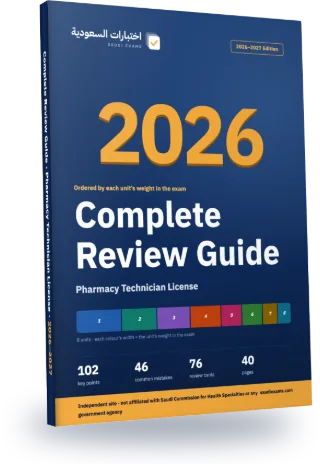
Pharmacy Technician License Complete Review Guide 2026–2027
Every exam topic in a 40-page Arabic PDF, ordered from the heaviest unit to the lightest. The first three chapters alone cover about 51% of the exam questions.
- 40Pages
- 102Key points
- 46Common mistakes
- 76Flashcards
Guide map
Each chapter is one exam unit, ordered by its weight in the real exam.
| Chapter | Unit | Weight | Exam questions | Key points |
|---|---|---|---|---|
| 1 | Essential and Over the Counter Medications | 20% | 30 | 14 |
| 2 | Pharmacy Calculation | 16% | 24 | 14 |
| 3 | Medication Safety | 15% | 23 | 14 |
| 4 | Sterile and Nonsterile Compounding | 15% | 22 | 14 |
| 5 | Pharmacy Law and Ethics | 10% | 15 | 12 |
| 6 | Material Management and Supply Chain | 10% | 15 | 14 |
| 7 | Drug Information and Health Informatics | 7% | 11 | 10 |
| 8 | Infection Control | 7% | 10 | 10 |
Chapter 1 in full: Essential and Over the Counter Medications
20% of the exam, about 30 questions. These are its key points, as in the guide.
- Metformin (e.g. Glucophage) is first-line type 2 diabetes therapy; counsel on GI upset and rare lactic acidosis risk with severe renal impairment.
- Atorvastatin and similar statins are usually taken at night for some agents; warn about muscle pain and drug interactions via CYP3A4.
- ACE inhibitors (e.g. lisinopril, enalapril) and ARBs lower blood pressure; monitor potassium and renal function conceptually at technician level.
The rest of chapter 1, on this page
- Warfarin interacts with many drugs and vitamin K–rich foods; INR monitoring is essential. DOACs have fewer food issues but still have key interactions.
- Short-acting beta-agonist inhalers (e.g. salbutamol) relieve acute bronchospasm; inhaled corticosteroids are controllers, not rescue alone.
- Auxiliary labels flag shake well, take with food, avoid alcohol, may cause drowsiness, refrigerate, and finish all antibiotic — apply the ones that match the product.
- NSAIDs raise GI bleed and renal risk and can antagonize antihypertensives; prefer pharmacist review in elderly or ulcer history.
- OTC referral red flags: chest pain, severe SOB, neurologic deficits, high fever in infants, uncontrolled bleeding, suspected overdose.
- Know common pairs: omeprazole/Losec or similar PPIs for GERD; amoxicillin for many bacterial infections when prescribed; paracetamol vs ibuprofen for analgesia/antipyresis.
- SL means under the tongue (rapid absorption); PR rectal; SC subcutaneous; IM intramuscular; IV intravenous continuous or push per order.
- Do not interchange insulin types or devices without pharmacist verification — onset and peak differ sharply.
- Narrow therapeutic index drugs (e.g. digoxin, lithium, carbamazepine, phenytoin, warfarin) need careful strength selection and counselling flags.
- Eye drops: wash hands, avoid touching the tip to the eye, wait between drops if directed; ointment blurs vision temporarily.
- When a customer asks for a brand, verify the generic active ingredient and available strength before pulling stock for the pharmacist.
Common mistakes in this chapter
- Picking a look-alike brand for the wrong generic (e.g. confusing Glucophage metformin with a sulphonylurea).
- Assuming every ACE inhibitor cough means allergy — cough is common; angioedema is the emergency.
- Dispensing a sustained-release tablet with instructions to crush — many SR/ER/EC forms must be swallowed whole.
- Treating antibiotic duration as optional; incomplete courses and wrong spectrum drive resistance.
- Recommending oral decongestants freely in uncontrolled hypertension or with MAOIs.
- Mixing up qd, qid and qod — write frequency in plain language on labels when possible.
The other chapters are in the full guide
One purchase · lifetime access · review guide included
7-day review plan
The chapters are spread over 6 days by weight so each day carries a similar load. Day 7 is a full exam.
Day 1 · 20% of the exam
Chapter 1: Essential and Over the Counter Medications
Day 2 · 16% of the exam
Chapter 2: Pharmacy Calculation
Day 3 · 15% of the exam
Chapter 3: Medication Safety
Day 4 · 15% of the exam
Chapter 4: Sterile and Nonsterile Compounding
Day 5 · 17% of the exam
Chapter 5: Pharmacy Law and Ethics
Chapter 7: Drug Information and Health InformaticsDay 6 · 17% of the exam
Chapter 6: Material Management and Supply Chain
Chapter 8: Infection ControlDay 7
Full mock exam: 150 questions in 180 minutes, then review the common mistakes in the units where you lost marks.
How many correct answers do you need?
- Pass mark 55%83 correct out of 150
Before you read: see your score today
10 free questions from the main units, no sign-up. Then you know which chapter to start with.
Try 10 free questions and see your levelA look at each chapter
The first three key points of each chapter, as they appear in the guide (in Arabic in the PDF).
Chapter 1: Essential and Over the Counter Medications
- Metformin (e.g. Glucophage) is first-line type 2 diabetes therapy; counsel on GI upset and…
- Atorvastatin and similar statins are usually taken at night for some agents; warn about…
- ACE inhibitors (e.g. lisinopril, enalapril) and ARBs lower blood pressure; monitor potassium and renal…
Chapter 2: Pharmacy Calculation
- 1 kg = 2.2 lb; 1 lb ≈ 0.45 kg. Convert weight to kg…
- 1 g = 1000 mg = 1,000,000 mcg. Move three decimal places between each…
- Dose (mg) = weight (kg) × ordered mg/kg. Check against a stated maximum single…
Chapter 3: Medication Safety
- Tall-man lettering highlights differing syllables (e.g. hydrALAZINE vs hydrOXYzine) to cut LASA selection errors.
- Separate LASA products on shelves, use barcode scanning, and read the generic name aloud…
- High-alert medications require independent double-checks, smart-pump limits and clear labelling of strength.
Chapter 4: Sterile and Nonsterile Compounding
- Trituration reduces particle size by grinding; levigation wets a powder with a levigating agent…
- Geometric dilution
- USP <795> default BUDs (when no stability data)
Chapter 5: Pharmacy Law and Ethics
- Under SFDA narcotic and psychotropic procedures, outpatient controlled prescriptions are time-limited (commonly 7 days…
- Inpatient narcotic order sheets commonly require renewal within 48 hours; do not dispense on…
- Retain controlled-drug registers for the periods required by SFDA (registers are kept longer than…
Chapter 6: Material Management and Supply Chain
- Reorder point ≈ (average demand during lead time) + safety stock. Order when on-hand…
- PAR level is the quantity that should be on hand; restock up to PAR…
- Inventory turnover ≈ cost of goods sold ÷ average inventory; very low turnover may…
Chapter 7: Drug Information and Health Informatics
- For Saudi-registered trade names and strengths, start with SFDA listings / Saudi National Formulary-type…
- IV Y-site and admixture compatibility questions need a dedicated compatibility reference (e.g. Trissel's), not…
- Interaction and pregnancy/lactation queries belong in a clinical drug database; escalate interpretation to the…
Chapter 8: Infection Control
- WHO recommends alcohol-based hand rub for 20–30 seconds when hands are not visibly dirty;…
- My 5 Moments
- Standard precautions assume every patient's blood and body fluids may transmit infection — gloves…
The full guide comes with lifetime access
The full guide (40 pages) is included with lifetime access to this exam, together with every question and full mock exam. Chapter 1 is free for everyone.
Questions about the guide
Is the guide free?
Chapter 1 is free to read on the guide page. The full guide comes with lifetime access to this exam; 7-day access does not include it.
Is it up to date for 2026–2027?
Yes. Unit weights and exam facts follow what the exam body last published, and the last check date is printed in the guide. If the standards change we update the file and buyers download the new version.
Does the guide have questions?
No. The guide covers key points and common mistakes; scoring, weak-area practice and full mock exams are on the site.
Can I read it on my phone?
Yes. A5 pages in a single column, with chapters linked from the contents.
- Pages
- 40
- Edition
- 1448 AH · 2026–2027
- Language
- Arabic
- Last updated
Buy this exam
Pick the access that lasts until your test date.
Included
- Full mock exams: 150 questions in 180 minutes, with a score for every unit
- 500 questions, every option explained with its source
- Practice that starts with your weakest units, plus a review of your mistakes
- Complete Review Guide 2026–2027 (PDF), with lifetime access only
Continue with your Google account and you go straight to the payment page.
You pay on the Waffo Pancake checkout page (in English). The amount is in US dollars and your bank converts it to riyals. One payment with no automatic renewal, by Visa, Mastercard (a mada card with either logo works too), Apple Pay or Google Pay. Your statement shows "WAFFO". Purchases are not refundable.