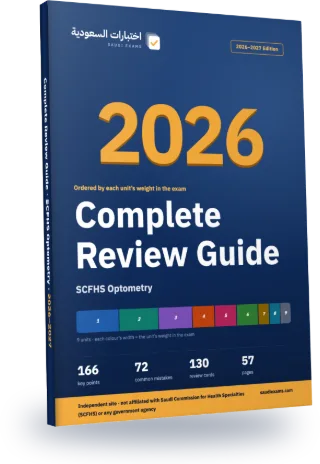
SCFHS Optometry Complete Review Guide 2026–2027
Every exam topic in a 57-page Arabic PDF, ordered from the heaviest unit to the lightest. The first three chapters alone cover about 50% of the exam questions.
- 57Pages
- 166Key points
- 72Common mistakes
- 130Flashcards
Guide map
Each chapter is one exam unit, ordered by its weight in the real exam.
| Chapter | Unit | Weight | Exam questions | Key points |
|---|---|---|---|---|
| 1 | Refraction | 18% | 28 | 20 |
| 2 | Contact Lenses | 17% | 27 | 19 |
| 3 | Ocular Disease | 15% | 23 | 19 |
| 4 | Binocular Vision | 10% | 16 | 19 |
| 5 | Pediatric Optometry | 10% | 16 | 18 |
| 6 | Low Vision Practice | 10% | 16 | 16 |
| 7 | Clinical Visual Optics | 5% | 8 | 20 |
| 8 | Ocular Anatomy and Physiology | 5% | 8 | 18 |
| 9 | Geriatric Optometry | 5% | 8 | 17 |
Chapter 1 in full: Refraction
18% of the exam, about 28 questions. These are its key points, as in the guide.
- Retinoscopy: 'with' motion means the far point lies behind the sight-hole and 'against' in front; the reflex becomes brighter, wider and faster near neutrality.
- Net = gross − working-distance power; e.g. +5.00 / −1.00 × 90 at 67 cm gives +3.50 / −1.00 × 90 (subtract +1.50 from the sphere only).
- Cyclopentolate 1% gives maximum cycloplegia in 30–45 minutes; a tonus allowance of about 0.50–1.00 D of plus is commonly subtracted when prescribing for children.
The rest of chapter 1, on this page
- An autorefractor is only a starting point refined by subjective refraction; it can give false myopia from near-focus accommodation.
- Keratometry: K = 337.5 ÷ r (mm); e.g. 7.80 mm gives 43.27 D; it samples about 3 mm of the front surface only; a steeper vertical meridian is with-the-rule astigmatism.
- MEM retinoscopy at 40 cm: normal lag is about +0.25 to +0.50 D; a lag of +1.25 D with near symptoms points to accommodative insufficiency.
- Fogging at the start of subjective refraction relaxes accommodation; the endpoint is maximum plus (least minus) for best visual acuity (MPMVA).
- A ±0.25 D Jackson cross cylinder equals +0.25 / −0.50 with zero spherical equivalent; equal blur in both positions means the cylinder power is correct.
- Duochrome: red clearer means add minus for a myope; the red and green foci are about 0.50 D apart; if equal is not reached, leave red slightly clearer.
- Keeping the spherical equivalent when changing cylinder: reducing the cylinder by 0.50 D shifts the sphere by 0.25 D; e.g. −2.00 / −1.50 becomes −2.25 / −1.00.
- Acuity equivalents: 6/12 = 20/40 = 0.5 decimal = 0.30 logMAR; each letter on a 5-letter logMAR chart is worth 0.02; testing at 3 m on a 6 m chart is recorded 3/6 = 6/12.
- Changing the cylinder axis (e.g. 180 to 160) can tilt the floor; move the axis partly back toward the old one and use a trial-frame walk-around in older patients.
- Vertex distance: −6.00 D at 14 mm becomes −5.86 D at 10 mm; the strongest spherical lens goes in the back cell of the trial frame because it is closest to the eye.
- Urgent signs: new flashes and floaters, an acute −2.50 D myopic shift after topiramate (angle closure), or a new hyperopic shift with distorted vision (macular elevation).
- Presbyopia is caused by lens stiffening; emmetropes notice it around 40–45, and uncorrected hyperopes earlier because accommodation is already used for distance.
- Near add = demand − half the amplitude; e.g. amplitude 3.00 D at 40 cm gives 2.50 − 1.50 = +1.00 D; the add reaches about +2.00 to +2.50 D in the late 50s.
- Amplitude: push-up = 1 ÷ near point (m); minus-lens method = lens power + target demand; the endpoint is the first sustained blur.
- Balancing the add: add + (NRA + PRA) ÷ 2; e.g. +1.50 with NRA +1.00 and PRA −0.50 gives +1.75 D; check the range of clear vision at the working distance.
- Bifocals: image jump is absent when the segment optical centre is at its top line (executive type); a 22 mm round segment with +2.00 D add gives 2.2Δ of jump.
- Anisometropia causes vertical prism imbalance at near (Prentice); manage with slab-off on the more minus lens, or contact lenses.
Common mistakes in this chapter
- A +3.00 D neutralising lens at 67 cm is not +3.00 D hyperopia; subtract +1.50 for a net of +1.50 D, and at 50 cm a plus gross finding can still be myopic.
- Autorefractors can give false myopia (instrument myopia) in young people; if acuity is 6/5 and retinoscopy and subjective refraction are plano, prescribe nothing.
- In transposition do all three steps together: add sphere and cylinder, change the cylinder sign and rotate the axis by 90 degrees.
- Red clearer on duochrome means the myope is under-corrected, so add minus; over-minus shows as smaller, blacker letters without better clarity.
- If +1.00 D added binocularly still leaves 6/6, the prescription is over-minused; an accurate endpoint drops acuity to about 6/12–6/18.
- Do not default to a full add: an add that is too strong brings the clear zone closer so the patient holds print very near; +2.75 D at age 50 is often too strong.
- An uncorrected −2.50 D myope reads at 40 cm without glasses because the far point is at 40 cm; this does not mean presbyopia is absent.
- Do not prescribe while glucose is high and unstable; refraction shifts with lens hydration, so defer until control is stable.
The other chapters are in the full guide
One purchase · lifetime access · review guide included
7-day review plan
The chapters are spread over 6 days by weight so each day carries a similar load. Day 7 is a full exam.
Day 1 · 18% of the exam
Chapter 1: Refraction
Day 2 · 17% of the exam
Chapter 2: Contact Lenses
Day 3 · 15% of the exam
Chapter 3: Ocular Disease
Day 4 · 15% of the exam
Chapter 4: Binocular Vision
Chapter 7: Clinical Visual OpticsDay 5 · 15% of the exam
Chapter 5: Pediatric Optometry
Chapter 8: Ocular Anatomy and PhysiologyDay 6 · 15% of the exam
Chapter 6: Low Vision Practice
Chapter 9: Geriatric OptometryDay 7
Full mock exam: 150 questions in 180 minutes, then review the common mistakes in the units where you lost marks.
How many correct answers do you need?
- Pass mark 60%90 correct out of 150
Before you read: see your score today
10 free questions from the main units, no sign-up. Then you know which chapter to start with.
Try 10 free questions and see your levelA look at each chapter
The first three key points of each chapter, as they appear in the guide (in Arabic in the PDF).
Chapter 1: Refraction
- Retinoscopy
- Net = gross − working-distance power; e.g. +5.00 / −1.00 × 90 at 67…
- Cyclopentolate 1% gives maximum cycloplegia in 30–45 minutes; a tonus allowance of about 0.50–1.00…
Chapter 2: Contact Lenses
- Dk/t = permeability ÷ thickness; e.g. Dk 30 with 0.15 mm thickness gives Dk/t…
- Silicone hydrogel carries oxygen through silicone, so Dk no longer depends on water content;…
- Soft lens total diameter is about 13.5–14.5 mm, extending 1–2 mm beyond the limbus;…
Chapter 3: Ocular Disease
- Demodex blepharitis shows cylindrical collarettes at the lash bases; a chalazion is a meibomian…
- A pterygium crosses the limbus onto the cornea unlike a pinguecula; refer for surgery…
- Adenoviral conjunctivitis
Chapter 4: Binocular Vision
- Panum's area
- Normal near stereoacuity in adults is about 40 seconds of arc or better; the…
- Maddox's components of vergence
Chapter 5: Pediatric Optometry
- Teller cards
- Newborns are about +2 D hyperopic; emmetropisation occurs mostly in the first two years;…
- Brückner test
Chapter 6: Low Vision Practice
- WHO (ICD-11)
- 1M subtends 5′ at 1 m, about newsprint size; near acuity is read in…
- If the top letter is not seen at 6 m, move the chart closer…
Chapter 7: Clinical Visual Optics
- The relaxed schematic eye has an equivalent power of about +60 D; the cornea…
- The far point is real and in front of the eye in myopia, virtual…
- Axial myopia
Chapter 8: Ocular Anatomy and Physiology
- Angle structures on gonioscopy from posterior to anterior
- Endothelial failure (such as Fuchs dystrophy with guttae) causes overnight oedema and misty morning…
- Limbal stem cells in the palisades of Vogt renew the corneal epithelium; their loss…
Chapter 9: Geriatric Optometry
- Presbyopia
- Near add for 1.00 D amplitude at 40 cm keeping half in reserve: 2.50…
- Senile miosis reduces retinal illumination, so older adults need more light to read; dark…
The full guide comes with lifetime access
The full guide (57 pages) is included with lifetime access to this exam, together with every question and full mock exam. Chapter 1 is free for everyone.
Questions about the guide
Is the guide free?
Chapter 1 is free to read on the guide page. The full guide comes with lifetime access to this exam; 7-day access does not include it.
Is it up to date for 2026–2027?
Yes. Unit weights and exam facts follow what the exam body last published, and the last check date is printed in the guide. If the standards change we update the file and buyers download the new version.
Does the guide have questions?
No. The guide covers key points and common mistakes; scoring, weak-area practice and full mock exams are on the site.
Can I read it on my phone?
Yes. A5 pages in a single column, with chapters linked from the contents.
- Pages
- 57
- Edition
- 1448 AH · 2026–2027
- Language
- Arabic
- Last updated
All Health Exams review guides
Back to SCFHS Classification Exam – Optometrist (Specialist)
Buy this exam
Pick the access that lasts until your test date.
Included
- Full mock exams: 150 questions in 180 minutes, with a score for every unit
- 775 questions, every option explained with its source
- Practice that starts with your weakest units, plus a review of your mistakes
- Complete Review Guide 2026–2027 (PDF), with lifetime access only
Continue with your Google account and you go straight to the payment page.
You pay on the Waffo Pancake checkout page (in English). The amount is in US dollars and your bank converts it to riyals. One payment with no automatic renewal, by Visa, Mastercard (a mada card with either logo works too), Apple Pay or Google Pay. Your statement shows "WAFFO". Purchases are not refundable.