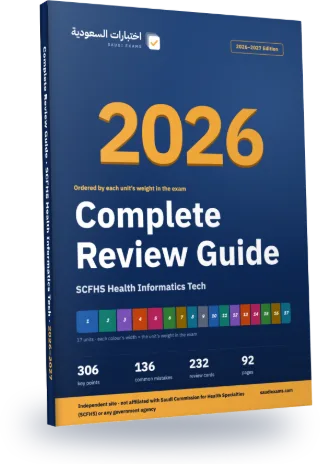
SCFHS Health Informatics Tech Complete Review Guide 2026–2027
Every exam topic in a 92-page Arabic PDF, ordered from the heaviest unit to the lightest. The first three chapters alone cover about 25% of the exam questions.
- 92Pages
- 306Key points
- 136Common mistakes
- 232Flashcards
Guide map
Each chapter is one exam unit, ordered by its weight in the real exam.
| Chapter | Unit | Weight | Exam questions | Key points |
|---|---|---|---|---|
| 1 | Database, Applications and Electronic Health Record | 10% | 15 | 20 |
| 2 | Health Statistics | 8% | 12 | 19 |
| 3 | Hospital Statistics | 7% | 11 | 18 |
| 4 | System for Numbering and Filing of Medical Records | 7% | 11 | 18 |
| 5 | Managing Health Services, Health Insurance | 7% | 11 | 18 |
| 6 | Health Care Statistics and Database Management | 6% | 9 | 17 |
| 7 | Health Record Analysis and Completion | 5% | 8 | 18 |
| 8 | Medical Terminology | 5% | 8 | 16 |
| 9 | Life Cycle of Medical Records and Functions of the Health Record | 5% | 8 | 18 |
| 10 | Location, Space and Equipment Requirements | 5% | 8 | 19 |
| 11 | Ethical Issues in Health Information | 5% | 7 | 17 |
| 12 | Preservation of Health Records | 5% | 7 | 18 |
| 13 | System for Control of Medical Records | 5% | 7 | 20 |
| 14 | Clinical Classification System | 5% | 7 | 17 |
| 15 | Content, Structure, and Formatting of the Health Record | 5% | 7 | 18 |
| 16 | Unit Record, Numbering and Filing System | 5% | 7 | 17 |
| 17 | Quality, Risk Management and Performance Improvement | 5% | 7 | 18 |
Chapter 1 in full: Database, Applications and Electronic Health Record
10% of the exam, about 15 questions. These are its key points, as in the guide.
- Interoperability is the ability of systems to exchange and use information.
- Semantic interoperability means shared meaning through common vocabularies such as SNOMED CT and LOINC.
- CPOE is computerized provider order entry; CDSS gives alerts and reminders at the point of care.
The rest of chapter 1, on this page
- Alert fatigue is clinicians ignoring alerts because of volume.
- Barcode medication administration (BCMA) reduces medication administration errors.
- An audit trail records who accessed or changed data and when.
- Role-based access control lets users reach only what their job requires.
- Encryption makes data unreadable without a key; two-factor authentication needs two credential types.
- The CIA triad: confidentiality, integrity, availability.
- Phishing is social engineering; report it to IT without clicking.
- Ransomware is mitigated by offline backups and patching.
- Recovery point objective (RPO) is the maximum acceptable data loss (time); a disaster recovery plan defines restoration.
- In Saudi Arabia, NPHIES is the health insurance information exchange (claims and eligibility), and the National Cybersecurity Authority (NCA) issues the cybersecurity controls.
- HL7 v2 messages are pipe-delimited and made of segments.
- An interface engine routes and translates messages between systems.
- SMART on FHIR lets third-party apps run inside the EHR.
- IHE develops integration profiles; an HIE enables sharing data across organizations.
- The laboratory information system (LIS) manages specimen tracking and results; PACS archives images.
- A clinical data repository (CDR) is a real-time database; a data warehouse is optimized for analysis.
- Computer-assisted coding (CAC) suggests codes using natural language processing (NLP) of free text.
Common mistakes in this chapter
- Confusing duplicate (one patient with multiple MRNs) with overlay (two patients sharing one MRN).
- An EMR usually stays within one organization, an EHR spans organizations, and a PHR is managed by the individual.
- ORU is for results and ORM for orders; ADT^A01 is admit and ADT^A03 is discharge.
- LOINC is for lab tests, SNOMED CT for clinical terms, RxNorm for drugs.
- DICOM and PACS are for medical images, not lab results.
- ASC X12 covers administrative claims in the US and NCPDP covers pharmacy transactions.
- Copy-and-paste creates inaccurate, outdated notes.
- A physician query must be non-leading, not steering to one answer.
The other chapters are in the full guide
One purchase · lifetime access · review guide included
7-day review plan
The chapters are spread over 6 days by weight so each day carries a similar load. Day 7 is a full exam.
Day 1 · 15% of the exam
Chapter 1: Database, Applications and Electronic Health Record
Chapter 12: Preservation of Health RecordsDay 2 · 18% of the exam
Chapter 2: Health Statistics
Chapter 11: Ethical Issues in Health Information
Chapter 17: Quality, Risk Management and Performance ImprovementDay 3 · 17% of the exam
Chapter 3: Hospital Statistics
Chapter 8: Medical Terminology
Chapter 14: Clinical Classification SystemDay 4 · 17% of the exam
Chapter 4: System for Numbering and Filing of Medical Records
Chapter 9: Life Cycle of Medical Records and Functions of the Health Record
Chapter 15: Content, Structure, and Formatting of the Health RecordDay 5 · 17% of the exam
Chapter 5: Managing Health Services, Health Insurance
Chapter 10: Location, Space and Equipment Requirements
Chapter 16: Unit Record, Numbering and Filing SystemDay 6 · 16% of the exam
Chapter 6: Health Care Statistics and Database Management
Chapter 7: Health Record Analysis and Completion
Chapter 13: System for Control of Medical RecordsDay 7
Full mock exam: 150 questions in 180 minutes, then review the common mistakes in the units where you lost marks.
How many correct answers do you need?
- Pass mark 55%83 correct out of 150
Before you read: see your score today
10 free questions from the main units, no sign-up. Then you know which chapter to start with.
Try 10 free questions and see your levelA look at each chapter
The first three key points of each chapter, as they appear in the guide (in Arabic in the PDF).
Chapter 1: Database, Applications and Electronic Health Record
- Interoperability is the ability of systems to exchange and use information.
- Semantic interoperability means shared meaning through common vocabularies such as SNOMED CT and LOINC.
- CPOE is computerized provider order entry; CDSS gives alerts and reminders at the point…
Chapter 2: Health Statistics
- The denominator of most annual vital rates is the mid-year population; vital statistics cover…
- Crude birth rate is per 1,000 population; general fertility rate is per 1,000 women…
- Crude death rate = deaths / mid-year population x 1,000 (4,000 / 500,000 x…
Chapter 3: Hospital Statistics
- The daily inpatient census is taken at midnight.
- Bed count is the number of inpatient beds available and staffed.
- Bed count days = beds × days; for example 100 beds for 15 days…
Chapter 4: System for Numbering and Filing of Medical Records
- Serial numbering gives a new number at every admission or visit; its drawback is…
- Unit numbering keeps one number for all encounters with all records together; it requires…
- Serial-unit numbering issues a new number each visit and moves old records forward, leaving…
Chapter 5: Managing Health Services, Health Insurance
- In Saudi Arabia CHI regulates cooperative insurance, requiring private-sector employers to cover non-Saudi employees…
- NPHIES is the national platform for health insurance transactions: eligibility, prior authorisation and claims.
- Premium is the periodic payment for cover; the deductible is paid by the insured…
Chapter 6: Health Care Statistics and Database Management
- The median of 3, 7, 9, 12, 20 is 9 (middle value after sorting).
- The mode is the most frequent value.
- The mean of 2, 3, 4, 5, 16 days is 6 while the median…
Chapter 7: Health Record Analysis and Completion
- The history and physical (H&P) is generally completed within 24 hours of admission (Joint…
- The discharge summary includes reason for admission, findings, treatment, condition at discharge and discharge…
- The operative report is documented immediately after surgery; its absence is a major deficiency.
Chapter 8: Medical Terminology
- -itis means inflammation, as in otitis media
- -ectomy is surgical removal
- -ostomy is a surgical opening
Chapter 9: Life Cycle of Medical Records and Functions of the Health Record
- The record's primary role is supporting patient care and communication among providers.
- Secondary uses include research, public health reporting (disease surveillance) and education.
- The record is legal evidence of care provided and supports reimbursement by documenting services.
Chapter 10: Location, Space and Equipment Requirements
- Mobile shelving maximizes storage capacity in limited floor space.
- Open shelves save space and allow faster retrieval than drawer cabinets.
- Floor load capacity must be checked for high-density mobile shelving.
Chapter 11: Ethical Issues in Health Information
- Confidentiality is protecting information from unauthorized disclosure.
- Patients generally have the right to access and obtain a copy of their health…
- Patients may request restrictions on some disclosures; an accounting of disclosures lists to whom…
Chapter 12: Preservation of Health Records
- When a hospital closes, records are transferred to a custodian per law.
- A records inventory before setting retention identifies record types, volume and location.
- Off-site storage contracts address confidentiality and retrieval time.
Chapter 13: System for Control of Medical Records
- The MPI is the key to locating a patient's records. It links name to…
- Minimum MPI elements
- Identity at registration is verified with an official document; for residents the Iqama number…
Chapter 14: Clinical Classification System
- WHO ICD-10 has 22 chapters and every code starts with a letter followed by…
- The alphabetic index is used to find the term and the code is then…
- Conventions
Chapter 15: Content, Structure, and Formatting of the Health Record
- The face sheet (admission-discharge record) is the first page holding demographic, financial and summary…
- The chief complaint is recorded in the patient's own words; the review of systems…
- The history and physical must be done within 24 hours of admission under accreditation…
Chapter 16: Unit Record, Numbering and Filing System
- Under unit numbering a returning patient's new encounter is filed under the same number…
- ED visits and others are filed in the same record; documents inside the record…
- The MPI links the name to the record number and is retained permanently; minimum…
Chapter 17: Quality, Risk Management and Performance Improvement
- Quality tools
- A Pareto chart rests on about 80% of problems coming from 20% of causes;…
- A run chart shows data over time, a control chart adds statistical limits to…
The full guide comes with lifetime access
The full guide (92 pages) is included with lifetime access to this exam, together with every question and full mock exam. Chapter 1 is free for everyone.
Questions about the guide
Is the guide free?
Chapter 1 is free to read on the guide page. The full guide comes with lifetime access to this exam; 7-day access does not include it.
Is it up to date for 2026–2027?
Yes. Unit weights and exam facts follow what the exam body last published, and the last check date is printed in the guide. If the standards change we update the file and buyers download the new version.
Does the guide have questions?
No. The guide covers key points and common mistakes; scoring, weak-area practice and full mock exams are on the site.
Can I read it on my phone?
Yes. A5 pages in a single column, with chapters linked from the contents.
- Pages
- 92
- Edition
- 1448 AH · 2026–2027
- Language
- Arabic
- Last updated
All Health Exams review guides
Back to SCFHS Classification Exam – Health Informatics (Medical Records) Technician
Buy this exam
Pick the access that lasts until your test date.
Included
- Full mock exams: 150 questions in 180 minutes, with a score for every unit
- 764 questions, every option explained with its source
- Practice that starts with your weakest units, plus a review of your mistakes
- Complete Review Guide 2026–2027 (PDF), with lifetime access only
Continue with your Google account and you go straight to the payment page.
You pay on the Waffo Pancake checkout page (in English). The amount is in US dollars and your bank converts it to riyals. One payment with no automatic renewal, by Visa, Mastercard (a mada card with either logo works too), Apple Pay or Google Pay. Your statement shows "WAFFO". Purchases are not refundable.