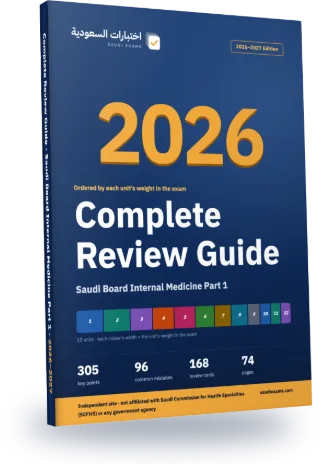
Saudi Board Internal Medicine Part 1 Complete Review Guide 2026–2027
Every exam topic in a 74-page Arabic PDF, ordered from the heaviest unit to the lightest. The first three chapters alone cover about 34% of the exam questions.
- 74Pages
- 305Key points
- 96Common mistakes
- 168Flashcards
Guide map
Each chapter is one exam unit, ordered by its weight in the real exam.
| Chapter | Unit | Weight | Exam questions | Key points |
|---|---|---|---|---|
| 1 | Cardiology | 12% | 18 | 24 |
| 2 | Gastroenterology | 12% | 18 | 25 |
| 3 | Endocrinology | 10% | 15 | 24 |
| 4 | Infectious Diseases | 10% | 15 | 26 |
| 5 | Pulmonary Diseases | 10% | 15 | 27 |
| 6 | Rheumatology | 9% | 13 | 26 |
| 7 | Hematology | 8% | 12 | 24 |
| 8 | Nephrology | 8% | 12 | 28 |
| 9 | Neurology | 6% | 9 | 26 |
| 10 | Ambulatory Care | 5% | 8 | 24 |
| 11 | Critical Care | 5% | 8 | 24 |
| 12 | Oncology | 5% | 7 | 27 |
Chapter 1 in full: Cardiology
12% of the exam, about 18 questions. These are its key points, as in the guide.
- ST elevation in II, III and aVF with reciprocal change in I and aVL usually means right coronary artery occlusion.
- STEMI within 12 hours: primary PCI is preferred if achievable within 120 minutes of diagnosis.
- If expected PCI delay exceeds 120 minutes: give fibrinolysis immediately, then transfer to a PCI centre.
The rest of chapter 1, on this page
- NSTE-ACS with refractory pain or haemodynamic instability: immediate angiography within 2 hours.
- Wellens pattern: deep symmetrical T-wave inversion in V2 to V4 indicates critical proximal LAD stenosis needing angiography.
- After ACS: high-intensity statin (atorvastatin 80 mg) and aspirin with ticagrelor for 12 months.
- Cocaine chest pain: IV benzodiazepine first to reduce sympathetic drive.
- Vasospastic angina: calcium-channel blockers such as diltiazem, with smoking cessation.
- New holosystolic murmur after inferior MI with pulmonary oedema: posteromedial papillary muscle rupture.
- HFrEF means LVEF of 40% or less with symptoms.
- NT-proBNP below 125 pg/mL in the non-acute setting makes heart failure unlikely.
- Four HFrEF pillars: ARNI (or ACEi/ARB), beta-blocker, mineralocorticoid receptor antagonist and SGLT2 inhibitor.
- Stop the MRA if potassium exceeds 6.0 mmol/L.
- Warm and wet acute HF: IV furosemide at or above the oral dose. Cold and wet with shock: dobutamine.
- Primary-prevention ICD: LVEF 35% or less after 3 months of optimal therapy and more than 40 days after MI.
- CRT: sinus rhythm, LBBB with QRS 150 ms or more, and LVEF 35% or less.
- Ivabradine: sinus rhythm with heart rate 70/min or more despite maximal beta-blocker, and LVEF 35% or less.
- AF with high stroke risk: a DOAC is preferred over warfarin, except with a mechanical valve or moderate to severe mitral stenosis.
- Reduce apixaban to 2.5 mg twice daily with 2 of: age 80 or more, weight 60 kg or less, creatinine 1.5 mg/dL or more.
- AF of 48 hours or more: anticoagulate 3 weeks before cardioversion and 4 weeks after, or exclude thrombus by TOE.
- Torsades de pointes: IV magnesium sulfate, stop QT-prolonging drugs and correct potassium.
- Symptomatic third-degree block without a reversible cause: permanent pacemaker. Asymptomatic Mobitz I in an athlete: reassurance.
- Severe aortic stenosis with symptoms or LVEF below 50%: valve replacement; TAVI for older patients at high surgical risk.
- Endocarditis: urgent surgery for heart failure from acute regurgitation, or vegetation 10 mm or more with embolism on antibiotics. S. gallolyticus needs colonoscopy.
Common mistakes in this chapter
- Nitrates or diuretics are given for hypotension in right ventricular MI. The correct step is IV fluids, since the RV is preload dependent.
- ST depression in V1 to V3 is read as anterior ischaemia. It may be posterior STEMI needing immediate reperfusion; record V7 to V9.
- Diltiazem or verapamil is added for rate control in HFrEF. They are negatively inotropic and should be avoided.
- Sacubitril–valsartan is started straight after an ACE inhibitor. A 36-hour washout is needed to avoid angioedema.
- Adenosine or an AV-nodal blocker is given in pre-excited AF. This is dangerous; use procainamide or cardioversion.
- A DOAC is prescribed with a mechanical mitral valve. Only warfarin is appropriate.
- Blood pressure is dropped to normal fast in hypertensive emergency. Lower mean pressure by no more than 25% in the first hour, except in dissection.
- An ACE inhibitor is stopped for a 20% creatinine rise. Continue with monitoring if the rise is up to 30%.
The other chapters are in the full guide
One purchase · lifetime access · review guide included
7-day review plan
The chapters are spread over 6 days by weight so each day carries a similar load. Day 7 is a full exam.
Day 1 · 17% of the exam
Chapter 1: Cardiology
Chapter 11: Critical CareDay 2 · 17% of the exam
Chapter 2: Gastroenterology
Chapter 12: OncologyDay 3 · 18% of the exam
Chapter 3: Endocrinology
Chapter 8: NephrologyDay 4 · 16% of the exam
Chapter 4: Infectious Diseases
Chapter 9: NeurologyDay 5 · 15% of the exam
Chapter 5: Pulmonary Diseases
Chapter 10: Ambulatory CareDay 6 · 17% of the exam
Chapter 6: Rheumatology
Chapter 7: Hematology
How many correct answers do you need?
- Pass mark 65%98 correct out of 150
Before you read: see your score today
10 free questions from the main units, no sign-up. Then you know which chapter to start with.
Try 10 free questions and see your levelA look at each chapter
The first three key points of each chapter, as they appear in the guide (in Arabic in the PDF).
Chapter 1: Cardiology
- ST elevation in II, III and aVF with reciprocal change in I and aVL…
- STEMI within 12 hours
- If expected PCI delay exceeds 120 minutes
Chapter 2: Gastroenterology
- Glasgow-Blatchford 0 to 1
- Peptic ulcer is the commonest cause of upper GI bleeding; NSAIDs are a major…
- Non-variceal upper bleeding
Chapter 3: Endocrinology
- Diabetes
- Established ASCVD
- Diabetic kidney disease with eGFR 20 or more
Chapter 4: Infectious Diseases
- E. coli causes 75% to 95% of uncomplicated cystitis; nitrofurantoin for 5 days is…
- Outpatient pyelonephritis with low quinolone resistance
- Bacterial meningitis above 50
Chapter 5: Pulmonary Diseases
- COPD
- GOLD group E with eosinophils 300 or more
- COPD exacerbation with purulent sputum
Chapter 6: Rheumatology
- Anti-CCP
- RA
- Methotrexate failure with poor prognostic factors (high anti-CCP, erosions): add a biologic DMARD. JAK…
Chapter 7: Hematology
- Low ferritin (below 30 µg/L) is the most specific test for iron deficiency.
- Iron deficiency in a man or postmenopausal woman
- Chronic inflammation
Chapter 8: Nephrology
- KDIGO AKI
- Prerenal
- Post-renal (urinary retention with suprapubic mass)
Chapter 9: Neurology
- Acute ischaemic stroke
- Before thrombolysis
- Large-vessel (M1) occlusion within 6 to 24 hours with salvageable penumbra: mechanical thrombectomy.
Chapter 10: Ambulatory Care
- Colorectal cancer, average risk
- First-degree relative with colorectal cancer before 60
- Lung cancer (USPSTF 2021)
Chapter 11: Critical Care
- Septic shock
- Initial fluids in septic hypotension or high lactate
- Norepinephrine is the first-line vasopressor; initial target MAP is 65 mmHg.
Chapter 12: Oncology
- Febrile neutropenia
- High risk
- Cord compression
The full guide comes with lifetime access
The full guide (74 pages) is included with lifetime access to this exam, together with every question and full mock exam. Chapter 1 is free for everyone.
Questions about the guide
Is the guide free?
Chapter 1 is free to read on the guide page. The full guide comes with lifetime access to this exam; 7-day access does not include it.
Is it up to date for 2026–2027?
Yes. Unit weights and exam facts follow what the exam body last published, and the last check date is printed in the guide. If the standards change we update the file and buyers download the new version.
Does the guide have questions?
No. The guide covers key points and common mistakes; scoring, weak-area practice and full mock exams are on the site.
Can I read it on my phone?
Yes. A5 pages in a single column, with chapters linked from the contents.
- Pages
- 74
- Edition
- 1448 AH · 2026–2027
- Language
- Arabic
- Last updated
All Health Exams review guides
Back to Saudi Board Part One Examination – Internal Medicine
Buy this exam
Pick the access that lasts until your test date.
Included
- Timed supplementary practice sessions: 150 questions in 90 minutes
- 750 questions, every option explained with its source
- Practice that starts with your weakest units, plus a review of your mistakes
- Complete Review Guide 2026–2027 (PDF), with lifetime access only
Continue with your Google account and you go straight to the payment page.
You pay on the Waffo Pancake checkout page (in English). The amount is in US dollars and your bank converts it to riyals. One payment with no automatic renewal, by Visa, Mastercard (a mada card with either logo works too), Apple Pay or Google Pay. Your statement shows "WAFFO". Purchases are not refundable.