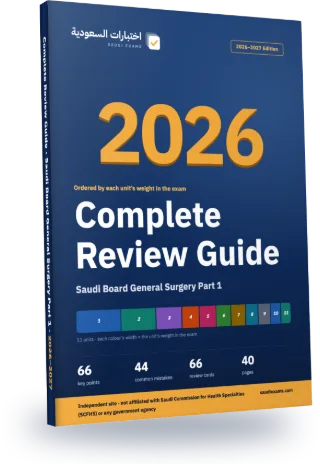
Saudi Board General Surgery Part 1 Complete Review Guide 2026–2027
Every exam topic in a 40-page Arabic PDF, ordered from the heaviest unit to the lightest. The first three chapters alone cover about 48% of the exam questions.
- 40Pages
- 66Key points
- 44Common mistakes
- 66Flashcards
Guide map
Each chapter is one exam unit, ordered by its weight in the real exam.
| Chapter | Unit | Weight | Exam questions | Key points |
|---|---|---|---|---|
| 1 | Surgical Anatomy | 20% | 30 | 6 |
| 2 | Trauma, Systemic Response to Injury and Metabolic Support | 16% | 24 | 6 |
| 3 | Shock, Fluid and Electrolyte Management of Surgical Patient | 12% | 18 | 6 |
| 4 | Surgical Physiology and Pathology | 8% | 12 | 6 |
| 5 | Principles of Pre-operative, Operative, Anesthesia, and Pain Management | 8% | 12 | 6 |
| 6 | Surgical Infection | 7% | 11 | 6 |
| 7 | Surgical Critical Care and Bedside Surgical Procedures | 7% | 10 | 6 |
| 8 | Haemostasis, Surgical Bleeding, and Transfusion | 6% | 9 | 6 |
| 9 | Surgical Complications | 6% | 9 | 6 |
| 10 | Burn and Wound Healing | 5% | 8 | 6 |
| 11 | Surgical Oncology and Transplantation | 5% | 7 | 6 |
Chapter 1 in full: Surgical Anatomy
20% of the exam, about 30 questions. These are its key points, as in the guide.
- The long thoracic nerve supplies serratus anterior; injury causes a winged scapula.
- The pelvic splanchnic nerves (S2–S4) are parasympathetic and control erection and the bladder.
- Midgut volvulus twists around the SMA when the mesenteric base is narrow.
The rest of chapter 1, on this page
- The cricothyroid membrane lies between the thyroid and cricoid cartilages and is the site of an emergency surgical airway.
- The ureter is supplied from its medial side in the abdomen and its lateral side in the pelvis.
- In axillary clearance the thoracodorsal nerve is preserved unless the tumour involves it.
Common mistakes in this chapter
- Confusing the superior laryngeal nerve (high-pitched voice) with the recurrent nerve (hoarseness, airway obstruction if bilateral).
- Forgetting that a direct hernia lies medial to the inferior epigastric vessels and an indirect one lateral.
- A left chest drain placed below the safe triangle puts the spleen at risk.
- A replaced right hepatic artery runs behind the pancreatic head and is injured in a Whipple if not expected.
The other chapters are in the full guide
One purchase · lifetime access · review guide included
7-day review plan
The chapters are spread over 6 days by weight so each day carries a similar load. Day 7 is a full exam.
Day 1 · 20% of the exam
Chapter 1: Surgical Anatomy
Day 2 · 16% of the exam
Chapter 2: Trauma, Systemic Response to Injury and Metabolic Support
Day 3 · 17% of the exam
Chapter 3: Shock, Fluid and Electrolyte Management of Surgical Patient
Chapter 10: Burn and Wound HealingDay 4 · 19% of the exam
Chapter 4: Surgical Physiology and Pathology
Chapter 8: Haemostasis, Surgical Bleeding, and Transfusion
Chapter 11: Surgical Oncology and TransplantationDay 5 · 14% of the exam
Chapter 5: Principles of Pre-operative, Operative, Anesthesia, and Pain Management
Chapter 9: Surgical ComplicationsDay 6 · 14% of the exam
Chapter 6: Surgical Infection
Chapter 7: Surgical Critical Care and Bedside Surgical ProceduresDay 7
Full mock exam: 150 questions in 180 minutes, then review the common mistakes in the units where you lost marks.
How many correct answers do you need?
- Pass mark 65%98 correct out of 150
Before you read: see your score today
10 free questions from the main units, no sign-up. Then you know which chapter to start with.
Try 10 free questions and see your levelA look at each chapter
The first three key points of each chapter, as they appear in the guide (in Arabic in the PDF).
Chapter 1: Surgical Anatomy
- The long thoracic nerve supplies serratus anterior; injury causes a winged scapula.
- The pelvic splanchnic nerves (S2–S4) are parasympathetic and control erection and the bladder.
- Midgut volvulus twists around the SMA when the mesenteric base is narrow.
Chapter 2: Trauma, Systemic Response to Injury and Metabolic Support
- Tranexamic acid
- The systolic target in severe brain injury is 100–110 mmHg or more.
- Daily energy need is about 25–30 kcal/kg, and protein 1.2–2.0 g/kg when stressed.
Chapter 3: Shock, Fluid and Electrolyte Management of Surgical Patient
- The 24-hour limit for raising sodium in chronic hyponatraemia is 10 mmol/L (European guideline…
- Dialysis is the definitive treatment for refractory hyperkalaemia in an anuric patient.
- Magnesium deficiency stops potassium and calcium from correcting.
Chapter 4: Surgical Physiology and Pathology
- In the third trimester the patient is tilted to the left to relieve caval…
- Appendicectomy in pregnancy is done without delay once the diagnosis is confirmed.
- Delirium is prevented with multicomponent non-drug measures.
Chapter 5: Principles of Pre-operative, Operative, Anesthesia, and Pain Management
- The WHO checklist phases
- The site mark is an indelible arrow visible after draping, made by the operator…
- PCA
Chapter 6: Surgical Infection
- Cefazolin is first-line prophylaxis for most clean and clean-contaminated operations.
- Gentamicin kills in a concentration-dependent way, so it is given once daily.
- Vaccines after emergency splenectomy are given about 14 days later.
Chapter 7: Surgical Critical Care and Bedside Surgical Procedures
- Driving pressure = plateau pressure minus PEEP.
- The Berlin definition needs PEEP or CPAP of at least 5 cmH₂O.
- A rapid shallow breathing index above about 105 predicts extubation failure.
Chapter 8: Haemostasis, Surgical Bleeding, and Transfusion
- INR above 10 without bleeding
- Factor VII has the shortest half-life of the vitamin K–dependent factors and factor II…
- Lupus anticoagulant prolongs the APTT and causes thrombosis, not bleeding.
Chapter 9: Surgical Complications
- Incisional hernia is the commonest late complication of a midline laparotomy.
- An inflamed central line with rigors
- Piperacillin-tazobactam alone for low-risk hospital-acquired pneumonia.
Chapter 10: Burn and Wound Healing
- Vitamin A counteracts the effect of steroids on wound healing.
- Copper is a cofactor for lysyl oxidase in collagen cross-linking.
- Facial sutures are removed after about 5 days.
Chapter 11: Surgical Oncology and Transplantation
- The N category in TNM describes regional lymph node involvement.
- CEA after colon cancer resection
- Risk-reducing salpingo-oophorectomy at 35–40 lowers mortality in BRCA1 carriers.
The full guide comes with lifetime access
The full guide (40 pages) is included with lifetime access to this exam, together with every question and full mock exam. Chapter 1 is free for everyone.
Questions about the guide
Is the guide free?
Chapter 1 is free to read on the guide page. The full guide comes with lifetime access to this exam; 7-day access does not include it.
Is it up to date for 2026–2027?
Yes. Unit weights and exam facts follow what the exam body last published, and the last check date is printed in the guide. If the standards change we update the file and buyers download the new version.
Does the guide have questions?
No. The guide covers key points and common mistakes; scoring, weak-area practice and full mock exams are on the site.
Can I read it on my phone?
Yes. A5 pages in a single column, with chapters linked from the contents.
- Pages
- 40
- Edition
- 1448 AH · 2026–2027
- Language
- Arabic
- Last updated
Buy this exam
Pick the access that lasts until your test date.
Included
- Full mock exams: 150 questions in 180 minutes, with a score for every unit
- 750 questions, every option explained with its source
- Practice that starts with your weakest units, plus a review of your mistakes
- Complete Review Guide 2026–2027 (PDF), with lifetime access only
Continue with your Google account and you go straight to the payment page.
You pay on the Waffo Pancake checkout page (in English). The amount is in US dollars and your bank converts it to riyals. One payment with no automatic renewal, by Visa, Mastercard (a mada card with either logo works too), Apple Pay or Google Pay. Your statement shows "WAFFO". Purchases are not refundable.