CPHQ
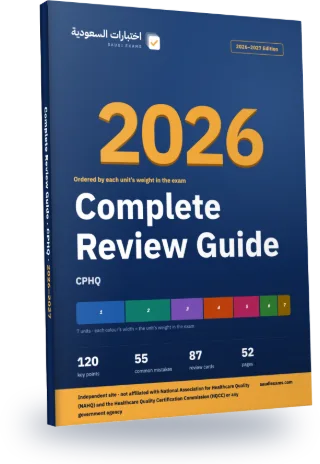
CPHQ Complete Review Guide 2026–2027
Every exam topic in a 52-page Arabic PDF, ordered from the heaviest unit to the lightest. The first three chapters alone cover about 58% of the exam questions.
- 52Pages
- 120Key points
- 55Common mistakes
- 87Flashcards
Guide map
Each chapter is one exam unit, ordered by its weight in the real exam.
| Chapter | Unit | Weight | Exam questions | Key points |
|---|---|---|---|---|
| 1 | Performance and Process Improvement | 22% | 30 | 18 |
| 2 | Health Data Analytics | 21% | 29 | 18 |
| 3 | Quality Leadership and Integration | 15% | 21 | 17 |
| 4 | Patient Safety | 14% | 20 | 18 |
| 5 | Quality Review and Accountability | 13% | 18 | 17 |
| 6 | Population Health and Care Transitions | 9% | 13 | 17 |
| 7 | Regulatory and Accreditation | 6% | 9 | 15 |
Chapter 1 in full: Performance and Process Improvement
22% of the exam, about 30 questions. These are its key points, as in the guide.
- Training evaluation (Kirkpatrick model) has four levels: reaction, learning, behavior and results.
- Communication about improvement is tailored to the audience: leaders need a short summary of results and impact, clinical teams need their own unit's data in a simple visual (such as run charts and dashboards).
- Sources of improvement opportunities: incident reports, patient complaints and experience surveys, benchmark comparisons, accreditation findings and data analysis. Priority goes to high-risk, high-volume and problem-prone processes.
The rest of chapter 1, on this page
- A project charter sets out the problem statement, a measurable aim, scope and its boundaries, team members and roles, timeline and resources. A clear scope prevents scope creep.
- Improvement team roles: the executive sponsor removes barriers and provides resources, the team leader manages the work, the facilitator runs meetings and process, and the clinical and data experts supply technical knowledge.
- Tuckman's stages of team development: forming, storming, norming, performing, then adjourning.
- Lewin's change model: unfreeze, change, refreeze. Kotter's eight steps: create urgency, build a guiding coalition, form a vision, communicate it, empower action, generate short-term wins, consolidate gains, and anchor the change in the culture.
- The Model for Improvement (IHI): three questions about aim, measures and changes, then PDSA cycles: Plan (and predict the result), Do (run the test on a small scale), Study (analyze the data against the prediction), Act (adopt, adapt or abandon).
- A good improvement aim is specific, measurable and time-bound, naming the patient group or unit (SMART), for example reducing falls on a named unit by a stated percentage within six months.
- DMAIC: Define (the problem and requirements), Measure (current performance), Analyze (root causes), Improve (implement and test solutions), Control (hold the gain with a control plan). Six Sigma level means about 3.4 defects per million opportunities.
- The eight Lean wastes (DOWNTIME): Defects, Overproduction, Waiting, Non-utilized talent, Transportation, Inventory, Motion, Extra-processing.
- Lean tools include the value stream map, kaizen (continuous improvement), the rapid kaizen event, and 5S: Sort, Set in order, Shine, Standardize, Sustain.
- The seven basic quality tools: fishbone diagram, check sheet, control chart, histogram, Pareto chart, scatter diagram and flowchart. A run chart shows performance over time.
- A control chart separates common from special cause variation. Common rules for signaling a special cause: a point outside the control limits, eight points in a row on one side of the center line, or six points in a row rising or falling.
- FMEA identifies potential failure modes in a process, scores each for severity, occurrence and detection (often 1 to 10), and multiplies them to get the RPN. The highest RPN or highest severity is addressed first.
- Timelines and deliverables are tracked with a Gantt chart, milestones and regular status meetings. When the project slips, it is raised to the sponsor with options for recovery.
- Team effectiveness is judged by clarity of aim and roles, member participation, quality of decisions and progress toward the aim, using a member survey and regular feedback.
- Judging project success compares results with the baseline and the aim, using outcome, process and balancing measures. Sustainability comes from writing the new way into policy, training staff, monitoring the indicator after the project ends and, where needed, a cost-benefit analysis.
Common mistakes in this chapter
- PDSA and PDCA share one origin (the Deming cycle). In PDSA the third step is Study, meaning analyzing what the test taught you, not just checking that the plan was carried out.
- Lean targets waste and flow, while Six Sigma targets variation and defects. A question about cutting waiting and unnecessary motion points to Lean; one about reducing variation in results points to Six Sigma.
- FMEA is proactive and used before harm occurs; root cause analysis (RCA) is retrospective and used after an event. Do not choose RCA to assess a new process that has not gone live.
- A Pareto chart ranks causes or problems by frequency and does not show cause and effect. The fishbone diagram is the one that groups possible causes into categories.
- Common cause variation is a normal part of the process and is addressed by changing the process itself. Special cause variation calls for investigating a specific event. Do not treat a point inside the control limits as an unusual event.
- A change is tested small first (one patient, one unit, one day) before it is scaled up. An answer that rolls the change out hospital-wide without testing is usually wrong.
- When people resist change, the right response is to understand the reasons and involve staff, not to impose the change by order or ignore those who object.
- An improved outcome measure alone does not prove success. Also check balancing measures and whether the gain holds after the project team steps back.
The other chapters are in the full guide
One purchase · lifetime access · review guide included
7-day review plan
The chapters are spread over 6 days by weight so each day carries a similar load. Day 7 is a full exam.
Day 1 · 22% of the exam
Chapter 1: Performance and Process Improvement
Day 2 · 21% of the exam
Chapter 2: Health Data Analytics
Day 3 · 15% of the exam
Chapter 3: Quality Leadership and Integration
Day 4 · 14% of the exam
Chapter 4: Patient Safety
Day 5 · 13% of the exam
Chapter 5: Quality Review and Accountability
Day 6 · 15% of the exam
Chapter 6: Population Health and Care Transitions
Chapter 7: Regulatory and AccreditationDay 7
Full mock exam: 140 questions in 180 minutes, then review the common mistakes in the units where you lost marks.
Before you read: see your score today
10 free questions from the main units, no sign-up. Then you know which chapter to start with.
Try 10 free questions and see your levelA look at each chapter
The first three key points of each chapter, as they appear in the guide (in Arabic in the PDF).
Chapter 1: Performance and Process Improvement
- Training evaluation (Kirkpatrick model) has four levels
- Communication about improvement is tailored to the audience
- Sources of improvement opportunities
Chapter 2: Health Data Analytics
- An indicator is defined by its numerator, denominator, exclusions, time period and measurement frequency.
- A structure measure captures resources and arrangements (such as nurse-to-patient ratio), a process measure…
- A balancing measure watches for an unintended side effect of a change, such as…
Chapter 3: Quality Leadership and Integration
- Mission states why the organization exists and what it does, vision describes the desired…
- The strategic plan is translated into SMART objectives
- A SWOT analysis examines internal strengths and weaknesses and external opportunities and threats, and…
Chapter 4: Patient Safety
- Near miss (close call)
- Adverse event
- Sentinel event
Chapter 5: Quality Review and Accountability
- A clinical practice guideline is a set of recommendations meant to optimize patient care…
- Evidence is ranked by strength of design
- A guideline's quality is appraised with tools such as AGREE II, which look at…
Chapter 6: Population Health and Care Transitions
- Population health
- A target population is defined by a shared characteristic
- Data sources
Chapter 7: Regulatory and Accreditation
- Accreditation is an independent external evaluation of an organization against published standards, done through…
- Certification is granted to a specific program, service or person (such as a clinical…
- Well-known hospital accreditors include The Joint Commission, DNV and, internationally, JCI; in Saudi Arabia…
The full guide comes with lifetime access
The full guide (52 pages) is included with lifetime access to this exam, together with every question and full mock exam. Chapter 1 is free for everyone.
Questions about the guide
Is the guide free?
Chapter 1 is free to read on the guide page. The full guide comes with lifetime access to this exam; 7-day access does not include it.
Is it up to date for 2026–2027?
Yes. Unit weights and exam facts follow what the exam body last published, and the last check date is printed in the guide. If the standards change we update the file and buyers download the new version.
Does the guide have questions?
No. The guide covers key points and common mistakes; scoring, weak-area practice and full mock exams are on the site.
Can I read it on my phone?
Yes. A5 pages in a single column, with chapters linked from the contents.
- Pages
- 52
- Edition
- 1448 AH · 2026–2027
- Language
- Arabic
- Last updated
Buy this exam
Pick the access that lasts until your test date.
Included
- Full mock exams: 140 questions in 180 minutes, with a score for every unit
- 741 questions, every option explained with its source
- Practice that starts with your weakest units, plus a review of your mistakes
- Complete Review Guide 2026–2027 (PDF), with lifetime access only
Continue with your Google account and you go straight to the payment page.
You pay on the Waffo Pancake checkout page (in English). The amount is in US dollars and your bank converts it to riyals. One payment with no automatic renewal, by Visa, Mastercard (a mada card with either logo works too), Apple Pay or Google Pay. Your statement shows "WAFFO". Purchases are not refundable.