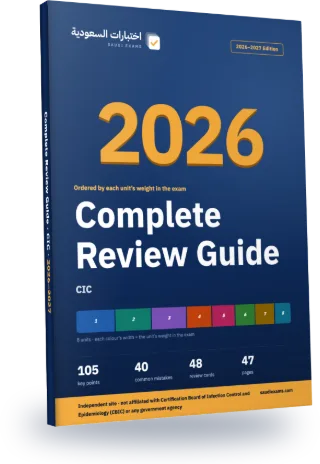
CIC Complete Review Guide 2026–2027
Every exam topic in a 47-page Arabic PDF, ordered from the heaviest unit to the lightest. The first three chapters alone cover about 50% of the exam questions.
- 47Pages
- 105Key points
- 40Common mistakes
- 48Flashcards
Guide map
Each chapter is one exam unit, ordered by its weight in the real exam.
| Chapter | Unit | Weight | Exam questions | Key points |
|---|---|---|---|---|
| 1 | Surveillance and Epidemiologic Investigation | 17% | 26 | 19 |
| 2 | Processes to Identify Infectious Diseases | 16% | 24 | 14 |
| 3 | Preventing/Controlling the Transmission of Infectious Agents | 16% | 24 | 14 |
| 4 | Management and Communication of the Infection Prevention Program | 12% | 18 | 12 |
| 5 | Education and Research | 11% | 17 | 10 |
| 6 | Environment of Care | 10% | 15 | 12 |
| 7 | Cleaning, Disinfection, Sterilization of Medical Devices and Equipment | 10% | 14 | 12 |
| 8 | Employee/Occupational Health | 8% | 12 | 12 |
Chapter 1 in full: Surveillance and Epidemiologic Investigation
17% of the exam, about 26 questions. These are its key points, as in the guide.
- (Design of surveillance systems) Surveillance is the ongoing, systematic collection, analysis and interpretation of health data, followed by timely feedback to those who can act. Source: CBIC CIC Content Outline (July 2026), Domain 2; CDC Principles of Epidemiology in Public Health Practice.
- (Design of surveillance systems) Begin with a risk assessment of the population served, procedures performed and past data to choose priority events and goals. Source: CBIC CIC Content Outline (July 2026), Domain 2; CDC NHSN Patient Safety Component Manual.
- (Design of surveillance systems) Choose methods deliberately: hospital-wide or targeted, active or passive, prospective or retrospective, outcome or process surveillance. Active, prospective, targeted surveillance is the usual choice for priority device and procedure events. Source: CBIC CIC Content Outline (July 2026), Domain 2; APIC Text of Infection Control and Epidemiology.
The rest of chapter 1, on this page
- (Collection and compilation of surveillance data) Common data sources are microbiology reports, pharmacy, admission and discharge records, radiology, clinical rounds and employee health records; using more than one source improves case finding. Source: CBIC CIC Content Outline (July 2026), Domain 2; CDC NHSN Patient Safety Component Manual.
- (Collection and compilation of surveillance data) Apply written case definitions consistently. For NHSN device-associated events the device must be in place for more than 2 consecutive calendar days on the date of event. Source: CBIC CIC Content Outline (July 2026), Domain 2; CDC NHSN Patient Safety Component Manual.
- (Collection and compilation of surveillance data) Incidence rate = new events ÷ population at risk × a constant (such as 1,000 device days). Prevalence = all existing cases ÷ population at a time point or period. Source: CBIC CIC Content Outline (July 2026), Domain 2; CDC Principles of Epidemiology in Public Health Practice.
- (Collection and compilation of surveillance data) Device utilization ratio = device days ÷ patient days. It shows how much the device is used and helps explain changes in the device-associated infection rate. Source: CBIC CIC Content Outline (July 2026), Domain 2; CDC NHSN Patient Safety Component Manual.
- (Interpretation and communication of surveillance data) The standardized infection ratio (SIR) is observed ÷ predicted events. A value above 1.0 means more events than predicted; the confidence interval shows whether the difference is meaningful. Source: CBIC CIC Content Outline (July 2026), Domain 2; CDC NHSN Patient Safety Component Manual.
- (Interpretation and communication of surveillance data) Use run charts and control charts to see trends over time; a single high month is a signal to look, not proof of a problem. Source: CBIC CIC Content Outline (July 2026), Domain 2; CDC Principles of Epidemiology in Public Health Practice.
- (Interpretation and communication of surveillance data) Report to different audiences differently: units want unit-level rates and actions; leaders want trends, benchmarks and risk; clinicians want clear, timely feedback. Source: CBIC CIC Content Outline (July 2026), Domain 2; APIC Text of Infection Control and Epidemiology.
- (Interpretation and communication of surveillance data) Reportable diseases must be notified to public health authorities within the time set by law; know your jurisdiction's list and deadlines. Source: CBIC CIC Content Outline (July 2026), Domain 2; CDC Principles of Epidemiology in Public Health Practice.
- (Actions based on surveillance data and quality improvement) Link each surveillance finding to an action: observe practice, audit adherence to prevention bundles, then use a plan-do-study-act cycle and re-measure. Source: CBIC CIC Content Outline (July 2026), Domain 2; CDC Infection Prevention Checklists / Targeted Assessment for Prevention (TAP).
- (Actions based on surveillance data and quality improvement) Validate the data: review a sample of cases and non-cases, because inaccurate case finding can make good or poor performance look different than it is. Source: CBIC CIC Content Outline (July 2026), Domain 2; CDC NHSN Patient Safety Component Manual.
- (Outbreak and exposure investigation) An outbreak is more cases than expected in a place and time. Confirm it by comparing with baseline and checking that the diagnoses are real and not a testing artifact (pseudo-outbreak). Source: CBIC CIC Content Outline (July 2026), Domain 2; CDC Steps of an Outbreak Investigation.
- (Outbreak and exposure investigation) A case definition uses clinical criteria plus person, place and time, and can have confirmed, probable and possible categories. Keep it simple and use it for case finding. Source: CBIC CIC Content Outline (July 2026), Domain 2; CDC Steps of an Outbreak Investigation.
- (Outbreak and exposure investigation) The epidemic curve shows onset over time: a point-source outbreak peaks quickly and falls within one incubation period; a continuous or propagated pattern shows repeated peaks. Source: CBIC CIC Content Outline (July 2026), Domain 2; CDC Steps of an Outbreak Investigation.
- (Outbreak and exposure investigation) A case-control study compares exposures in cases and controls and gives an odds ratio; a cohort study compares attack rates in exposed and unexposed groups and gives a relative risk. Source: CBIC CIC Content Outline (July 2026), Domain 2; CDC Principles of Epidemiology in Public Health Practice.
- (Outbreak and exposure investigation) Start control measures as soon as a source or route is suspected; molecular typing (such as whole-genome sequencing) supports, but does not replace, epidemiologic evidence. Source: CBIC CIC Content Outline (July 2026), Domain 2; CDC Steps of an Outbreak Investigation.
- (Outbreak and exposure investigation) An exposure investigation lists who was exposed, when and how; assess susceptibility (immunity), decide on prophylaxis or work restrictions, and follow up for the incubation period. Source: CBIC CIC Content Outline (July 2026), Domain 2; CDC Guideline for Infection Control in Health Care Personnel (1998).
Common mistakes in this chapter
- Do not wait for laboratory confirmation before starting control measures in an outbreak.
- A rate per 1,000 device days and a rate per 100 admissions are not interchangeable; use the denominator that matches the exposure.
- A rise in cases is not always an outbreak: check for changes in testing, definitions or population first.
- Incidence counts new cases; prevalence counts all existing cases at a point or period in time.
- Statistical significance does not mean the difference is important to patient care.
The other chapters are in the full guide
One purchase · lifetime access · review guide included
7-day review plan
The chapters are spread over 6 days by weight so each day carries a similar load. Day 7 is a full exam.
Day 1 · 17% of the exam
Chapter 1: Surveillance and Epidemiologic Investigation
Day 2 · 16% of the exam
Chapter 2: Processes to Identify Infectious Diseases
Day 3 · 16% of the exam
Chapter 3: Preventing/Controlling the Transmission of Infectious Agents
Day 4 · 12% of the exam
Chapter 4: Management and Communication of the Infection Prevention Program
Day 5 · 19% of the exam
Chapter 5: Education and Research
Chapter 8: Employee/Occupational HealthDay 6 · 19% of the exam
Chapter 6: Environment of Care
Chapter 7: Cleaning, Disinfection, Sterilization of Medical Devices and EquipmentDay 7
Full mock exam: 150 questions in 180 minutes, then review the common mistakes in the units where you lost marks.
Before you read: see your score today
10 free questions from the main units, no sign-up. Then you know which chapter to start with.
Try 10 free questions and see your levelA look at each chapter
The first three key points of each chapter, as they appear in the guide (in Arabic in the PDF).
Chapter 1: Surveillance and Epidemiologic Investigation
- (Design of surveillance systems) Surveillance is the ongoing, systematic collection, analysis and interpretation of…
- (Design of surveillance systems) Begin with a risk assessment of the population served, procedures…
- (Design of surveillance systems) Choose methods deliberately
Chapter 2: Processes to Identify Infectious Diseases
- (Clinical information) Combine history, exposures, symptoms, vital signs and the timeline of hospital stay…
- (Clinical information) Fever, new cough, dysuria, wound drainage or diarrhea point to a body…
- (Disease presentation) Rash with fever and cough with conjunctivitis suggests measles; vesicular rash in…
Chapter 3: Preventing/Controlling the Transmission of Infectious Agents
- (Policies, procedures and risk assessment) Write policies from current evidence, define who is responsible…
- (Policies, procedures and risk assessment) A risk assessment ranks risks by probability and consequence…
- (Standard precautions and device/procedure-related risks) Standard precautions: hand hygiene, PPE by anticipated exposure, respiratory…
Chapter 4: Management and Communication of the Infection Prevention Program
- (Planning, leadership and resources) An infection prevention program needs a written annual plan built…
- (Planning, leadership and resources) Make the business case for resources with outcomes and cost…
- (Planning, leadership and resources) An infection prevention committee brings together leaders from medicine, nursing…
Chapter 5: Education and Research
- (Education) Adults learn best when content is relevant to their job, practical, and allows…
- (Education) Do a needs assessment from surveillance data, audits and staff questions; write measurable…
- (Education) Teach patients and families in plain language, in their language, and check understanding…
Chapter 6: Environment of Care
- (Environmental safety and operations) Health-care water systems can grow Legionella and Pseudomonas; a water…
- (Environmental safety and operations) Hot water is stored at a temperature that limits Legionella…
- (Environmental safety and operations) Clean from clean to dirty and from high to low;…
Chapter 7: Cleaning, Disinfection, Sterilization of Medical Devices and Equipment
- (Reprocessing practices and oversight) Spaulding classification: critical items enter sterile tissue or the vascular…
- (Reprocessing practices and oversight) Reprocessing flow
- (Reprocessing practices and oversight) Steam sterilization needs time, temperature, pressure and steam contact; common…
Chapter 8: Employee/Occupational Health
- (Collaboration with occupational health) Infection prevention and occupational health share goals: protect staff, protect…
- (Screening) Pre-placement screening reviews immunity to measles, mumps, rubella, varicella and hepatitis B and…
- (Screening) Serial tuberculosis testing is not routine for personnel without exposure; after an exposure…
The full guide comes with lifetime access
The full guide (47 pages) is included with lifetime access to this exam, together with every question and full mock exam. Chapter 1 is free for everyone.
Questions about the guide
Is the guide free?
Chapter 1 is free to read on the guide page. The full guide comes with lifetime access to this exam; 7-day access does not include it.
Is it up to date for 2026–2027?
Yes. Unit weights and exam facts follow what the exam body last published, and the last check date is printed in the guide. If the standards change we update the file and buyers download the new version.
Does the guide have questions?
No. The guide covers key points and common mistakes; scoring, weak-area practice and full mock exams are on the site.
Can I read it on my phone?
Yes. A5 pages in a single column, with chapters linked from the contents.
- Pages
- 47
- Edition
- 1448 AH · 2026–2027
- Language
- Arabic
- Last updated
All Health Exams review guides
Back to CIC – Certification in Infection Prevention and Control (CBIC)
Buy this exam
Pick the access that lasts until your test date.
Included
- Timed supplementary practice sessions: 150 questions in 180 minutes
- 750 questions, every option explained with its source
- Practice that starts with your weakest units, plus a review of your mistakes
- Complete Review Guide 2026–2027 (PDF), with lifetime access only
Continue with your Google account and you go straight to the payment page.
You pay on the Waffo Pancake checkout page (in English). The amount is in US dollars and your bank converts it to riyals. One payment with no automatic renewal, by Visa, Mastercard (a mada card with either logo works too), Apple Pay or Google Pay. Your statement shows "WAFFO". Purchases are not refundable.