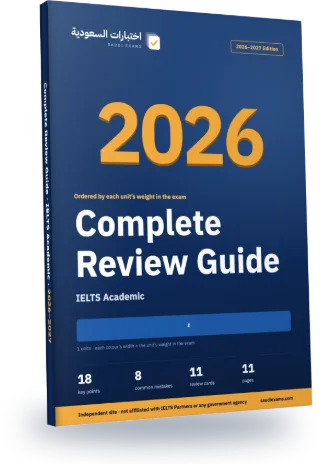
IELTS Academic Complete Review Guide 2026–2027
Every exam topic in a 11-page Arabic PDF, ordered from the heaviest unit to the lightest. The first three chapters alone cover about 100% of the exam questions.
- 11Pages
- 18Key points
- 8Common mistakes
- 11Flashcards
Guide map
Each chapter is one exam unit, ordered by its weight in the real exam.
| Chapter | Unit | Weight | Exam questions | Key points |
|---|---|---|---|---|
| 1 | Academic Reading | 100% | 40 | 18 |
Chapter 1 in full: Academic Reading
100% of the exam, about 40 questions. These are its key points, as in the guide.
- A possibility is weaker than a certainty. An association does not by itself establish a cause.
- When a question asks what the passage supports, use its evidence rather than outside knowledge.
- A main-idea answer must cover the paragraph, not merely repeat an attractive example.
The rest of chapter 1, on this page
- For example, if attendance rose after opening hours changed but advertising also increased, the passage cannot isolate opening hours as the cause.
- Each correct answer scores one mark and wrong answers lose nothing, so guess rather than leave a blank.
- Answers must be transferred to the answer sheet within the 60 minutes; no extra transfer time is given.
- Common types: multiple choice, identifying information (T/F/NG), identifying the writer's views (Y/N/NG), matching headings and information, sentence, summary and table completion.
- In completion tasks keep to the word limit (such as "no more than two words") and copy the word as it appears in the text.
- Questions usually follow the order of the text, except heading and information matching.
- Matching headings: read the first and last sentences of a paragraph and look for the general idea, not a detail.
- Words such as always, never, only and all make a claim stronger and easier to prove wrong; check the text.
- Skim the text for structure, then scan for the specific information.
- In Y/N/NG: "Yes" if the claim agrees with the writer's view, "No" if it contradicts it, "Not Given" if no view is expressed.
- Inference questions need evidence in the text, not your personal experience.
- The context around a hard word is often enough to understand it without a dictionary.
- Synonyms and paraphrase underlie most questions, so wider vocabulary improves results.
- Practise with varied academic texts (science, history, social topics) and note each paragraph's main idea.
- Academic Reading texts are taken from books, journals, magazines and newspapers suited to a non-specialist reader.
Common mistakes in this chapter
- Reject options that change some to all, may to must, or short-term findings to permanent effects.
- A true statement may still answer a different question.
- These short drills do not reproduce the sustained reading load of a full paper.
- Choosing "True" because you already know the idea; the decision depends on the text only.
- Confusing "False" (the text contradicts the statement) with "Not Given" (the text says nothing about it).
- Copying answers with a spelling error or beyond the word limit; both lose the mark.
- Spending too long on one hard question and leaving easier ones unanswered.
- Treating your accuracy in this practice as an official band score.
The other chapters are in the full guide
One purchase · lifetime access · review guide included
7-day review plan
The chapters are spread over 6 days by weight so each day carries a similar load. Day 7 is a full exam.
Day 1 · 100% of the exam
Chapter 1: Academic Reading
Day 2
Full mock exam: 40 questions in 60 minutes, then review the common mistakes in the units where you lost marks.
Before you read: see your score today
10 free questions from the main units, no sign-up. Then you know which chapter to start with.
Try 10 free questions and see your levelA look at each chapter
The first three key points of each chapter, as they appear in the guide (in Arabic in the PDF).
Chapter 1: Academic Reading
- A possibility is weaker than a certainty. An association does not by itself establish…
- When a question asks what the passage supports, use its evidence rather than outside…
- A main-idea answer must cover the paragraph, not merely repeat an attractive example.
The full guide comes with lifetime access
The full guide (11 pages) is included with lifetime access to this exam, together with every question and full mock exam. Chapter 1 is free for everyone.
Questions about the guide
Is the guide free?
Chapter 1 is free to read on the guide page. The full guide comes with lifetime access to this exam; 7-day access does not include it.
Is it up to date for 2026–2027?
Yes. Unit weights and exam facts follow what the exam body last published, and the last check date is printed in the guide. If the standards change we update the file and buyers download the new version.
Does the guide have questions?
No. The guide covers key points and common mistakes; scoring, weak-area practice and full mock exams are on the site.
Can I read it on my phone?
Yes. A5 pages in a single column, with chapters linked from the contents.
- Pages
- 11
- Edition
- 1448 AH · 2026–2027
- Language
- Arabic
- Last updated
Buy this exam
Pick the access that lasts until your test date.
Included
- Timed supplementary practice sessions: 40 questions in 60 minutes
- 500 questions, every option explained with its source
- Practice that starts with your weakest units, plus a review of your mistakes
- Complete Review Guide 2026–2027 (PDF), with lifetime access only
Continue with your Google account and you go straight to the payment page.
You pay on the Waffo Pancake checkout page (in English). The amount is in US dollars and your bank converts it to riyals. One payment with no automatic renewal, by Visa, Mastercard (a mada card with either logo works too), Apple Pay or Google Pay. Your statement shows "WAFFO". Purchases are not refundable.