CME-2A · Global Financial Compliance
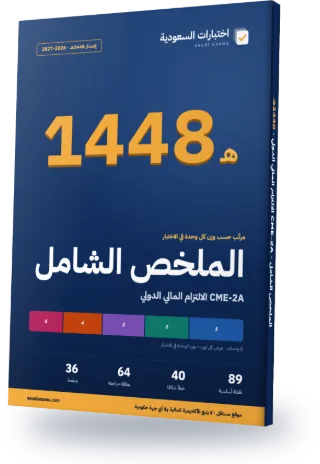
CME-2A Global Financial Compliance Complete Review Guide 2026–2027
Every exam topic in a 36-page Arabic PDF, ordered from the heaviest unit to the lightest. The first three chapters alone cover about 64% of the exam questions.
- 36Pages
- 89Key points
- 40Common mistakes
- 64Flashcards
Guide map
Each chapter is one exam unit, ordered by its weight in the real exam.
| Chapter | Unit | Weight | Exam questions | Key points |
|---|---|---|---|---|
| 1 | The Compliance Function | 24% | 24 | 18 |
| 2 | The International Regulatory Environment | 20% | 20 | 17 |
| 3 | Managing the Risk of Financial Crime | 20% | 20 | 18 |
| 4 | Ethics, Integrity and Fairness | 19% | 19 | 18 |
| 5 | Governance, Risk Management and Compliance | 17% | 17 | 18 |
Chapter 1 in full: The Compliance Function
24% of the exam, about 24 questions. These are its key points, as in the guide.
- Compliance risk is the risk of legal or regulatory sanctions, material financial loss or loss to reputation from failing to comply with laws, regulations, rules, SRO standards and codes of conduct (§1.1.1).
- Compliance starts at the top but is everyone's concern, not only that of compliance specialists, and covers the spirit as well as the letter of the law (§1.1.1).
- The BCBS issued ten principles on compliance and the compliance function; under Principle 1 the board oversees compliance risk, approves the compliance policy and assesses effectiveness at least once a year (§1.1.2).
The rest of chapter 1, on this page
- Senior management establishes and communicates a written compliance policy, ensures it is observed, assesses the main compliance risks at least annually with the compliance function, reports to the board annually and promptly on any material failure (§1.1.3).
- Principle 6 (resources): compliance staff need suitable qualifications and experience, kept current through regular, systematic education and training (§1.2).
- The compliance manual documents the standards staff must follow and gives policy and guidance, not detailed procedures; it must be a living document, reviewed and updated for changes and staff feedback (§1.3).
- The compliance function has a formal documented status, a right of access to information (with a staff duty to cooperate), a right to investigate and appoint outside experts, and direct access to the board or a board committee (§1.3.3).
- The monitoring programme is risk-based because reviewing every item is impractical; it confirms that tasks follow procedures and that procedures still reflect current regulatory requirements (§1.5).
- The three stages are information gathering on potential adverse events, scoring (financial impact, exposure frequency, probability) and weightings (anxiety, perspective, days since last tested) (§1.5).
- In the scoring example, 250 is a daily event, 50 weekly, 1 annual and 0.1 rare; probability of the risk crystallising is low below 30%, medium 30% to 70% and high above 70% (§1.5).
- Working papers give an evidential record of what was tested and found; findings go to business management to agree remedial action, and larger programmes produce a risk mitigation plan for the board (§1.5).
- Regulatory requirements are integrated through five elements: people, allocation of responsibilities, training, procedures and systems (§1.6).
- Regulations are minimum rules set by governments and regulators; internal policies are set by the firm and may go beyond regulation; procedures detail what staff do; local rules may conflict with head-office policies (§1.7).
- Outsourcing: the firm stays responsible; the regulator expects due diligence on the provider, enough expertise to oversee it, a written contract with an SLA and KPIs, and business continuity and disaster recovery plans (§1.8.1).
- Capital: the minimum is set by a standard formula (higher risk, more capital) or by internal models approved by the regulator; examples are Basel II and III for banks and Solvency II for insurers (§1.8.2).
- Variation of permission: a minor variation can take two to eight weeks and a major one up to a year; compliance should be involved early in any new activity (§1.8.3).
- Independence has four elements: formal status, a head of compliance, no conflict of interest with other responsibilities, and access to information and personnel (§2.1.3).
- Three lines of defence: operational controls and business and process owners; compliance, supporting management through sample-based review; internal audit, giving assurance to senior management and the board (§2.1.3).
Common mistakes in this chapter
- Mixing up policies and procedures: a policy sets principles and may go beyond regulation, procedures give detailed steps, and the compliance manual is policy and guidance, not a procedures manual.
- Believing independence means distance from the business: close cooperation is welcome; independence means formal status, a head of compliance, no conflicts of interest, and access to information.
- Pay linked to the performance of the business line a compliance officer oversees undermines independence; pay linked to the performance of the whole bank is generally acceptable.
- Thinking outsourcing transfers responsibility: the firm remains responsible for outsourced tasks and must not become an “empty shell” without the substance to stay authorised.
- Confusing the second and third lines: compliance is the second line (sample-based monitoring supporting management); internal audit is the third (assurance to senior management and the board).
- Assuming every breach is reported to the regulator at once: minor breaches go in the breaches log and are reviewed; a notifiable breach is one the rules make reportable, typically within 24 hours of identification.
- Confusing reporting with tipping off: reporting suspicion to the MLRO and the authorities is required and does not breach confidentiality; telling the client a report is being made is tipping off, which can be punished.
- Mixing up scoring and weightings in the monitoring programme: scoring covers financial impact, exposure frequency and probability; weightings add anxiety, perspective and days since last tested.
The other chapters are in the full guide
One purchase · lifetime access · review guide included
7-day review plan
The chapters are spread over 6 days by weight so each day carries a similar load. Day 7 is a full exam.
Day 1 · 24% of the exam
Chapter 1: The Compliance Function
Day 2 · 20% of the exam
Chapter 2: The International Regulatory Environment
Day 3 · 20% of the exam
Chapter 3: Managing the Risk of Financial Crime
Day 4 · 19% of the exam
Chapter 4: Ethics, Integrity and Fairness
Day 5 · 17% of the exam
Chapter 5: Governance, Risk Management and Compliance
Day 6
Full mock exam: 100 questions in 120 minutes, then review the common mistakes in the units where you lost marks.
How many correct answers do you need?
- Pass mark 70%70 correct out of 100
Before you read: see your score today
10 free questions from the main units, no sign-up. Then you know which chapter to start with.
Try 10 free questions and see your levelA look at each chapter
The first three key points of each chapter, as they appear in the guide (in Arabic in the PDF).
Chapter 1: The Compliance Function
- Compliance risk is the risk of legal or regulatory sanctions, material financial loss or…
- Compliance starts at the top but is everyone's concern, not only that of compliance…
- The BCBS issued ten principles on compliance and the compliance function; under Principle 1…
Chapter 2: The International Regulatory Environment
- Objectives of regulation
- Law sets the structural framework of the sector and its products; regulation holds the…
- Rules
Chapter 3: Managing the Risk of Financial Crime
- Money laundering
- Terrorist financing
- The three stages
Chapter 4: Ethics, Integrity and Fairness
- Regulatory standards cover four areas
- The eight CISI Principles are Personal Accountability, Client Focus, Conflict of Interest, Respect for…
- Fiduciary duty is a relationship of trust over the management of money or property…
Chapter 5: Governance, Risk Management and Compliance
- Corporate governance is how the board and senior management run the firm, including setting…
- Poor governance can contribute to bank failures and make markets lose confidence, which can…
- In the UK the Senior Manager and Certification Regime (SMCR) was introduced in 2015…
The full guide comes with lifetime access
The full guide (36 pages) is included with lifetime access to this exam, together with every question and full mock exam. Chapter 1 is free for everyone.
Questions about the guide
Is the guide free?
Chapter 1 is free to read on the guide page. The full guide comes with lifetime access to this exam; 7-day access does not include it.
Is it up to date for 2026–2027?
Yes. Unit weights and exam facts follow what the exam body last published, and the last check date is printed in the guide. If the standards change we update the file and buyers download the new version.
Does the guide have questions?
No. The guide covers key points and common mistakes; scoring, weak-area practice and full mock exams are on the site.
Can I read it on my phone?
Yes. A5 pages in a single column, with chapters linked from the contents.
- Pages
- 36
- Edition
- 1448 AH · 2026–2027
- Language
- Arabic
- Last updated
All Finance & Insurance Exams review guides
Back to CME-2A – Global Financial Compliance (International Compliance Exam)
Buy this exam
Pick the access that lasts until your test date.
Included
- Full mock exams: 100 questions in 120 minutes, with a score for every unit
- 558 questions, every option explained with its source
- Practice that starts with your weakest units, plus a review of your mistakes
- Complete Review Guide 2026–2027 (PDF), with lifetime access only
Continue with your Google account and you go straight to the payment page.
You pay on the Waffo Pancake checkout page (in English). The amount is in US dollars and your bank converts it to riyals. One payment with no automatic renewal, by Visa, Mastercard (a mada card with either logo works too), Apple Pay or Google Pay. Your statement shows "WAFFO". Purchases are not refundable.