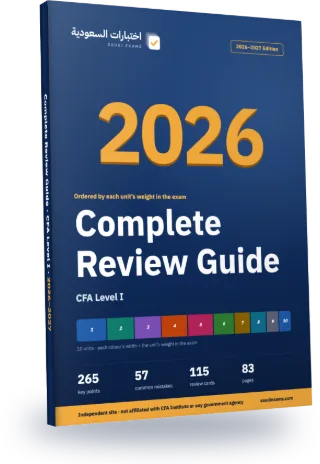
CFA Level I Complete Review Guide 2026–2027
Every exam topic in a 83-page Arabic PDF, ordered from the heaviest unit to the lightest. The first three chapters alone cover about 38% of the exam questions.
- 83Pages
- 265Key points
- 57Common mistakes
- 115Flashcards
Guide map
Each chapter is one exam unit, ordered by its weight in the real exam.
| Chapter | Unit | Weight | Exam questions | Key points |
|---|---|---|---|---|
| 1 | Ethical and Professional Standards | 13% | 24 | 30 |
| 2 | Quantitative Methods | 12% | 22 | 19 |
| 3 | Financial Statement Analysis | 12% | 22 | 39 |
| 4 | Equities | 12% | 22 | 27 |
| 5 | Fixed Income | 12% | 22 | 32 |
| 6 | Portfolio Construction | 10% | 18 | 32 |
| 7 | Derivatives and Risk Management | 8% | 14 | 16 |
| 8 | Alternative Investments | 8% | 14 | 32 |
| 9 | Economics | 6% | 11 | 20 |
| 10 | Corporate Finance | 6% | 11 | 18 |
Chapter 1 in full: Ethical and Professional Standards
13% of the exam, about 24 questions. These are its key points, as in the guide.
- Professional duties can exceed legal minimums; identify affected parties and assess alternatives before acting.
- The Code emphasizes integrity, competent independent judgment, client interests, ethical markets and continuing professional learning.
- I(A): identify the laws governing your role, follow the stricter applicable requirement and cease involvement in known misconduct.
The rest of chapter 1, on this page
- I(B): assess benefits offered or received for their effect on independent judgment, including commercial pressure.
- I(C): communicate credentials, research ownership and investment characteristics accurately; material omissions can mislead.
- I(D): dishonest professional records and deceptive conduct undermine integrity even when a trade later earns a profit.
- I(E): skills must match current responsibilities. A new mandate may require training, assistance or limits on the work accepted.
- II(A): do not trade or tip others using important information that has not been publicly disseminated.
- Mosaic analysis can combine public information and individually immaterial observations; a valuable conclusion alone does not make its inputs prohibited.
- II(B): fabricated rumors and artificial orders intended to mislead differ from genuine trades that happen to move prices.
- III(A): identify the ultimate client, put client welfare first and assess brokerage and voting decisions from that perspective.
- III(B): distribute recommendations and allocate scarce opportunities fairly; transparent service tiers need not provide identical meetings.
- III(C): understand objectives, experience and constraints, update them as circumstances change, and evaluate holdings together.
- A portfolio managed to a defined mandate must remain within its stated investment restrictions, even when an outside opportunity looks attractive.
- III(D): performance must be understandable and not selectively favorable; distinguish actual results from hypothetical illustrations.
- III(E): protect prospective, current and former client information. Consider authorization, legal requirements and the stated exceptions carefully.
- IV(A): protect employer confidential materials while employed and on departure. General experience differs from taking proprietary records.
- Preparation for a new business can differ from active solicitation or misuse of employer resources. Client protection may justify reporting misconduct.
- IV(B): obtain required written consents before accepting extra compensation that competes with employment interests.
- IV(C): create reasonable controls, train and monitor staff, investigate warnings and keep oversight when delegating.
- V(A): research must provide a defensible basis. Assess external research and model assumptions rather than relying only on reputation.
- V(B): explain the service, client costs, investment process and material limitations; communicate significant changes promptly.
- Label estimates as estimates. Communication duties apply to online posts and short messages as well as lengthy reports.
- V(C): retain support for recommendations in all media and follow applicable retention law; departure does not authorize taking employer files.
- VI(A): avoid conflicts when reasonably possible; otherwise explain the relevant conflict clearly and prominently, and keep disclosure current.
- VI(B): personal beneficial interests must not receive improper trading priority; family accounts require careful classification and fair treatment.
- VI(C): disclose relevant referral incentives, including noncash benefits and amounts paid as well as received.
- VII(A): protect exam integrity. Private groups and unpaid sharing do not authorize revealing questions or specific coverage.
- VII(B): describe program progress accurately; passing one level does not award a partial charter or guarantee superior returns.
- Professional Conduct proceedings may investigate members or candidates, close an inquiry without sanction or refer contested matters to a review panel.
Common mistakes in this chapter
- A profitable result does not prove an ethical process, and a loss does not by itself prove inadequate diligence.
- Fair dealing need not mean identical services or identical trades for different clients.
- Publicly available conflict information is not automatically effective client disclosure.
- Passing an examination does not demonstrate competence for every professional assignment.
- Avoid conflicts when reasonably possible. Disclosure does not make prohibited conduct permissible or replace missing professional competence.
The other chapters are in the full guide
One purchase · lifetime access · review guide included
7-day review plan
The chapters are spread over 6 days by weight so each day carries a similar load. Day 7 is a full exam.
Day 1 · 13% of the exam
Chapter 1: Ethical and Professional Standards
Day 2 · 20% of the exam
Chapter 2: Quantitative Methods
Chapter 8: Alternative InvestmentsDay 3 · 18% of the exam
Chapter 3: Financial Statement Analysis
Chapter 9: EconomicsDay 4 · 18% of the exam
Chapter 4: Equities
Chapter 10: Corporate FinanceDay 5 · 12% of the exam
Chapter 5: Fixed Income
Day 6 · 18% of the exam
Chapter 6: Portfolio Construction
Chapter 7: Derivatives and Risk ManagementDay 7
Full mock exam: 180 questions in 270 minutes, then review the common mistakes in the units where you lost marks.
Before you read: see your score today
10 free questions from the main units, no sign-up. Then you know which chapter to start with.
Try 10 free questions and see your levelA look at each chapter
The first three key points of each chapter, as they appear in the guide (in Arabic in the PDF).
Chapter 1: Ethical and Professional Standards
- Professional duties can exceed legal minimums; identify affected parties and assess alternatives before acting.
- The Code emphasizes integrity, competent independent judgment, client interests, ethical markets and continuing professional…
- I(A)
Chapter 2: Quantitative Methods
- Required returns compensate for time, expected inflation and relevant risk premiums. State whether the…
- Holding-period return includes income and price change divided by the initial investment. Real return…
- Compound successive subperiod returns. Time weighting removes external-flow timing; money weighting is the IRR…
Chapter 3: Financial Statement Analysis
- Financial analysis informs resource-allocation decisions. Annual/interim filings, notes, audit opinions and management commentary provide…
- Read notes for measurement methods, estimates, maturities and restrictions. IFRS/US GAAP differences can remain…
- IFRS 15
Chapter 4: Equities
- 1. Instrument claims
- 2. Public and private
- 3. Rights and jurisdiction
Chapter 5: Fixed Income
- Bond documents define principal, maturity, coupon and investor protections. Affirmative covenants require actions; negative…
- Bullet principal is repaid at maturity; amortizing debt returns principal over time. Floating coupons…
- An issuer call can limit investor price upside when rates fall. A holder put…
Chapter 6: Portfolio Construction
- Assess an asset by its effect on the whole portfolio; standalone volatility does not…
- Risk aversion permits risk when sufficiently compensated; it does not require holding only cash.
- With decimal inputs, mean–variance utility is U=E(R)−0.5Aσ². More risk aversion raises the penalty on…
Chapter 7: Derivatives and Risk Management
- A derivative links future contractual payments to an underlying such as an equity price…
- OTC terms can be negotiated to match a specific amount and date. Exchange contracts…
- Forwards and futures commit both parties to settlement. Swaps exchange a sequence of cash…
Chapter 8: Alternative Investments
- Alternative investments are a diverse group outside traditional public equity, fixed income and cash…
- Fund investment delegates asset selection and management to a specialist. Direct investment gives the…
- In a typical limited partnership, the GP manages investments and LPs supply capital under…
Chapter 9: Economics
- At an interior profit maximum, marginal revenue equals marginal cost and marginal cost is…
- Breakeven compares revenue with total economic cost. When all fixed costs are sunk, a…
- Economies of scale lower long-run unit cost as output expands; diseconomies raise it. Specialization…
Chapter 10: Corporate Finance
- Legal form and exchange listing are different. A corporation can be privately held. Limited…
- Shareholders elect directors, and the board appoints and oversees senior managers. This separation allows…
- Debt has promised payments and a claim ahead of ordinary equity. Ordinary equity is…
The full guide comes with lifetime access
The full guide (83 pages) is included with lifetime access to this exam, together with every question and full mock exam. Chapter 1 is free for everyone.
Questions about the guide
Is the guide free?
Chapter 1 is free to read on the guide page. The full guide comes with lifetime access to this exam; 7-day access does not include it.
Is it up to date for 2026–2027?
Yes. Unit weights and exam facts follow what the exam body last published, and the last check date is printed in the guide. If the standards change we update the file and buyers download the new version.
Does the guide have questions?
No. The guide covers key points and common mistakes; scoring, weak-area practice and full mock exams are on the site.
Can I read it on my phone?
Yes. A5 pages in a single column, with chapters linked from the contents.
- Pages
- 83
- Edition
- 1448 AH · 2026–2027
- Language
- Arabic
- Last updated
Buy this exam
Pick the access that lasts until your test date.
Included
- Timed supplementary practice sessions: 180 questions in 270 minutes
- 930 questions, every option explained with its source
- Practice that starts with your weakest units, plus a review of your mistakes
- Complete Review Guide 2026–2027 (PDF), with lifetime access only
Continue with your Google account and you go straight to the payment page.
You pay on the Waffo Pancake checkout page (in English). The amount is in US dollars and your bank converts it to riyals. One payment with no automatic renewal, by Visa, Mastercard (a mada card with either logo works too), Apple Pay or Google Pay. Your statement shows "WAFFO". Purchases are not refundable.