PE
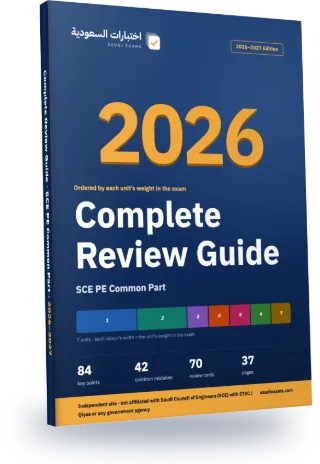
SCE PE Common Part Complete Review Guide 2026–2027
Every exam topic in a 37-page Arabic PDF, ordered from the heaviest unit to the lightest. The first three chapters alone cover about 60% of the exam questions.
- 37Pages
- 84Key points
- 42Common mistakes
- 70Flashcards
Guide map
Each chapter is one exam unit, ordered by its weight in the real exam.
| Chapter | Unit | Weight | Exam questions | Key points |
|---|---|---|---|---|
| 1 | Ethics | 27% | 8 | 12 |
| 2 | Professionalism | 23% | 7 | 12 |
| 3 | Laws for Professional Practice, Professional Laws and Regulation | 10% | 3 | 12 |
| 4 | Environment and Natural Resources | 10% | 3 | 12 |
| 5 | Engineering Management | 10% | 3 | 12 |
| 6 | Engineering Economics | 10% | 3 | 12 |
| 7 | Health, Safety and Security (HSS) | 10% | 3 | 12 |
Chapter 1 in full: Ethics
27% of the exam, about 8 questions. These are its key points, as in the guide.
- Indicators CMP-T1-1 to CMP-T1-18 are the basis of this area, starting with upholding the SCE code of ethics.
- The exam manual suggests studying the SCE code of ethics and other codes such as the NSPE code.
- Order of loyalty in a conflict: public health and safety first, then the profession, then the employer and client.
The rest of chapter 1, on this page
- Protect the innocent and respect the public's right to consent to what affects them (CMP-T1-8).
- Respect all people and avoid any form of discrimination or bias (CMP-T1-6).
- Do not harm other people's reputation or employment through malicious actions (CMP-T1-14).
- Preserve the reputation of the profession and the engineer's right to act ethically (CMP-T1-4).
- Due diligence means checking assumptions and data before relying on them, and following best practice (CMP-T1-11).
- Moral responsibility includes self-management and balancing the wider public interest with employer and client interests (CMP-T1-12).
- Analysing a complex ethics case starts with the facts, then the parties and duties, then the most ethical course of action (CMP-T1-13).
- Supporting, encouraging and rewarding ethics awareness, training and the profession's societal impact is part of the engineer's role (CMP-T1-16, CMP-T1-17).
- Internal reporting channels protect the reporter from reprisal and allow early action (CMP-T1-18).
Common mistakes in this chapter
- "The client is paying" never justifies hiding a public safety risk; an option that puts the client's wishes above safety is wrong.
- Noting a problem in a report while work continues is not enough when the hazard is real; look for the option that prevents harm.
- Disclosing a conflict of interest does not automatically mean withdrawing; disclose first and let the affected party decide.
- Going straight to the media or an outside body is rarely the first step; start with internal channels unless the danger is imminent or they have been ignored.
- Extreme options such as "ignore it completely" or "dismiss the colleague at once" are rarely best; the answer is usually stepwise and proportionate.
- A small gift or hospitality may look harmless, but if it is tied to an evaluation or award decision it is a conflict of interest to refuse or disclose.
The other chapters are in the full guide
One purchase · lifetime access · review guide included
7-day review plan
The chapters are spread over 6 days by weight so each day carries a similar load. Day 7 is a full exam.
Day 1 · 27% of the exam
Chapter 1: Ethics
Day 2 · 23% of the exam
Chapter 2: Professionalism
Day 3 · 20% of the exam
Chapter 3: Laws for Professional Practice, Professional Laws and Regulation
Chapter 7: Health, Safety and Security (HSS)Day 4 · 10% of the exam
Chapter 4: Environment and Natural Resources
Day 5 · 10% of the exam
Chapter 5: Engineering Management
Day 6 · 10% of the exam
Chapter 6: Engineering Economics
Day 7
Full mock exam: 30 questions in 150 minutes, then review the common mistakes in the units where you lost marks.
How many correct answers do you need?
- Pass mark 60%18 correct out of 30
Before you read: see your score today
10 free questions from the main units, no sign-up. Then you know which chapter to start with.
Try 10 free questions and see your levelA look at each chapter
The first three key points of each chapter, as they appear in the guide (in Arabic in the PDF).
Chapter 1: Ethics
- Indicators CMP-T1-1 to CMP-T1-18 are the basis of this area, starting with upholding the…
- The exam manual suggests studying the SCE code of ethics and other codes such…
- Order of loyalty in a conflict
Chapter 2: Professionalism
- Indicators CMP-T2-1 to CMP-T2-24 are the basis of this area.
- The engineer is responsible for public safety and for best practice in protecting natural…
- Awareness of practice responsibilities in local, regional and global contexts (CMP-T2-3).
Chapter 3: Laws for Professional Practice, Professional Laws and Regulation
- The exam manual lists the required laws under indicator CMP-T3-3, including the heritage protection…
- The manual suggests studying the Engineering Professions Practice Law, the Environmental Law, the Government…
- The SCE regulates the profession, issues executive regulations and receives complaints about unethical or…
Chapter 4: Environment and Natural Resources
- Indicators CMP-T4-1 to CMP-T4-9 are the basis of this area.
- The exam manual suggests studying the Saudi Environmental Law (CMP-T4-1).
- Source–pathway–receptor model
Chapter 5: Engineering Management
- Indicators CMP-T5-1 to CMP-T5-25 are the basis of this area.
- SWOT
- A functional structure groups people by specialism; a product-based structure groups them by product…
Chapter 6: Engineering Economics
- Indicators CMP-T6-1 to CMP-T6-11 are the basis of this area.
- Example
- NPV = sum of discounted cash flows − initial investment; a positive NPV means…
Chapter 7: Health, Safety and Security (HSS)
- Indicators CMP-T7-1 to CMP-T7-15 are the basis of this area.
- Common hazard identification methods
- A risk matrix combines likelihood and severity to rank risks by priority.
The full guide comes with lifetime access
The full guide (37 pages) is included with lifetime access to this exam, together with every question and full mock exam. Chapter 1 is free for everyone.
Questions about the guide
Is the guide free?
Chapter 1 is free to read on the guide page. The full guide comes with lifetime access to this exam; 7-day access does not include it.
Is it up to date for 2026–2027?
Yes. Unit weights and exam facts follow what the exam body last published, and the last check date is printed in the guide. If the standards change we update the file and buyers download the new version.
Does the guide have questions?
No. The guide covers key points and common mistakes; scoring, weak-area practice and full mock exams are on the site.
Can I read it on my phone?
Yes. A5 pages in a single column, with chapters linked from the contents.
- Pages
- 37
- Edition
- 1448 AH · 2026–2027
- Language
- Arabic
- Last updated
Buy this exam
Pick the access that lasts until your test date.
Included
- Full mock exams: 30 questions in 150 minutes, with a score for every unit
- 510 questions, every option explained with its source
- Practice that starts with your weakest units, plus a review of your mistakes
- Complete Review Guide 2026–2027 (PDF), with lifetime access only
Continue with your Google account and you go straight to the payment page.
You pay on the Waffo Pancake checkout page (in English). The amount is in US dollars and your bank converts it to riyals. One payment with no automatic renewal, by Visa, Mastercard (a mada card with either logo works too), Apple Pay or Google Pay. Your statement shows "WAFFO". Purchases are not refundable.