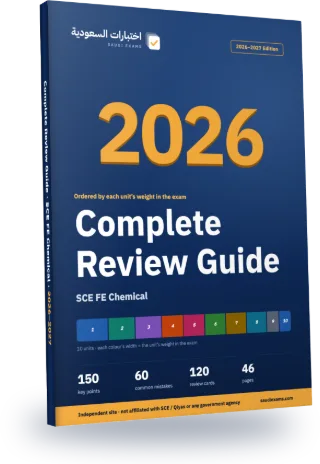
SCE FE Chemical Complete Review Guide 2026–2027
Every exam topic in a 46-page Arabic PDF, ordered from the heaviest unit to the lightest. The first three chapters alone cover about 38% of the exam questions.
- 46Pages
- 150Key points
- 60Common mistakes
- 120Flashcards
Guide map
Each chapter is one exam unit, ordered by its weight in the real exam.
| Chapter | Unit | Weight | Exam questions | Key points |
|---|---|---|---|---|
| 1 | Chemical Engineering Principles | 14% | 7 | 15 |
| 2 | Mass Transfer | 12% | 6 | 15 |
| 3 | Reaction Engineering | 12% | 6 | 15 |
| 4 | Chemistry Foundation | 10% | 5 | 15 |
| 5 | Chemical Engineering Thermodynamics | 10% | 5 | 15 |
| 6 | Fluid Mechanics | 10% | 5 | 15 |
| 7 | Heat Transfer | 10% | 5 | 15 |
| 8 | Process Economics | 10% | 5 | 15 |
| 9 | Process Control | 6% | 3 | 15 |
| 10 | Safety, Health, and Environment | 6% | 3 | 15 |
Chapter 1 in full: Chemical Engineering Principles
14% of the exam, about 7 questions. These are its key points, as in the guide.
- Specific gravity is the liquid's density relative to water at a reference temperature (usually 4 °C).
- Combustion example: methane with 20% excess air: theoretical \( O_2 \) 2, actual 2.4, air 11.4 mol per mol.
- A tie component passes unchanged between streams, such as nitrogen in combustion or solids in drying.
The rest of chapter 1, on this page
- Dryer: 500 kg/h at 40% moisture to 5%: dry solids 300; product 316; water removed 184 kg/h.
- Sensible heat changes temperature without phase change: \( Q=m c_p\Delta T \).
- Insulated exchanger: heat lost by the hot stream equals heat gained by the cold stream.
- Ideal gas molar flow: \( \dot n=PV/RT \): 10 m³/s at 300 K and 101.3 kPa = 406 mol/s.
- Heat release rate: 50 mol/s with heat of combustion −890 kJ/mol = 44.5 MW.
- Superheating saturated steam: \( Q=\dot m c_p\Delta T=1.5\times2.0\times50=150 \) kW.
- The specific volume of humid air at fixed dry-bulb temperature increases with humidity ratio.
- Air at 25 °C and 60% RH (\( P_{sat}=3.17 \)) has humidity ratio 0.0119 kg/kg.
- Combustion balances start with a basis and then balance each element.
- Degrees of freedom = variables − independent equations; a problem is solvable at zero.
- A purge prevents build-up of inerts in a recycle loop.
- Common conversions: 50 psi ≈ 345 kPa and 150 °F ≈ 339 K.
Common mistakes in this chapter
- Elements in their standard state have \( \Delta H_f=0 \): \( 2\times(-46.1)=-92.2 \) kJ for ammonia synthesis.
- \( W_s \) is positive when done by the system: \( Q=-50 \), \( W_s=+20 \) gives \( \Delta H=-70 \) kW.
- Overall conversion with recycle differs from single-pass conversion; 50% per pass with 90% recycle gives 90.9% overall.
- Molar masses: methane 16, ethane 30; an equimolar mixture has methane mass fraction 0.348, not 0.5.
- Adiabatic flame temperature is highest with stoichiometric pure oxygen (no nitrogen or excess to heat).
- In adiabatic humidification the wet-bulb temperature (enthalpy) stays about constant.
The other chapters are in the full guide
One purchase · lifetime access · review guide included
7-day review plan
The chapters are spread over 6 days by weight so each day carries a similar load. Day 7 is a full exam.
Day 1 · 14% of the exam
Chapter 1: Chemical Engineering Principles
Day 2 · 18% of the exam
Chapter 2: Mass Transfer
Chapter 10: Safety, Health, and EnvironmentDay 3 · 12% of the exam
Chapter 3: Reaction Engineering
Day 4 · 20% of the exam
Chapter 4: Chemistry Foundation
Chapter 7: Heat TransferDay 5 · 20% of the exam
Chapter 5: Chemical Engineering Thermodynamics
Chapter 8: Process EconomicsDay 6 · 16% of the exam
Chapter 6: Fluid Mechanics
Chapter 9: Process ControlDay 7
Full mock exam: 50 questions in 180 minutes, then review the common mistakes in the units where you lost marks.
Before you read: see your score today
10 free questions from the main units, no sign-up. Then you know which chapter to start with.
Try 10 free questions and see your levelA look at each chapter
The first three key points of each chapter, as they appear in the guide (in Arabic in the PDF).
Chapter 1: Chemical Engineering Principles
- Specific gravity is the liquid's density relative to water at a reference temperature (usually…
- Combustion example
- A tie component passes unchanged between streams, such as nitrogen in combustion or solids…
Chapter 2: Mass Transfer
- \( R_{min} \) example
- Fenske example
- \( Sh=50 \) for a 2 cm sphere with \( D=2\times10^{-9} \) gives \(…
Chapter 3: Reaction Engineering
- First-order CSTR
- \( k=0.05 \) min⁻¹ for 30 min in batch
- Second order in a PFR
Chapter 4: Chemistry Foundation
- Brønsted–Lowry
- The best buffer near pH 9.25 is \( NH_3/NH_4Cl \) since \( pK_a(NH_4^+)=9.25 \).
- Dilution example
Chapter 5: Chemical Engineering Thermodynamics
- Entropy of heating water
- Wet steam at 100 °C with quality 0.80
- \( \Delta G^\circ=-20 \) kJ/mol at 298 K gives \( K\approx3205 \).
Chapter 6: Fluid Mechanics
- Example
- \( f=0.0178 \) at \( Re=10^5 \) by Blasius.
- Horizontal frictionless Bernoulli
Chapter 7: Heat Transfer
- Radiation needs no medium.
- The critical heat flux in pool boiling marks the transition from nucleate to film…
- Steam economy of a multiple-effect evaporator rises with the number of effects.
Chapter 8: Process Economics
- DDB
- SYD
- Straight-line
Chapter 9: Process Control
- \( G=10/(20s+2) \) equals \( 5/(10s+1) \)
- The dead time in \( 4e^{-2s}/(s+1)^2 \) is 2 s.
- At \( t=\tau \)
Chapter 10: Safety, Health, and Environment
- Bonding and grounding reduce static hazards when transferring flammable liquids.
- HAZOP
- A GHS Safety Data Sheet has 16 sections.
The full guide comes with lifetime access
The full guide (46 pages) is included with lifetime access to this exam, together with every question and full mock exam. Chapter 1 is free for everyone.
Questions about the guide
Is the guide free?
Chapter 1 is free to read on the guide page. The full guide comes with lifetime access to this exam; 7-day access does not include it.
Is it up to date for 2026–2027?
Yes. Unit weights and exam facts follow what the exam body last published, and the last check date is printed in the guide. If the standards change we update the file and buyers download the new version.
Does the guide have questions?
No. The guide covers key points and common mistakes; scoring, weak-area practice and full mock exams are on the site.
Can I read it on my phone?
Yes. A5 pages in a single column, with chapters linked from the contents.
- Pages
- 46
- Edition
- 1448 AH · 2026–2027
- Language
- Arabic
- Last updated
Buy this exam
Pick the access that lasts until your test date.
Included
- Full mock exams: 50 questions in 180 minutes, with a score for every unit
- 500 questions, every option explained with its source
- Practice that starts with your weakest units, plus a review of your mistakes
- Complete Review Guide 2026–2027 (PDF), with lifetime access only
Continue with your Google account and you go straight to the payment page.
You pay on the Waffo Pancake checkout page (in English). The amount is in US dollars and your bank converts it to riyals. One payment with no automatic renewal, by Visa, Mastercard (a mada card with either logo works too), Apple Pay or Google Pay. Your statement shows "WAFFO". Purchases are not refundable.