ITIL 4 Foundation
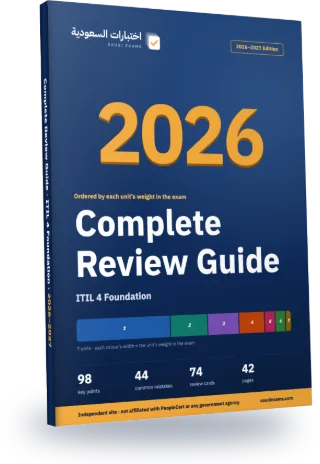
ITIL 4 Foundation Complete Review Guide 2026–2027
Every exam topic in a 42-page Arabic PDF, ordered from the heaviest unit to the lightest. The first three chapters alone cover about 75% of the exam questions.
- 42Pages
- 98Key points
- 44Common mistakes
- 74Flashcards
Guide map
Each chapter is one exam unit, ordered by its weight in the real exam.
| Chapter | Unit | Weight | Exam questions | Key points |
|---|---|---|---|---|
| 1 | Understand 7 ITIL practices | 43% | 17 | 18 |
| 2 | Know the purpose and key terms of 15 ITIL practices | 18% | 7 | 18 |
| 3 | Understand how the ITIL guiding principles can help an organization adopt and adapt service management | 15% | 6 | 12 |
| 4 | Understand the key concepts of service management | 13% | 5 | 14 |
| 5 | Understand the four dimensions of service management | 5% | 2 | 12 |
| 6 | Understand the activities of the service value chain, and how they interconnect | 5% | 2 | 12 |
| 7 | Understand the purpose and components of the ITIL service value system | 3% | 1 | 12 |
Chapter 1 in full: Understand 7 ITIL practices
43% of the exam, about 17 questions. These are its key points, as in the guide.
- The continual improvement model: What is the vision? Where are we now? Where do we want to be? How do we get there? Take action. Did we get there? How do we keep the momentum going? (4.6).
- The continual improvement register (CIR) is a database or structured document used to track and manage improvement ideas from identification to final action, and to prioritize them (5.1.2).
- Standard change: low-risk, pre-authorized, well understood and fully documented, and can be implemented without additional authorization; often started as a service request (5.2.4).
The rest of chapter 1, on this page
- Normal change: must be scheduled, assessed and authorized following a process; the change authority depends on the type of change (5.2.4).
- Emergency change: must be implemented as soon as possible, for example to resolve an incident or apply a security patch; assessment and authorization are expedited and a separate change authority may be used (5.2.4).
- Change authority: the person or group who authorizes a change. The change schedule is used to plan changes, help communication, avoid conflicts and assign resources (5.2.4).
- Incidents are prioritized based on an agreed classification, so that those with the highest business impact are resolved first (5.2.5).
- Incidents may be resolved by users through self-help, by the service desk, by support teams or suppliers; complex incidents may need temporary teams or swarming (5.2.5).
- Problem identification includes trend analysis of incident records, detecting duplicate and recurring issues, and using information from suppliers, partners and development teams (5.2.8).
- Problem control includes problem analysis and documenting workarounds and known errors; problems are prioritized by the risk they pose (5.2.8).
- Error control manages known errors: it identifies potential permanent solutions, which may lead to a change request, and regularly re-assesses known errors that are not resolved (5.2.8).
- Workaround: a solution that reduces or eliminates the impact of an incident or problem for which a full resolution is not yet available (5.2.8).
- Service request: a request from a user or a user's authorized representative that initiates a service action which has been agreed as a normal part of service delivery (5.2.16).
- Service requests should be standardized and automated as far as possible, with policies on which requests need little or no extra approval and clear expectations for fulfilment times (5.2.16).
- The service desk gives users a clear path to report issues, queries and requests and have them acknowledged, classified, owned and actioned; it can be physical or virtual (5.2.14).
- Service desk channels include phone, service portals and mobile apps, live chat and chatbots, email, walk-in, text and social media, and discussion forums (5.2.14).
- Service level agreement (SLA): a documented agreement between a service provider and a customer that identifies both the services required and the expected level of service (5.2.15).
- Service level management gathers information from customer engagement, customer feedback, operational metrics and business metrics (5.2.15.1).
Common mistakes in this chapter
- Where are we now? is the baseline assessment. Defining measurable targets belongs to Where do we want to be?
- Standard changes are pre-authorized because their risk was assessed when the procedure was created, not because they never carry risk.
- Emergency changes still need assessment and authorization; it is expedited, not skipped.
- Incident management restores service; finding the root cause belongs to problem management. A workaround can come from either.
- A service request is not an incident. A password reset or a new laptop is a request; something broken or degraded is an incident.
- Compliments, complaints and feedback can be handled as service requests.
- Green SLA metrics with unhappy customers is the watermelon effect; the fix is to measure what matters to the customer, not to add more technical metrics.
- Continual improvement is everyone's responsibility, even when a small dedicated team leads it.
The other chapters are in the full guide
One purchase · lifetime access · review guide included
7-day review plan
The chapters are spread over 6 days by weight so each day carries a similar load. Day 7 is a full exam.
Day 1 · 43% of the exam
Chapter 1: Understand 7 ITIL practices
Day 2 · 18% of the exam
Chapter 2: Know the purpose and key terms of 15 ITIL practices
Day 3 · 15% of the exam
Chapter 3: Understand how the ITIL guiding principles can help an organization adopt and adapt service management
Day 4 · 13% of the exam
Chapter 4: Understand the key concepts of service management
Day 5 · 8% of the exam
Chapter 5: Understand the four dimensions of service management
Chapter 7: Understand the purpose and components of the ITIL service value systemDay 6 · 5% of the exam
Chapter 6: Understand the activities of the service value chain, and how they interconnect
Day 7
Full mock exam: 40 questions in 60 minutes, then review the common mistakes in the units where you lost marks.
How many correct answers do you need?
- Pass mark 65%26 correct out of 40
Before you read: see your score today
10 free questions from the main units, no sign-up. Then you know which chapter to start with.
Try 10 free questions and see your levelA look at each chapter
The first three key points of each chapter, as they appear in the guide (in Arabic in the PDF).
Chapter 1: Understand 7 ITIL practices
- The continual improvement model
- The continual improvement register (CIR) is a database or structured document used to track…
- Standard change
Chapter 2: Know the purpose and key terms of 15 ITIL practices
- Information security management
- Relationship management
- Supplier management
Chapter 3: Understand how the ITIL guiding principles can help an organization adopt and adapt service management
- Guiding principle
- The seven principles
- Focus on value
Chapter 4: Understand the key concepts of service management
- Service
- Utility
- Warranty
Chapter 5: Understand the four dimensions of service management
- The four dimensions
- The four dimensions apply to the service value system as a whole and to…
- Organizations and people covers roles and responsibilities, formal organizational structures, culture, and the staffing…
Chapter 6: Understand the activities of the service value chain, and how they interconnect
- The six activities
- The activities are interconnected
- To carry out an activity, an organization uses a combination of practices; a practice…
Chapter 7: Understand the purpose and components of the ITIL service value system
- The SVS describes how all the components and activities of the organization work together…
- Inputs to the SVS
- Opportunity
The full guide comes with lifetime access
The full guide (42 pages) is included with lifetime access to this exam, together with every question and full mock exam. Chapter 1 is free for everyone.
Questions about the guide
Is the guide free?
Chapter 1 is free to read on the guide page. The full guide comes with lifetime access to this exam; 7-day access does not include it.
Is it up to date for 2026–2027?
Yes. Unit weights and exam facts follow what the exam body last published, and the last check date is printed in the guide. If the standards change we update the file and buyers download the new version.
Does the guide have questions?
No. The guide covers key points and common mistakes; scoring, weak-area practice and full mock exams are on the site.
Can I read it on my phone?
Yes. A5 pages in a single column, with chapters linked from the contents.
- Pages
- 42
- Edition
- 1448 AH · 2026–2027
- Language
- Arabic
- Last updated
Buy this exam
Pick the access that lasts until your test date.
Included
- Timed supplementary practice sessions: 40 questions in 60 minutes
- 510 questions, every option explained with its source
- Practice that starts with your weakest units, plus a review of your mistakes
- Complete Review Guide 2026–2027 (PDF), with lifetime access only
Continue with your Google account and you go straight to the payment page.
You pay on the Waffo Pancake checkout page (in English). The amount is in US dollars and your bank converts it to riyals. One payment with no automatic renewal, by Visa, Mastercard (a mada card with either logo works too), Apple Pay or Google Pay. Your statement shows "WAFFO". Purchases are not refundable.