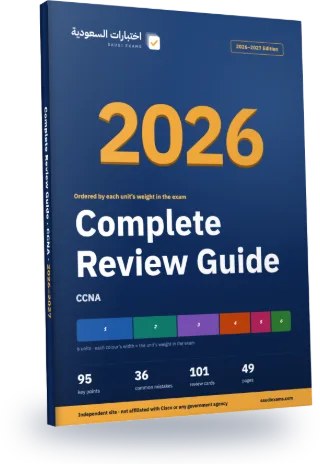
CCNA Complete Review Guide 2026–2027
Every exam topic in a 49-page Arabic PDF, ordered from the heaviest unit to the lightest. The first three chapters alone cover about 65% of the exam questions.
- 49Pages
- 95Key points
- 36Common mistakes
- 101Flashcards
Guide map
Each chapter is one exam unit, ordered by its weight in the real exam.
| Chapter | Unit | Weight | Exam questions | Key points |
|---|---|---|---|---|
| 1 | IP Connectivity | 25% | 15 | 13 |
| 2 | Network Fundamentals | 20% | 12 | 21 |
| 3 | Network Access | 20% | 12 | 20 |
| 4 | Security Fundamentals | 15% | 9 | 14 |
| 5 | IP Services | 10% | 6 | 12 |
| 6 | Automation and Programmability | 10% | 6 | 15 |
Chapter 1 in full: IP Connectivity
25% of the exam, about 15 questions. These are its key points, as in the guide.
- Full means the adjacency databases are synchronized. [RFC 2328 §10.1]
- DROTHER pairs need not form full adjacency. [RFC 2328 §7.5]
- Hello intervals must match. [RFC 2328 §10.5]
The rest of chapter 1, on this page
- The OSPF identifier is 32 bits and unique in the domain. [RFC 2328 §1.2]
- Area zero is the backbone. [RFC 2328 §3.1]
- 15 is the lower accumulated cost. [RFC 2328 §16.1]
- OSPF permits multiple equal-cost next hops. [RFC 2328 §2.4]
- Read a route as prefix/mask, protocol code, next hop and output interface; brackets commonly show [administrative distance/metric]. Route installation compares eligible sources for the same prefix; local AD chooses trustworthiness. Packet forwarding then uses the longest matching installed prefix, so AD does not let a /16 beat a matching /24. [RIB Route Comparison; Longest Prefix Match]
- Static route examples: ip route 198.51.100.7 255.255.255.255 192.0.2.2 selects one host. IPv4 default uses 0.0.0.0 0.0.0.0; IPv6 default uses::/0. A floating static uses an AD higher than the primary route to the same prefix. It still needs a valid outgoing path; AD255 is not an installed backup. [Additional Uses of AD; — Static Routes]
- IPv6 recursive static routes must resolve without depending on themselves. Link-local next hops require interface scope. Check show ipv 6 route and interface/neighbor state rather than treating a line in running configuration as proof of installation. [Recursive Static Routes; Fully Specified Static Routes; Verification]
- OSPF troubleshooting sequence: verify interface enablement, area and primary subnet, compatible timers and unique router IDs; then inspect neighbor state. INIT suggests missing two-way Hello recognition; EXSTART/EXCHANGE requires examining DBD exchange and MTU, not assuming MTU is the only cause. A passive LAN can be advertised without sending Hellos. [pp.1–4]
- FHRP separates a host’s virtual gateway identity from one physical router. HSRP normally has one active per group; a higher priority wins initial selection, while taking over from a healthy lower-priority active requires preemption. Tracking can reduce priority when an upstream object fails. Example 120−30=90 allows a priority 100 peer with preemption to take over. [Background Information]
- VRRPv3 is the IETF virtual-router redundancy protocol for IPv4 and IPv6. FHRP does not provide onward routes or repair every failed WAN path. Verify both gateway ownership and routing on the successor. Suggested lab: compare longest-prefix cases, withdraw a primary route, and inspect OSPF/FHRP outputs before and after failure; no live device execution is claimed here. [§1; — Basic Operation]
Common mistakes in this chapter
- OSPF uses a link-state database. [RFC 2328 §1]
- The calculating router is its own tree root. [RFC 2328 §2.2]
- Hello discovers and maintains neighbors. [RFC 2328 §7.1]
- Priority zero removes election eligibility. [RFC 2328 §9.4]
- Router ID breaks an equal-priority tie. [RFC 2328 §9.4]
- BDR takes over DR duties. [RFC 2328 §7.4]
- Point-to-point OSPF forms adjacency without DR/BDR election. [RFC 2328 §7.5]
The other chapters are in the full guide
One purchase · lifetime access · review guide included
7-day review plan
The chapters are spread over 6 days by weight so each day carries a similar load. Day 7 is a full exam.
Day 1 · 25% of the exam
Chapter 1: IP Connectivity
Day 2 · 20% of the exam
Chapter 2: Network Fundamentals
Day 3 · 20% of the exam
Chapter 3: Network Access
Day 4 · 15% of the exam
Chapter 4: Security Fundamentals
Day 5 · 10% of the exam
Chapter 5: IP Services
Day 6 · 10% of the exam
Chapter 6: Automation and Programmability
Day 7
Full mock exam: 60 questions in 120 minutes, then review the common mistakes in the units where you lost marks.
Before you read: see your score today
10 free questions from the main units, no sign-up. Then you know which chapter to start with.
Try 10 free questions and see your levelA look at each chapter
The first three key points of each chapter, as they appear in the guide (in Arabic in the PDF).
Chapter 1: IP Connectivity
- Full means the adjacency databases are synchronized. [RFC 2328 §10.1]
- DROTHER pairs need not form full adjacency. [RFC 2328 §7.5]
- Hello intervals must match. [RFC 2328 §10.5]
Chapter 2: Network Fundamentals
- A single compression location preserves an unambiguous expansion. [4291 §2.2]
- Remove leading zeros and compress the consecutive zero groups once. [4291 §2.2]
- The first eight multicast address bits are all ones. [4291 §2.7]
Chapter 3: Network Access
- VLAN lab plan
- Voice-port check
- Trunk example
Chapter 4: Security Fundamentals
- Example — A fake help-desk link asks for a password
- Example — A router has an unpatched defect
- Quick reference — Use individual accounts for operator attribution and grant only task-required permissions…
Chapter 5: IP Services
- ICMP success does not demonstrate that NTP transport is allowed. [RFC 5905 §7.2]
- The peer’s synchronization state matters in accepting time. [RFC 5905 §§7.3, 8]
- NTP derives distinct offset and round-trip delay estimates. [RFC 5905 §8]
Chapter 6: Automation and Programmability
- Inventory lists managed nodes and groups. [Inventory]
- Ansible playbooks are written in YAML. [Playbooks]
- Ansible CLI tools run on the control node. [Control node]
The full guide comes with lifetime access
The full guide (49 pages) is included with lifetime access to this exam, together with every question and full mock exam. Chapter 1 is free for everyone.
Questions about the guide
Is the guide free?
Chapter 1 is free to read on the guide page. The full guide comes with lifetime access to this exam; 7-day access does not include it.
Is it up to date for 2026–2027?
Yes. Unit weights and exam facts follow what the exam body last published, and the last check date is printed in the guide. If the standards change we update the file and buyers download the new version.
Does the guide have questions?
No. The guide covers key points and common mistakes; scoring, weak-area practice and full mock exams are on the site.
Can I read it on my phone?
Yes. A5 pages in a single column, with chapters linked from the contents.
- Pages
- 49
- Edition
- 1448 AH · 2026–2027
- Language
- Arabic
- Last updated
Buy this exam
Pick the access that lasts until your test date.
Included
- Timed supplementary practice sessions: 60 questions in 120 minutes
- 500 questions, every option explained with its source
- Practice that starts with your weakest units, plus a review of your mistakes
- Complete Review Guide 2026–2027 (PDF), with lifetime access only
Continue with your Google account and you go straight to the payment page.
You pay on the Waffo Pancake checkout page (in English). The amount is in US dollars and your bank converts it to riyals. One payment with no automatic renewal, by Visa, Mastercard (a mada card with either logo works too), Apple Pay or Google Pay. Your statement shows "WAFFO". Purchases are not refundable.