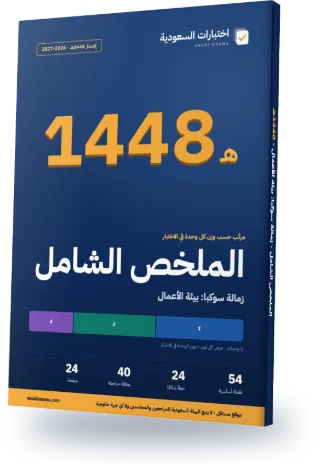
SOCPA Fellowship Business Environment Complete Review Guide 2026–2027
Every exam topic in a 24-page Arabic PDF, ordered from the heaviest unit to the lightest. The first three chapters alone cover about 100% of the exam questions.
- 24Pages
- 54Key points
- 24Common mistakes
- 40Flashcards
Guide map
Each chapter is one exam unit, ordered by its weight in the real exam.
| Chapter | Unit | Weight | Exam questions | Key points |
|---|---|---|---|---|
| 1 | Economic analysis and concepts | 39% | 20 | 18 |
| 2 | Financial management | 39% | 19 | 18 |
| 3 | Information technology | 22% | 11 | 18 |
Chapter 1 in full: Economic analysis and concepts
39% of the exam, about 20 questions. These are its key points, as in the guide.
- Microeconomics studies the behaviour of individual consumers, firms and markets (prices and quantities). Macroeconomics studies the economy as a whole: output, unemployment, inflation and policy.
- Equilibrium is the price at which quantity demanded equals quantity supplied. Above it there is a surplus and prices fall. Below it there is a shortage and prices rise.
- Circular flow: households supply factors of production to firms for income, and firms supply goods and services for spending. A closed economy has no foreign trade. An open economy has exports and imports.
The rest of chapter 1, on this page
- Price elasticity of demand (midpoint method) = [(Q2 − Q1) ÷ average Q] ÷ [(P2 − P1) ÷ average P]. An absolute value above 1 is elastic, equal to 1 is unit elastic and below 1 is inelastic.
- Income elasticity is positive for a normal good, above 1 for a luxury and negative for an inferior good. Cross elasticity is positive for substitutes and negative for complements.
- The tax burden falls more on the less elastic side (buyers or sellers). The less elastic demand is, the larger the share of the tax the buyer pays.
- Opportunity cost is the value of the best alternative given up. A sunk cost cannot be recovered, so it should not affect the decision. Comparative advantage belongs to whoever has the lower opportunity cost.
- Perfect competition: many firms, identical products, free entry and price-taking. Monopoly: one firm and high entry barriers. Oligopoly: a few interdependent firms. Monopolistic competition: many firms selling differentiated products.
- A firm maximizes profit at the quantity where marginal revenue equals marginal cost (MR = MC). In perfect competition price = MR. In monopoly price is above MR.
- Expenditure approach: GDP = C + I + G + (X − M). The income approach sums wages, rent, interest and profit (plus depreciation and indirect taxes). The production approach sums value added at each stage.
- GNP = GDP + net factor income from abroad. Real GDP = nominal GDP ÷ deflator × 100, and the deflator = (nominal ÷ real) × 100.
- The business cycle has four phases: expansion, peak, contraction and trough. Leading indicators move before the cycle (building permits, for example), coincident ones move with it and lagging ones follow it (the unemployment rate, for example).
- Unemployment rate = unemployed ÷ labour force × 100. Types: frictional, structural and cyclical. The natural rate includes frictional and structural unemployment but not cyclical.
- Demand-pull inflation comes from rising aggregate demand and cost-push inflation from rising production costs. The Phillips curve shows a short-run inverse link between inflation and unemployment. Stagflation is high inflation together with high unemployment.
- Expansionary fiscal policy: more government spending or lower taxes. Simple multiplier = 1 ÷ (1 − MPC). Automatic stabilizers (progressive taxes, unemployment benefits) soften swings without a new decision. Crowding out: government borrowing raises interest rates and reduces private investment.
- Functions of money: medium of exchange, unit of account and store of value. Simple money multiplier = 1 ÷ reserve requirement ratio. Buying bonds, lowering the reserve ratio and lowering the discount rate are expansionary. The opposites are contractionary.
- The spot rate is for delivery now. A forward rate is for delivery at a later date at a price agreed today, and it is a hedging tool. A regime can be fixed, floating or managed float. The Saudi riyal is pegged to the US dollar at 3.75 riyals per dollar.
- Currency value is affected by interest and inflation differentials, purchasing power parity, the current account and political stability. In the balance of payments, the current, capital and financial accounts sum to zero in principle, because every transaction is recorded as a debit and a credit.
Common mistakes in this chapter
- Read elasticity in absolute value: |Ed| above 1 is elastic and below 1 is inelastic. The negative sign does not make demand inelastic.
- Raising the price increases total revenue when demand is inelastic and lowers it when demand is elastic. Many candidates swap the two cases.
- GDP measures output produced inside a country's borders whatever the producer's nationality. GNP measures output by a country's nationals wherever they are. Do not mix them up.
- Nominal GDP uses current prices and real GDP uses base-year prices. A rise in nominal GDP alone may be inflation, not growth.
- When the central bank buys bonds in the open market it is expanding, because it adds reserves to banks. Selling is contractionary. The direction of each tool is the most common trap.
- A sunk cost has no place in today's decision, but opportunity cost always does, including implicit costs such as the owner's forgone wage.
- A change in the good's own price moves along the same demand curve (quantity demanded). A change in any other factor (income, tastes, another price) shifts the whole curve.
- In a direct quote one unit of foreign currency is expressed in domestic currency, and in an indirect quote it is the reverse. Check which quote the question uses before deciding whether a currency rose or fell.
The other chapters are in the full guide
One purchase · lifetime access · review guide included
7-day review plan
The chapters are spread over 6 days by weight so each day carries a similar load. Day 7 is a full exam.
Day 1 · 39% of the exam
Chapter 1: Economic analysis and concepts
Day 2 · 39% of the exam
Chapter 2: Financial management
Day 3 · 22% of the exam
Chapter 3: Information technology
Day 4
Full mock exam: 50 questions in 120 minutes, then review the common mistakes in the units where you lost marks.
How many correct answers do you need?
- Pass mark 60%30 correct out of 50
Before you read: see your score today
10 free questions from the main units, no sign-up. Then you know which chapter to start with.
Try 10 free questions and see your levelA look at each chapter
The first three key points of each chapter, as they appear in the guide (in Arabic in the PDF).
Chapter 1: Economic analysis and concepts
- Microeconomics studies the behaviour of individual consumers, firms and markets (prices and quantities). Macroeconomics…
- Equilibrium is the price at which quantity demanded equals quantity supplied. Above it there…
- Circular flow
Chapter 2: Financial management
- Degree of operating leverage (DOL) = % change in operating profit ÷ % change…
- Degree of financial leverage (DFL) = EBIT ÷ (EBIT − interest). Combined leverage =…
- Modigliani-Miller
Chapter 3: Information technology
- Data lifecycle
- Structured data sits in tables and defined fields (databases); unstructured data has no fixed…
- Data mining finds hidden patterns and relationships in large data sets; visualization presents results…
The full guide comes with lifetime access
The full guide (24 pages) is included with lifetime access to this exam, together with every question and full mock exam. Chapter 1 is free for everyone.
Questions about the guide
Is the guide free?
Chapter 1 is free to read on the guide page. The full guide comes with lifetime access to this exam; 7-day access does not include it.
Is it up to date for 2026–2027?
Yes. Unit weights and exam facts follow what the exam body last published, and the last check date is printed in the guide. If the standards change we update the file and buyers download the new version.
Does the guide have questions?
No. The guide covers key points and common mistakes; scoring, weak-area practice and full mock exams are on the site.
Can I read it on my phone?
Yes. A5 pages in a single column, with chapters linked from the contents.
- Pages
- 24
- Edition
- 1448 AH · 2026–2027
- Language
- Arabic
- Last updated
Buy this exam
Pick the access that lasts until your test date.
Included
- Full mock exams: 50 questions in 120 minutes, with a score for every unit
- 326 questions, every option explained with its source
- Practice that starts with your weakest units, plus a review of your mistakes
- Complete Review Guide 2026–2027 (PDF), with lifetime access only
Continue with your Google account and you go straight to the payment page.
You pay on the Waffo Pancake checkout page (in English). The amount is in US dollars and your bank converts it to riyals. One payment with no automatic renewal, by Visa, Mastercard (a mada card with either logo works too), Apple Pay or Google Pay. Your statement shows "WAFFO". Purchases are not refundable.