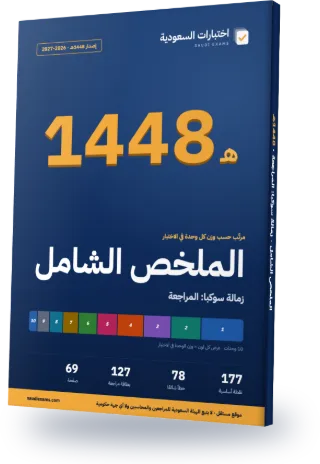
SOCPA Fellowship Auditing Complete Review Guide 2026–2027
Every exam topic in a 69-page Arabic PDF, ordered from the heaviest unit to the lightest. The first three chapters alone cover about 45% of the exam questions.
- 69Pages
- 177Key points
- 78Common mistakes
- 127Flashcards
Guide map
Each chapter is one exam unit, ordered by its weight in the real exam.
| Chapter | Unit | Weight | Exam questions | Key points |
|---|---|---|---|---|
| 1 | Obtaining audit evidence | 19% | 17 | 18 |
| 2 | Forming an opinion and the independent auditor's report | 14% | 12 | 18 |
| 3 | Overall objectives, principles and general responsibilities in an audit | 13% | 11 | 18 |
| 4 | Planning an audit of financial statements | 13% | 11 | 18 |
| 5 | International Code of Ethics for Professional Accountants | 10% | 9 | 18 |
| 6 | Quality management for firms | 9% | 8 | 18 |
| 7 | Other assurance engagements | 8% | 7 | 18 |
| 8 | Review engagements | 7% | 6 | 17 |
| 9 | Related services engagements | 6% | 5 | 17 |
| 10 | International framework for assurance engagements | 4% | 4 | 17 |
Chapter 1 in full: Obtaining audit evidence
19% of the exam, about 17 questions. These are its key points, as in the guide.
- Procedures to obtain audit evidence are inspection, observation, external confirmation, recalculation, reperformance and analytical procedures, in addition to inquiry (ISA 500, paras. A6 and A18–A26).
- When using information produced by the entity the auditor evaluates its accuracy and completeness and whether it is precise and detailed enough (ISA 500, para. 9); if evidence is inconsistent or doubtful, procedures are modified or added (para. 11).
- If inventory held by a third party is material, the auditor requests confirmation of quantities and condition from the third party or performs inspection or other appropriate procedures (ISA 501, para. 8).
The rest of chapter 1, on this page
- To identify litigation and claims the auditor inquires of management and in-house counsel, reviews minutes of those charged with governance, correspondence with external counsel and legal expense accounts, and requests a written representation that they have been disclosed (ISA 501, paras. 9 and 12).
- The auditor keeps control over confirmation requests: determining the information, selecting the confirming party, designing properly addressed requests with return details to the auditor, and sending and following up (ISA 505, para. 7).
- Negative confirmation can be the sole substantive procedure only if all four hold: low risk with evidence of control effectiveness, a large population of small homogeneous items, a very low expected exception rate, and no awareness of circumstances that would make recipients disregard requests (ISA 505, para. 15).
- The auditor reads the most recent financial statements and the predecessor auditor's report, if any, checks balances brought forward and policy appropriateness, and checks consistent application of policies (ISA 510, paras. 5, 6 and 8).
- If sufficient evidence about opening balances cannot be obtained, the opinion is qualified or a disclaimer; if opening balances contain a material misstatement not properly dealt with, qualified or adverse (ISA 510, paras. 10 and 11).
- If differences from expectation are significant or inconsistent with other information, the auditor inquires of management, obtains evidence supporting the responses, and performs other procedures as necessary (ISA 520, para. 7).
- Analytical procedures near the end of the audit help form an overall conclusion on whether the financial statements are consistent with the auditor's understanding of the entity (ISA 520, para. 6).
- The sampling risk error that worries the auditor most is concluding that controls are more effective than they are, or that no material misstatement exists when it does, because it affects audit effectiveness (ISA 530, para. 5(c)).
- Tolerable misstatement is performance materiality applied to a particular sampling procedure and may equal or be lower than it (ISA 530, para. A3); the sample size must reduce sampling risk to an acceptably low level (para. 7).
- The auditor reviews the outcome of previous estimates to help assess current risks, decides whether the team needs specialized skills, and considers estimation uncertainty, complexity and subjectivity (ISA 540, paras. 14–16).
- When the auditor identifies related parties or significant transactions management has not identified, the auditor promptly informs the team, performs substantive procedures, reconsiders the risk of other related parties, and evaluates the implications if non-disclosure appears intentional (ISA 550, para. 22).
- For significant related party transactions outside the normal course of business, the auditor inspects the contracts, evaluates business rationale and consistency of terms with management's explanations, and obtains evidence of authorization (ISA 550, para. 23).
- Subsequent events are events between the date of the financial statements and the date of the auditor's report, and facts that become known after the report date (ISA 560, para. 5(e)); procedures include understanding management's procedures, inquiry, reading minutes and reading the latest interim statements (para. 7).
- The going concern evaluation covers the same period as management's assessment; if it is less than twelve months from the date of the financial statements the auditor asks management to extend it to at least twelve months (ISA 570, para. 13), and inquires about events beyond that period (para. 15).
- The auditor requests written representations that management fulfilled its responsibility for preparing the statements, provided all information and recorded all transactions (ISA 580, paras. 10 and 11); if they are not provided, or doubts about integrity make them unreliable, the auditor disclaims an opinion (para. 20).
Common mistakes in this chapter
- Sufficiency is not appropriateness: sufficiency is quantity, affected by risk assessment and evidence quality; appropriateness is quality (relevance and reliability). More quantity does not make up for poor quality.
- Inquiry alone ordinarily does not give sufficient evidence of no material misstatement or of control effectiveness (ISA 500, para. A6); written representations alone are not sufficient evidence on a matter (ISA 580, para. 4).
- Attending the count does not replace procedures over the final inventory records, and if the count is on another date the auditor tests changes between that date and the statements date (ISA 501, paras. 4 and 5).
- A non-response is not a confirmation: for each non-response the auditor performs alternative procedures (ISA 505, para. 12); if a positive confirmation is necessary and not received, alternatives will not suffice and the effect on the opinion is considered (para. 13).
- Do not confuse deviation and misstatement: deviations relate to tests of controls, misstatements to tests of details. An anomaly is extremely rare and needs a high degree of certainty that it is not representative (ISA 530, para. 13).
- Do not confuse sampling risk and non-sampling risk: the first arises because only part of the population is tested; the second has other causes, such as an inappropriate procedure or misinterpreting evidence (ISA 530, para. 5 and para. A1).
- On subsequent events the auditor has no obligation to perform procedures after the report date, but if a fact becomes known that might change the report, the auditor must discuss it with management, whether before issue (ISA 560, para. 10) or after (para. 14); a new report is not dated earlier than approval of the amended statements (para. 11).
- A going concern material uncertainty section is not a modified opinion: if disclosure is adequate the opinion is unmodified with a separate section; if not, qualified or adverse; if the going concern basis is inappropriate, adverse (ISA 570, paras. 21–23).
The other chapters are in the full guide
One purchase · lifetime access · review guide included
7-day review plan
The chapters are spread over 6 days by weight so each day carries a similar load. Day 7 is a full exam.
Day 1 · 19% of the exam
Chapter 1: Obtaining audit evidence
Day 2 · 14% of the exam
Chapter 2: Forming an opinion and the independent auditor's report
Day 3 · 19% of the exam
Chapter 3: Overall objectives, principles and general responsibilities in an audit
Chapter 9: Related services engagementsDay 4 · 17% of the exam
Chapter 4: Planning an audit of financial statements
Chapter 10: International framework for assurance engagementsDay 5 · 16% of the exam
Chapter 5: International Code of Ethics for Professional Accountants
Chapter 8: Review engagementsDay 6 · 17% of the exam
Chapter 6: Quality management for firms
Chapter 7: Other assurance engagementsDay 7
Full mock exam: 90 questions in 180 minutes, then review the common mistakes in the units where you lost marks.
How many correct answers do you need?
- Pass mark 60%54 correct out of 90
Before you read: see your score today
10 free questions from the main units, no sign-up. Then you know which chapter to start with.
Try 10 free questions and see your levelA look at each chapter
The first three key points of each chapter, as they appear in the guide (in Arabic in the PDF).
Chapter 1: Obtaining audit evidence
- Procedures to obtain audit evidence are inspection, observation, external confirmation, recalculation, reperformance and analytical…
- When using information produced by the entity the auditor evaluates its accuracy and completeness…
- If inventory held by a third party is material, the auditor requests confirmation of…
Chapter 2: Forming an opinion and the independent auditor's report
- To form the opinion the auditor concludes whether reasonable assurance has been obtained that…
- Under a fair presentation framework the auditor uses one of two equivalent phrases for…
- Report sections in order
Chapter 3: Overall objectives, principles and general responsibilities in an audit
- The purpose of an audit is to enhance intended users' confidence in the financial…
- Reasonable assurance is a high but not absolute level of assurance, because most audit…
- The premise of an audit
Chapter 4: Planning an audit of financial statements
- At the start of the engagement the auditor performs preliminary activities: acceptance and continuance…
- The engagement partner and key team members take part in planning, and the partner…
- Risk assessment procedures include inquiries of management and others, analytical procedures, and observation and…
Chapter 5: International Code of Ethics for Professional Accountants
- The five fundamental principles
- An accountant shall not disclose confidential information or use it for the advantage of…
- Confidential information may be disclosed where there is a legal or professional duty or…
Chapter 6: Quality management for firms
- The firm's objective is a system of quality management giving reasonable assurance that the…
- The eight components
- The firm assigns ultimate responsibility to the CEO, managing partner or managing board of…
Chapter 7: Other assurance engagements
- An assurance engagement is one in which the practitioner aims to obtain sufficient appropriate…
- Reasonable assurance reduces engagement risk to an acceptably low level and is expressed as…
- In an attestation engagement a party other than the practitioner measures the underlying subject…
Chapter 8: Review engagements
- A review is a limited assurance engagement; if the practitioner becomes aware of a…
- Limited assurance
- Analytical procedures
Chapter 9: Related services engagements
- An agreed-upon procedures engagement is one in which the practitioner carries out procedures agreed…
- The value of the engagement comes from the practitioner's compliance with standards and ethics…
- The practitioner's objectives are threefold
Chapter 10: International framework for assurance engagements
- An assurance engagement
- Subject matter information is the outcome of applying criteria to the underlying subject matter;…
- Attestation engagement
The full guide comes with lifetime access
The full guide (69 pages) is included with lifetime access to this exam, together with every question and full mock exam. Chapter 1 is free for everyone.
Questions about the guide
Is the guide free?
Chapter 1 is free to read on the guide page. The full guide comes with lifetime access to this exam; 7-day access does not include it.
Is it up to date for 2026–2027?
Yes. Unit weights and exam facts follow what the exam body last published, and the last check date is printed in the guide. If the standards change we update the file and buyers download the new version.
Does the guide have questions?
No. The guide covers key points and common mistakes; scoring, weak-area practice and full mock exams are on the site.
Can I read it on my phone?
Yes. A5 pages in a single column, with chapters linked from the contents.
- Pages
- 69
- Edition
- 1448 AH · 2026–2027
- Language
- Arabic
- Last updated
Buy this exam
Pick the access that lasts until your test date.
Included
- Full mock exams: 90 questions in 180 minutes, with a score for every unit
- 493 questions, every option explained with its source
- Practice that starts with your weakest units, plus a review of your mistakes
- Complete Review Guide 2026–2027 (PDF), with lifetime access only
Continue with your Google account and you go straight to the payment page.
You pay on the Waffo Pancake checkout page (in English). The amount is in US dollars and your bank converts it to riyals. One payment with no automatic renewal, by Visa, Mastercard (a mada card with either logo works too), Apple Pay or Google Pay. Your statement shows "WAFFO". Purchases are not refundable.