CIA Part 1
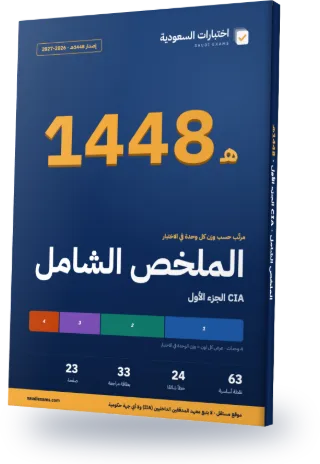
CIA Part 1 Complete Review Guide 2026–2027
Every exam topic in a 23-page Arabic PDF, ordered from the heaviest unit to the lightest. The first three chapters alone cover about 85% of the exam questions.
- 23Pages
- 63Key points
- 24Common mistakes
- 33Flashcards
Guide map
Each chapter is one exam unit, ordered by its weight in the real exam.
| Chapter | Unit | Weight | Exam questions | Key points |
|---|---|---|---|---|
| 1 | Foundations of Internal Auditing | 35% | 44 | 17 |
| 2 | Governance, Risk Management, and Control | 30% | 37 | 16 |
| 3 | Ethics and Professionalism | 20% | 25 | 15 |
| 4 | Fraud Risks | 15% | 19 | 15 |
Chapter 1 in full: Foundations of Internal Auditing
35% of the exam, about 44 questions. These are its key points, as in the guide.
- The Global Internal Audit Standards (2024) are organized into five domains: Purpose of Internal Auditing; Ethics and Professionalism; Governing the Internal Audit Function; Managing the Internal Audit Function; Performing Internal Audit Services.
- The Standards contain 15 principles; each principle is supported by standards with requirements, considerations for implementation and examples of evidence.
- Purpose of internal auditing: strengthen the organization's ability to create, protect and sustain value by giving the board and management independent, risk-based, objective assurance, advice, insight and foresight.
The rest of chapter 1, on this page
- The internal audit mandate defines the function's authority, role and responsibilities; it comes from the board and, where applicable, laws and regulations.
- The internal audit charter is a formal written document: it includes the mandate, the commitment to follow the Standards, and the scope and types of services. The CAE drafts it; the board approves it.
- The CAE reviews the charter periodically and presents it to the board and senior management for approval.
- Functional reporting goes to the board (approving the charter, plan, budget and CAE appointment and pay); administrative reporting goes to the CEO or another senior executive for day-to-day matters.
- Assurance services are objective assessments giving opinions or conclusions; three parties are involved: the process owner, the internal auditor and the user of the assessment.
- Advisory services give advice to a requesting client; two parties are involved, and the scope is agreed with the client as long as objectivity is not impaired.
- Typical assurance work includes risk and control assessments, compliance, financial, operational and IT audits, and assessments of governance processes.
- Typical advisory work includes consulting on process design, training, facilitation, benchmarking and control self-assessment facilitation.
- Organizational independence is the freedom from conditions that threaten the ability to carry out responsibilities in an unbiased manner; the CAE must confirm it to the board at least annually.
- If independence is impaired in fact or appearance, the CAE must disclose the details of the impairment to the board.
- Examples of impairment: interference in scope or reporting, budget cuts that limit work, the CAE reporting only to the CFO, or auditing an area the CAE also manages.
- Internal audit's core role in risk management is giving assurance that risk processes are effective and that key risks are evaluated and reported properly.
- Permitted with safeguards: facilitating risk identification workshops and coaching management on risk, provided management stays responsible for decisions.
- Internal audit must not set the risk appetite, impose a risk management process, own risks, or decide and implement risk responses for management.
Common mistakes in this chapter
- Internal audit does not guarantee accuracy of financial statements or eliminate risk; it provides reasonable assurance and advice.
- The CAE does not approve its own charter; the board does.
- Advisory work does not need a separate opinion user; it has only a requester and the advisor.
- Reporting administratively to the CFO or CEO is fine; reporting functionally to them is what threatens independence.
- Facilitating a risk workshop is allowed; choosing the risk response for management is not.
- Independence is about the function's position; objectivity is the individual auditor's mental attitude. Do not swap them.
The other chapters are in the full guide
One purchase · lifetime access · review guide included
7-day review plan
The chapters are spread over 6 days by weight so each day carries a similar load. Day 7 is a full exam.
Day 1 · 35% of the exam
Chapter 1: Foundations of Internal Auditing
Day 2 · 30% of the exam
Chapter 2: Governance, Risk Management, and Control
Day 3 · 20% of the exam
Chapter 3: Ethics and Professionalism
Day 4 · 15% of the exam
Chapter 4: Fraud Risks
Day 5
Full mock exam: 125 questions in 150 minutes, then review the common mistakes in the units where you lost marks.
Before you read: see your score today
10 free questions from the main units, no sign-up. Then you know which chapter to start with.
Try 10 free questions and see your levelA look at each chapter
The first three key points of each chapter, as they appear in the guide (in Arabic in the PDF).
Chapter 1: Foundations of Internal Auditing
- The Global Internal Audit Standards (2024) are organized into five domains: Purpose of Internal…
- The Standards contain 15 principles; each principle is supported by standards with requirements, considerations…
- Purpose of internal auditing
Chapter 2: Governance, Risk Management, and Control
- Governance is the combination of processes and structures used by the board to inform…
- Three Lines Model
- First line owns and manages risk and controls; the second line (risk, compliance) provides…
Chapter 3: Ethics and Professionalism
- Principle 1, demonstrate integrity
- Principle 2, maintain objectivity
- Principle 3, demonstrate competence
Chapter 4: Fraud Risks
- Fraud is an intentional act of deception to obtain an unjust or illegal advantage;…
- The fraud triangle has three elements
- The fraud diamond adds capability
The full guide comes with lifetime access
The full guide (23 pages) is included with lifetime access to this exam, together with every question and full mock exam. Chapter 1 is free for everyone.
Questions about the guide
Is the guide free?
Chapter 1 is free to read on the guide page. The full guide comes with lifetime access to this exam; 7-day access does not include it.
Is it up to date for 2026–2027?
Yes. Unit weights and exam facts follow what the exam body last published, and the last check date is printed in the guide. If the standards change we update the file and buyers download the new version.
Does the guide have questions?
No. The guide covers key points and common mistakes; scoring, weak-area practice and full mock exams are on the site.
Can I read it on my phone?
Yes. A5 pages in a single column, with chapters linked from the contents.
- Pages
- 23
- Edition
- 1448 AH · 2026–2027
- Language
- Arabic
- Last updated
All Accounting & Tax Exams review guides
Back to Certified Internal Auditor (CIA) Part 1: Internal Audit Fundamentals
Buy this exam
Pick the access that lasts until your test date.
Included
- Full mock exams: 125 questions in 150 minutes, with a score for every unit
- 717 questions, every option explained with its source
- Practice that starts with your weakest units, plus a review of your mistakes
- Complete Review Guide 2026–2027 (PDF), with lifetime access only
Continue with your Google account and you go straight to the payment page.
You pay on the Waffo Pancake checkout page (in English). The amount is in US dollars and your bank converts it to riyals. One payment with no automatic renewal, by Visa, Mastercard (a mada card with either logo works too), Apple Pay or Google Pay. Your statement shows "WAFFO". Purchases are not refundable.