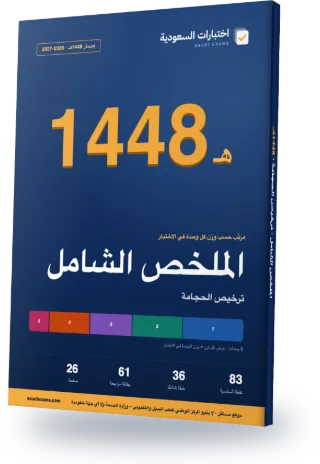
Hijama licence Complete Review Guide 2026–2027
Every exam topic in a 26-page Arabic PDF, ordered from the heaviest unit to the lightest. The first three chapters alone cover about 70% of the exam questions.
- 26Pages
- 83Key points
- 36Common mistakes
- 61Flashcards
Guide map
Each chapter is one exam unit, ordered by its weight in the real exam.
| Chapter | Unit | Weight | Exam questions | Key points |
|---|---|---|---|---|
| 1 | Infection control, sterilization and waste | 27% | 8 | 18 |
| 2 | Patient assessment, contraindications and cautions | 23% | 7 | 16 |
| 3 | Regulation and licensing | 20% | 6 | 16 |
| 4 | Procedure, clinic equipment, complications and first aid | 20% | 6 | 17 |
| 5 | Ethics and client rights | 10% | 3 | 16 |
Chapter 1 in full: Infection control, sterilization and waste
27% of the exam, about 8 questions. These are its key points, as in the guide.
- (Hand hygiene) Alcohol rub 20 to 30 seconds until dry, before and after hijama and after removing PPE.
- (Hand hygiene) Soap 40 to 60 seconds when visibly soiled, contaminated with blood, or after handling waste.
- (Hand hygiene) Dedicated sinks, soap, hand rub and paper towels; alcohol gel is an acceptable alternative.
The rest of chapter 1, on this page
- (PPE) Sterile gloves for incisions and dressings, non-sterile for contaminated items, heavy-duty for cleaning and waste.
- (PPE) A plastic apron when soiling is expected and a surgical mask, all single-use, put on just before and removed just after.
- (Contamination) A sterile or single-use clipper head for hair removal, or surgical gel if removal is not possible.
- (Contamination) Disinfect the skin with an SFDA-approved antiseptic before wet cupping, and for dry cupping too.
- (Contamination) Discard unused leftovers after hijama; never use anything suspected of contamination.
- (Reprocessing) Reusable items are cleaned, disinfected and sterilized between clients with approved devices and agents.
- (Spaulding) Items that penetrate skin are critical and sterilized; those touching mucous membranes are semi-critical; those touching intact skin are non-critical and cleaned.
- (Spaulding) Cleaning is the first step before any disinfection or sterilization.
- (Environment) Easy-clean surfaces, single-use couch covers, disinfectants made up per the label, and a spill kit with written Arabic and English procedures.
- (Waste) Proper segregation, blood-soiled items in yellow, sharps in a nearby puncture-proof container, filled to three quarters, never stapled.
- (Waste) Written sharps-injury procedures and a contract with a licensed waste transporter.
- (Practitioner safety) Hepatitis B vaccine for those testing negative, test results kept in clinic files, and a health certificate renewed every 3 years.
- (Practitioner safety) Needle-stick injuries are reported at once to the regional infection-control department.
- (Infections) Hepatitis B has a safe, effective vaccine; hepatitis C has none; spread is through unsterile sharp instruments.
- (Ethics) A practitioner does not refuse a patient for an infection, and stops practising himself if he has a transmissible infection.
Common mistakes in this chapter
- Using alcohol rub on blood-soiled hands: wash with soap for 40 to 60 seconds.
- Thinking gloves replace hand hygiene: clean hands after removing them.
- Wearing PPE all day and moving between clients in it.
- Keeping the rest of an opened sterile pack for the next client.
- Recapping a needle by hand or bending it before disposal.
- Putting the scalpel in the yellow bag instead of the sharps container.
- Thinking a negative hepatitis B result means immunity: vaccinate.
- Leaving a needle-stick report to the periodic report: report at once to infection control.
The other chapters are in the full guide
One purchase · lifetime access · review guide included
7-day review plan
The chapters are spread over 6 days by weight so each day carries a similar load. Day 7 is a full exam.
Day 1 · 27% of the exam
Chapter 1: Infection control, sterilization and waste
Day 2 · 23% of the exam
Chapter 2: Patient assessment, contraindications and cautions
Day 3 · 20% of the exam
Chapter 3: Regulation and licensing
Day 4 · 20% of the exam
Chapter 4: Procedure, clinic equipment, complications and first aid
Day 5 · 10% of the exam
Chapter 5: Ethics and client rights
Day 6
Full mock exam: 30 questions in 30 minutes, then review the common mistakes in the units where you lost marks.
Before you read: see your score today
10 free questions from the main units, no sign-up. Then you know which chapter to start with.
Try 10 free questions and see your levelA look at each chapter
The first three key points of each chapter, as they appear in the guide (in Arabic in the PDF).
Chapter 1: Infection control, sterilization and waste
- (Hand hygiene) Alcohol rub 20 to 30 seconds until dry, before and after hijama…
- (Hand hygiene) Soap 40 to 60 seconds when visibly soiled, contaminated with blood, or…
- (Hand hygiene) Dedicated sinks, soap, hand rub and paper towels; alcohol gel is an…
Chapter 2: Patient assessment, contraindications and cautions
- (History) The specialist doctor takes it and records it before hijama.
- (Vital signs) Temperature, pulse, blood pressure and respiration, plus haemoglobin and bleeding and clotting…
- (Vital signs) Abnormal values may signal a disease that rules out hijama, so the…
Chapter 3: Regulation and licensing
- (Definitions) A clinic is one room for one practice, a centre is more than…
- (Definitions) Dry cupping is vacuum cups without scratches; wet cupping adds superficial scratches to…
- (Licensing body) The Center grants clinic and practitioner licences; classification is with the Commission…
Chapter 4: Procedure, clinic equipment, complications and first aid
- (Types) Dry is suction without incisions, wet is suction with superficial incisions, sliding moves…
- (Equipment) Couches covered in plastic with single-use sheets, and a single-use cupping device registered…
- (Equipment) Blood-pressure device, thermometer and stethoscope, scalpels, gauze, antiseptics and sterile gloves, a steriliser…
Chapter 5: Ethics and client rights
- (Consent) Written consent from the client or his representative on the Center's form before…
- (Consent) Valid with adequate information in a language he understands, capacity to understand, and…
- (Consent) It must be written for invasive procedures with possible risks.
The full guide comes with lifetime access
The full guide (26 pages) is included with lifetime access to this exam, together with every question and full mock exam. Chapter 1 is free for everyone.
Questions about the guide
Is the guide free?
Chapter 1 is free to read on the guide page. The full guide comes with lifetime access to this exam; 7-day access does not include it.
Is it up to date for 2026–2027?
Yes. Unit weights and exam facts follow what the exam body last published, and the last check date is printed in the guide. If the standards change we update the file and buyers download the new version.
Does the guide have questions?
No. The guide covers key points and common mistakes; scoring, weak-area practice and full mock exams are on the site.
Can I read it on my phone?
Yes. A5 pages in a single column, with chapters linked from the contents.
- Pages
- 26
- Edition
- 1448 AH · 2026–2027
- Language
- Arabic
- Last updated
All Health Exams review guides
Back to Hijama (Cupping) Practitioner Licensing Test – NCCAM, Saudi Arabia
Full prep for this exam
All of this in one purchase.
- Full mock exam, same as the real one30 questions in 30 minutes. You get a total score and a score for every unit.
- Practice unit by unit179 questions, every option explained with its source. Starts with your weakest units.
- Complete Review Guide 2026–2027 (PDF)Ordered by each unit's weight in the exam. With lifetime access only.
Choose your access
Continue with your Google account and you go straight to the payment page.