Try the questions in the test above first, then open each one here to see the correct answer and why every other option is wrong.
01What is \frac{\sqrt{3}+\sqrt{2}}{\sqrt{3}-\sqrt{2}} in simplest form?
Past exam question Unit: Numbers and operations
A5+2\sqrt{6} ✓ Correct answer
Correct; multiply numerator and denominator by \sqrt{3}+\sqrt{2}: \frac{(\sqrt{3}+\sqrt{2})^{2}}{3-2}=5+2\sqrt{6}.
B5-2\sqrt{6}
Incorrect; this is the reciprocal of the result (\frac{\sqrt{3}-\sqrt{2}}{\sqrt{3}+\sqrt{2}}), not the result itself.
C5+\sqrt{6}
Incorrect; the middle term when expanding (\sqrt{3}+\sqrt{2})^{2} is 2\sqrt{6}, not \sqrt{6}.
D1+2\sqrt{6}
Incorrect; the first part of the expansion of (\sqrt{3}+\sqrt{2})^{2} is 3+2=5, not 1.
Reference: ETEC Mathematics Teacher Standards, Level 1 (1441 AH / 2020), specialized standard 6.3.1, indicator 2, p. 8
Ask your colleagues
02Hind has 3 times as much money as Suad, and Suad has x riyals. Someone gave Hind 250 riyals and then she gave 50 riyals to charity. Which equation gives half of the money she has left, y?
Past exam question Unit: Algebra and real functions
Ay=3x+100
This halves 250-50 but does not halve 3x, so it is not half of the whole remaining amount.
By=\dfrac{3}{2}x+50
This is half of 3x+100, so the net addition was taken as 100 instead of 200.
Cy=\dfrac{3}{2}x+100 ✓ Correct answer
Hind's remaining money is 3x+250-50=3x+200, and half of it is \dfrac{3x+200}{2}=\dfrac{3}{2}x+100.
Dy=\dfrac{3}{2}x+200
This halves 3x but does not halve 200.
Reference: ETEC Mathematics Teacher Standards, Level 1 (1441 AH / 2020), specialized standard 6.3.2, indicator 8, p. 8
Ask your colleagues
03Three circles have radii 1 cm, 2 cm and 3 cm, and each pair of circles touches externally. What is the area, in square centimetres, of the triangle whose vertices are the three centres?
Past exam question Unit: Geometry
A6 ✓ Correct answer
The distance between centres of externally tangent circles is the sum of their radii, so the sides are 3, 4 and 5. It is a right triangle since 3^2+4^2=5^2, and its area is \frac{1}{2}\times3\times4=6.
B7.5
7.5 comes from \frac{1}{2}\times3\times5, using the hypotenuse as a leg.
C10
10 is not half the product of the two legs 3\times4.
D12
12 is the perimeter 3+4+5, not the area.
Reference: ETEC Mathematics Teacher Standards, Level 1 (1441 AH / 2020), specialized standard 6.3.3, indicator 6, p. 8
Ask your colleagues
04A rectangular room is 5\text{ m} long and 3\text{ m} wide. It is to be tiled with square tiles of side 30\text{ cm}, with no tile cut. What is the area left untiled?
Past exam question Unit: Measurement
A0.3\text{ m}^{2}
This assumes a leftover strip 10\text{ cm} wide, but it is 20\text{ cm}.
B0.9\text{ m}^{2}
This assumes a leftover strip of 30\text{ cm}, a whole tile, which is wrong.
C0.6\text{ m}^{2} ✓ Correct answer
The width takes 300\div 30=10 whole tiles; the length 500\div 30 takes 16 tiles and leaves 20\text{ cm}; the leftover is 20\times 300=6000\text{ cm}^{2}.
D1.5\text{ m}^{2}
This comes from fitting only 15 tiles per row instead of 16, leaving 50\text{ cm}.
Reference: ETEC Mathematics Teacher Standards, Level 1 (1441 AH / 2020), specialized standard 6.3.4, indicator 6, p. 9
Ask your colleagues
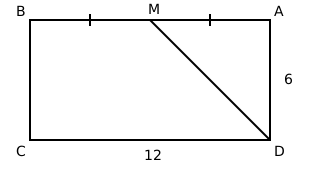
05In the figure, ABCD is a rectangle with AB=12 and BC=6, and M is the midpoint of AB. If a point is chosen at random inside the rectangle, what is the probability that it lies inside BCDM?
Past exam question Unit: Statistics and probability
A\frac{2}{9}
This is less than half the area, but the shape fills more than half the rectangle.
B\frac{4}{9}
This is also under one half and does not match the ratio of the areas.
C\frac{2}{3}
If BCDM were two thirds of the rectangle its area would be 48, but it is 54.
D\frac{3}{4} ✓ Correct answer
Trapezoid BCDM has area \frac{6+12}{2}\times 6=54 and the rectangle 6\times 12=72, so the probability is \frac{54}{72}=\frac{3}{4}.
Reference: ETEC Mathematics Teacher Standards, Level 1 (1441 AH / 2020), specialized standard 6.3.5, indicator 5, p. 9
06The statement equivalent to (p\wedge\sim q)\vee(p\wedge q) is:
Past exam question Unit: Logic and reasoning
Ap ✓ Correct answer
Factoring out p: p\wedge(\sim q\vee q); since \sim q\vee q is always true, only p remains. The truth table gives T,T,F,F, the values of p.
Bq
When p is true and q false the statement is true while q is false, so they are not equivalent.
C\sim p
When p is true the statement is true while \sim p is false, so they are not equivalent.
D\sim q
When p and q are both true the statement is true while \sim q is false, so they are not equivalent.
Reference: ETEC Mathematics Teacher Standards, Level 1 (1441 AH / 2020), specialized standard 6.3.6, indicator 1, p. 9
Ask your colleagues
07In the vertical method for 23\times32, pupils wrote 46 in the first row and 69 in the second row, shifted one place to the left. Faisal said 69 is shifted because we are multiplying by tens. Yasser said we must move one place in every multiplication step. Which answer is more accurate?
Past exam question Unit: Teaching mathematics
AYasser's, because it applies to every row of the multiplication
The first row, 46, is not shifted at all because it comes from multiplying by the ones digit, so the rule of one place every time fails.
BBoth are correct, because each row is shifted one place from the row before
If every row were shifted from the one before, the first row would be shifted too, yet it starts at the ones place with no shift.
CBoth are wrong, because the shift has nothing to do with place value
The shift comes from the place value of the digit being multiplied by, so Faisal's explanation is correct and both cannot be wrong.
DFaisal's, because it links the shift to the value of the tens place ✓ Correct answer
The 3 in 32 stands for 30, so we compute 23\times30=690. The 69 sits in the tens place and is shifted one place, so Faisal's explanation rests on place value.
Reference: ETEC Mathematics Teacher Standards, Level 1 (1441 AH / 2020), specialized standard 6.3.7, indicator 1, p. 9
Ask your colleagues
08In which of Polya's phases are the data of the problem linked to what is required?
Past exam question Unit: Problem solving
ACarrying out the plan and doing the operations step by step
In this phase the chosen plan is carried out step by step, which does not match the action in the question.
BDevising a plan and choosing a suitable strategy to follow ✓ Correct answer
This is the phase described: the data are linked to the unknown and a strategy is chosen, which is exactly what the question describes.
CLooking back to check that the answer is correct and reasonable
In this phase the solution is checked for correctness and reasonableness, which does not match the action in the question.
DUnderstanding the problem: what is given and what is asked
In this phase the problem is read and what is given and asked is identified, which does not match the action in the question.
Reference: ETEC Mathematics Teacher Standards, Level 1 (1441 AH / 2020), specialized standard 6.3.8, indicator 1, p. 10
Ask your colleagues
09A mathematics teacher reads his students a story containing a mathematical concept and asks them to listen in order to pick out the concept. Which kind of mathematical communication is he developing in this situation?
Past exam question Unit: Mathematical communication
AListening ✓ Correct answer
Listening to the story in order to pick out the mathematical concept develops the listening skill.
BReading
Reading is done by the student from a written text, but here the teacher is the one reading.
CWriting
Writing requires the student to write something down, which the situation does not ask for.
DSpeaking
Speaking requires the student to express orally, while the situation asks them to listen first.
Reference: ETEC Mathematics Teacher Standards, Level 1 (1441 AH / 2020), specialized standard 6.3.9, indicator 3, p. 10
Ask your colleagues
10To prove that if x^{2} is even then x is even, we assumed that x is odd and then proved that x^{2} is odd. Which type of proof is used?
Past exam question Unit: Reasoning and argument
ACounterexample
A counterexample disproves a general statement with one case; it does not prove it.
BProof by contrapositive ✓ Correct answer
Proving "if x is not even then x^{2} is not even" proves the equivalent contrapositive statement, which is what was done.
CProof by contradiction
In proof by contradiction we assume the hypothesis and the negation of the conclusion together and reach a contradiction, which did not happen here.
DDirect proof
A direct proof starts from the hypothesis "x^{2} is even" and reaches the conclusion, but here we started from the negation of the conclusion.
Reference: ETEC Mathematics Teacher Standards, Level 1 (1441 AH / 2020), specialized standard 6.3.11, indicator 2, p. 10
Ask your colleagues

